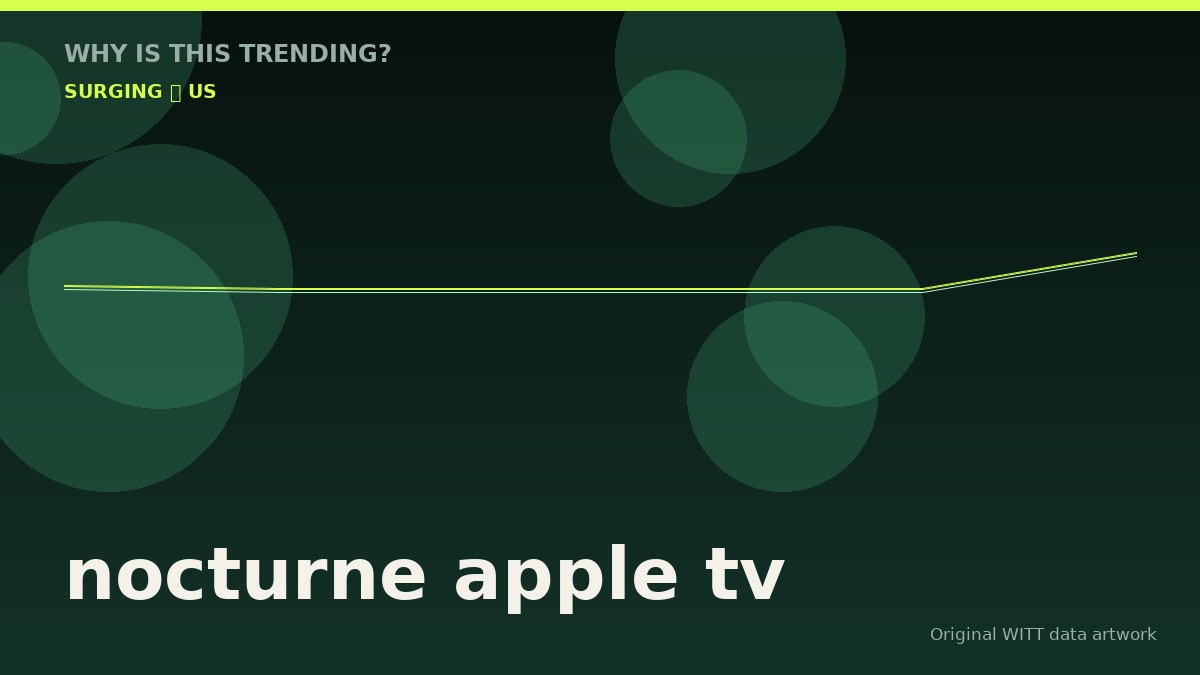
The Anatomy of a Seasonal Spike
Audiences are constantly hunting for something dark and compelling to match the shifting calendar, and Apple TV delivered precisely on that seasonal impulse. The psychological thriller Nocturne debuted its first two episodes on October 29, 2026, positioning itself perfectly within the autumn window when viewers actively look for chilling entertainment [1]. In the days leading up to that official release date, search interest climbed noticeably as promotional pushes highlighted the show's deeply unsettling tone and high-profile cast [1].
It remains vital to separate what search trends reveal from direct proof of causation or precise audience metrics. Google Trends attention metrics show rising public curiosity and search intent, but they do not act as an exact mirror for total viewership numbers. Even so, the clear correlation between a high-profile platform debut, a themed promotional push, and an immediate spike in public curiosity is unmistakable. Apple TV explicitly framed the 10-part series as a seasonal watch, leaning heavily on the terrifying performance of Stephen Graham as incarcerated serial killer Jurek Walter [1].
Translating Scandi Noir to Western Pennsylvania
Beyond the deliberate calendar alignment, what caught viewers' attention—and set off extensive discussions online—was the show's unusual geographic translation. Nocturne is adapted from the bestselling novels by Swedish authors Alexandra Coelho Ahndoril and Alexander Ahndoril, writing under the pseudonym Lars Kepler [1], [2]. The original books are quintessential pieces of Scandinavian crime fiction, defined by lingering dread, freezing landscapes, and insular communities.
Rather than setting the adaptation in Scandinavia or standard Hollywood backdrops, co-showrunner John Hlavin and the creative team deliberately relocated the story to Western Pennsylvania [2]. According to production notes, the geographic shift was chosen because the region's vast canopy of trees, dense rural isolation, and unique sunlight patterns map directly onto the aesthetic of Swedish noir [2]. Initially, the production considered setting the story in Maine to mimic rural Sweden's forests and lakes, but that plan was ultimately scrapped in favor of Western Pennsylvania to better capture this specific mood [2].
Swedish noir and Scandi noir maps most directly to Western Pennsylvania because of the 16 million acres of woods in the state, because of the way the sun travels through the canopy of trees, because of the ruralness of so much of the state, because of the private nature of a lot of its residents and people that keep to themselves.
John Hlavin via TribLIVE.com [2]
Embracing Regional Authenticity
To deepen that atmosphere, the production leaned heavily into regional authenticity rather than masking its American setting with generic dialects. The series features explicit use of local speech patterns, aided by dialect coach Susanne Selby and informed directly by the local Pittsburgh crew [2]. Lead actor Stephen Graham noted that he patterned elements of his character's speech after listening carefully to his real-life driver and the local Teamsters on set [2]. Co-showrunner John Hlavin pointed out that once star Liev Schreiber decided to use a modified Philadelphia accent for his retired cop character Jonah Lynn, the production elevated everyone else's performance to ensure the dialogue felt cohesive across the cast [2].
This localized texture separates Nocturne from generic procedural thrillers. By grounding a dark, psychological cat-and-mouse game between investigators—played by Liev Schreiber and Zazie Beetz—and a sadistic mastermind within a specific, moody American landscape, the series created a distinct talking point for viewers looking for atmospheric texture alongside their seasonal chills [1], [2].
Signal Versus Noise in the Current Trend
When analyzing why a series like Nocturne captures public curiosity so suddenly, it helps to separate marketing-driven noise from genuine audience engagement. The immediate spike around October 29 is a predictable outcome of scheduled streaming rollouts backed by seasonal framing [1]. However, the lasting conversation points toward a deeper appreciation for creative risk-taking—specifically, how an international literary property can be successfully transplanted into a hyper-local regional setting without losing its psychological gravity [2].
For viewers wondering whether to dive into the first two episodes on Apple TV, the current attention serves as a reliable indicator that the series has struck a chord with fans of dark psychological dramas. With additional episodes rolling out weekly, the real test will be whether the intricate character dynamics between Graham's imprisoned killer and the law enforcement officers tracking him can sustain the momentum generated by this strong Halloween debut [1], [2].