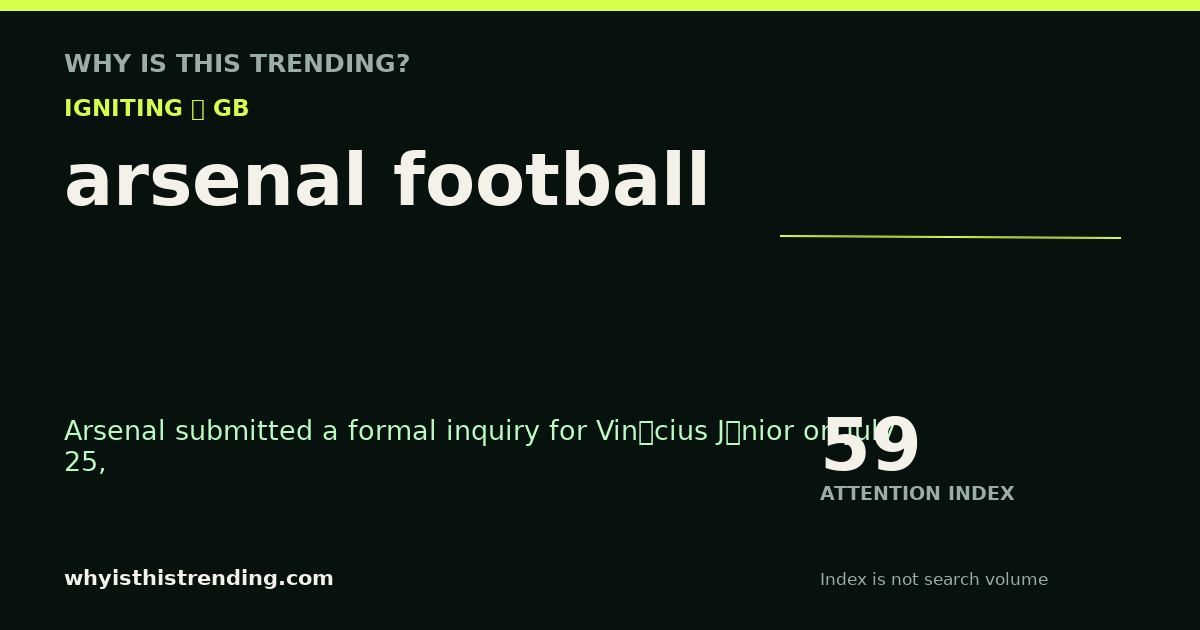
Decoding the Arsenal and Vinícius Júnior Timeline
When news broke that Arsenal had made a formal inquiry about Vinícius Júnior on July 25, 2026, it immediately seized the attention of football observers across Europe [4]. To understand why this story is trending, we have to look past the surface-level shock value and examine the mechanics of elite transfer strategy. Mikel Arteta’s side did not pull this interest out of thin air; the inquiry arrived just days before media reports detailed that negotiations over the Brazilian forward's long-term future remained unresolved [2], [4].
In high-stakes football administration, timing is everything. With only a single year remaining on his contract at the Santiago Bernabéu [2], [4], any elite player triggers a predictable sequence of market events. Clubs monitoring the situation must decide whether to test the waters or watch from the sidelines. Arsenal’s early move was a textbook example of exploring the conditions of a complex market before positions harden.
The operational reality of modern recruitment departments is that they rarely operate in a vacuum. When a player of international prestige reaches a contractual crossroads, sporting directors are expected to carry out due diligence. Even if the probability of securing a signature is narrow, establishing lines of communication ensures that a club is never caught flat-footed should the landscape shift dramatically prior to the transfer deadline.
Signal Versus Noise: Contract Impasse or Real Exit?
It is vital to separate the genuine signal of a contractual stalemate from the background noise of standard transfer window posturing. Coverage on July 28, 2026, outlined that talks with the 26-year-old forward were ongoing but still lacked a definitive agreement [2], [3]. For a player who has netted 128 goals in 375 matches and secured 14 trophies since arriving in Spain as a teenager [3], entering the final twelve months of a deal introduces profound organizational jeopardy [2], [3].
As industry analysts note, allowing a global icon of his stature to approach the window where he can negotiate a pre-contract with foreign clubs carries massive financial implications [2], [3]. Consider the structural realities at play:
- Contract Countdown: Vinícius has entered the final year of his existing Bernabéu agreement [2], [4].
- Ongoing Negotiations: Media reports verified that discussions regarding his future remained open [2].
- Strategic Probing: Arsenal’s inquiry leveraged this exact window of uncertainty [2], [4].
Yet, despite the swirling rumors, there is no strong public evidence indicating the player actively desires an exit from the Spanish capital [2]. Observers point out that leaving a historic institution like Real Madrid is rarely straightforward for South American stars who view the club as a lifelong pinnacle [3].
Broader Implications for Arsenal's Transfer Philosophy
Arsenal's approach to the summer window under recruitment direction models a preference for keeping multiple options alive. Rather than pinning all their hopes on a single unattainable profile, recruitment teams often cast a wide net across Europe. Alongside monitoring elite forwards, the club has actively balanced additions across the pitch, welcoming players like Christos Tzolis to bolster their attacking depth [4].
When an inquiry is made for a player of Vinícius Júnior’s magnitude, it signals to the market that the North London club is operating at the absolute highest tier of ambition following their Premier League successes [4]. Even if the odds of completing such a monumental transaction remain long, mapping out the financial and contractual parameters ensures the club is positioned to act should any unexpected opening materialize [2], [3]. For supporters tracking these developments, separating the disciplined strategy of exploring market conditions from the noise of tabloid speculation offers a much clearer view of how modern clubs navigate high-profile negotiations.