The Attention Mechanism and Timing
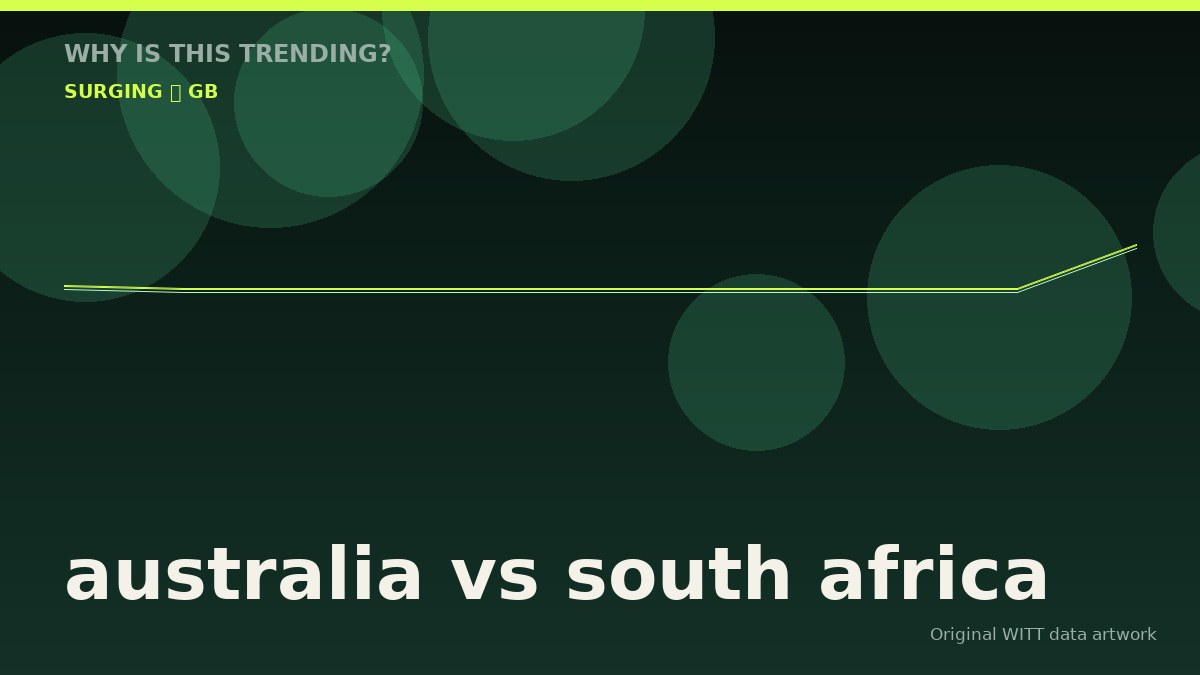
Search interest surrounding the fixture between Australia and South Africa climbed sharply on October 10, 2026, aligning precisely with the opening Test match at Kingsmead Stadium in Durban [1]. The surge was catalyzed by team announcements and late injury disclosures from the Proteas camp, framing an encounter loaded with historical tension and modern selection gambles [2].
While internet search trends reflect an obvious spike in curiosity regarding team sheets and broadcasting details, Google Trends attention measures relative query interest rather than exact search volumes or direct proof of causal match outcomes. Even so, the narrative hook is clear: both squads arrived at the series opener grappling with structural vulnerabilities in their batting orders and forced adjustments in their bowling attacks.
South Africa's Fast Bowling Shuffle
The host nation enters the series opener without pace spearhead Kagiso Rabada, who was ruled out due to a right hamstring injury sustained during winter training [2]. Although Rabada has not played since the Indian Premier League in May, captain Temba Bavuma noted that the team adopted a conservative recovery path [2]. South Africa remains hopeful that their premier fast bowler will return for the second Test in Gqeberha [2].
In Rabada's absence, attention swung to Anrich Nortje, who returned to the Test XI for his first red-ball appearance in three years [2]. Nortje partners Marco Jansen with the new ball [2]. Despite a lengthy layoff due to back and hip injuries—his previous Test coming against the West Indies in March 2023—Nortje earned selection over alternatives like Dane Paterson and Gerald Coetzee purely on raw velocity [2].
Temba Bavuma via cricket.com.au [2]
It's hard to ignore his X-factor,Bavuma said of Nortje.There's not many guys around who are bowling 150(kph) plus, and I think as a batter, that's not something that I would look forward to.
The rest of the Proteas lineup leans into familiar combinations, retaining nine players from the side that secured the World Test Championship final victory over Australia in June of the previous year [2]. Spin duties fall to the dual-spin pairing of Keshav Maharaj and Simon Harmer, while Wiaan Mulder operates as the third seamer and utility option [2].
Australia's Familiar Formula and Batting Experiments
For the touring side, the overarching narrative is one of a rock-solid bowling core paired with a patchwork batting order. Australia relies once again on the veteran bowling quartet of Pat Cummins, Nathan Lyon, Josh Hazlewood, and Mitchell Starc—four stalwarts who have accumulated nearly a thousand Test wickets since the turbulent tour of 2018 [1].
Yet, the batting unit behind Steve Smith and Marnus Labuschagne carries substantial question marks [1]. Cameron Green’s late injury forced a scramble for lower-middle-order solutions, bringing unconventional selection debates into sharp focus [1]. With Beau Webster covering bowling requirements, selectors weighed unproven potential against seasoned domestic resumes in filling out the remaining batting slots [1].
Historical shadows from the 2018 tour continue to frame the discourse around the tourists. Just as previous squads balanced elite fast-bowling firepower with unfamiliar or makeshift personnel in the top and middle orders, the modern lineup forces selectors to gamble on players who have had limited long-form preparation [1].
Signal Versus Noise in Selection Choices
Discussions across sports media often conflate nostalgic appeal with current operational readiness. In South Africa's case, fast-tracking Anrich Nortje represents a calculated risk based on sheer pace rather than an accumulation of red-ball overs [2]. For Australia, the chatter surrounding makeshift batting replacements highlights a recurring vulnerability: relying on heavy-lifting from a few elite stalwarts while testing the waters with less-proven quantities abroad [1].
Readers following the series should look past pre-match speculation about past tours and focus on how efficiently South Africa's pace attack adapts without Rabada, as well as whether Australia's revamped batting order can withstand hostile spells on seaming pitches [1], [2].