The Disclosure That Changed the Narrative
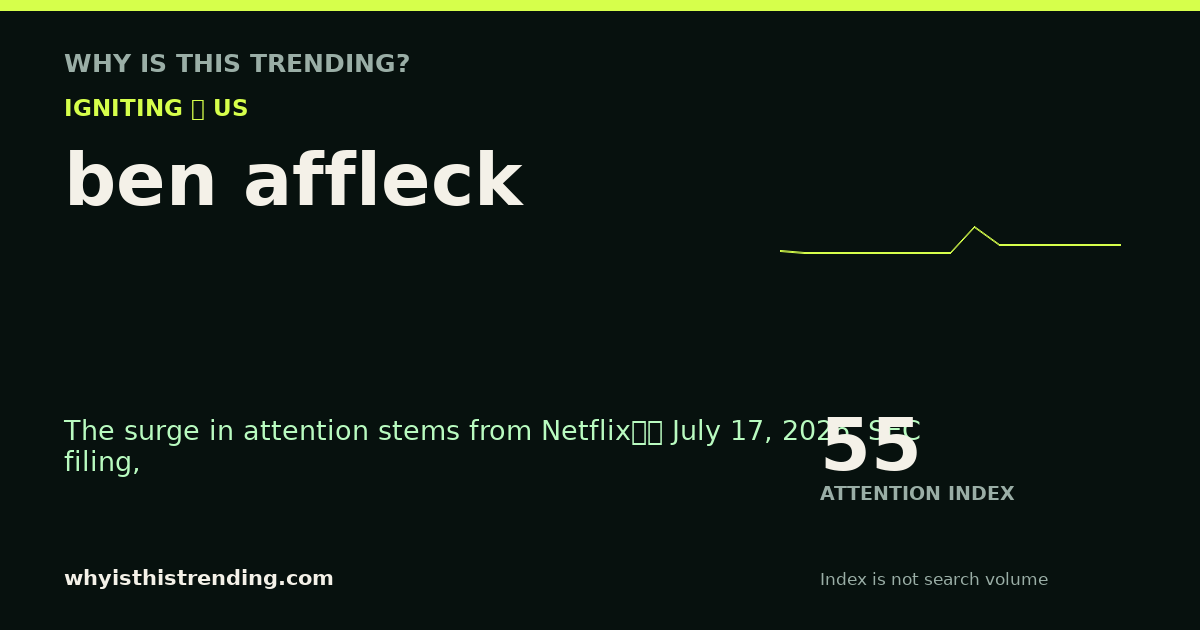
For months, the industry operated on speculation. When Netflix first announced its acquisition of InterPositive in March 2026, the financial terms remained shrouded in the kind of ambiguity typical of high-level corporate maneuvering. It wasn't until a July 17, 2026, Form 10-Q filing with the Securities and Exchange Commission that the figure—$587 million in cash—became a concrete reality for investors and the public alike (Variety).
This disclosure acted as a catalyst, transforming a vague industry rumor into a quantifiable signal of Netflix's strategic direction. The timing of this news, surfacing just as the company navigated a challenging earnings cycle, ensured that the acquisition was not viewed in isolation but as a centerpiece of Netflix's broader technological roadmap (Los Angeles Times). The attention is less about the startup itself and more about the validation of a specific, high-cost investment strategy during a period when Netflix's stock has faced significant volatility.
Beyond the Headline: What InterPositive Actually Does
The attention surrounding this deal is often conflated with broader fears about generative AI replacing human labor. However, the technical reality of InterPositive suggests a more nuanced, workflow-oriented approach. Founded by Ben Affleck in 2022, the company was built in stealth mode with a stated mission to protect the power of human creativity
(TechCrunch).
Unlike generic text-to-video models that generate content from scratch, InterPositive’s tools are designed to work with existing production footage. By training models on specific dailies from a project, the software assists in post-production tasks such as:
- Relighting shots: Adjusting lighting conditions after the fact to maintain visual consistency.
- Background enhancements: Seamlessly modifying environments without the need for extensive reshoots.
- Workflow efficiency: Addressing practical challenges like missing shots or complex visual effects sequences.
As Netflix co-CEO Ted Sarandos noted during the July 2026 earnings call, the goal is not to replace the artist, but to provide tools that make the process twice as fast and at half the cost of previous options
(Variety). By bringing the 16-person InterPositive team in-house and appointing Affleck as a senior adviser, Netflix is effectively betting that the future of streaming dominance lies in proprietary, creator-focused AI rather than off-the-shelf solutions. The 16-person team represents a massive per-head valuation, signaling that Netflix is buying a specific philosophy of production as much as it is buying the software itself (Entrepreneur Loop).
Signal vs. Noise: Why This Matters
It is easy to get lost in the noise of the $587 million price tag. When analyzing the attention mechanism here, it is vital to distinguish between the cost of the acquisition and the scale of the integration. The most significant signal is not the cash amount, but the fact that Netflix reported 300 of its productions are already utilizing generative AI in some capacity (Los Angeles Times).
This suggests that AI has moved from an experimental R&D phase to a core component of the production pipeline. The acquisition of InterPositive represents a strategic move to control the quality and specificity of these tools. By keeping the technology exclusive, Netflix aims to differentiate its content—not just in terms of storytelling, but in the polish and efficiency of its visual output.
The cultural tension here is palpable. While Netflix frames this as a way to empower filmmakers, the industry remains deeply divided. The inclusion of Ben Affleck, a respected director and actor, is a tactical attempt to bridge the gap between Silicon Valley's engineering-first approach and Hollywood's craft-first culture. Affleck has explicitly stated his desire to protect the power of human creativity
(TechCrunch), a sentiment that serves as a necessary buffer against the skepticism of unions and creative guilds.
For the reader, the takeaway is clear: the industry is currently in a transition period where the debate is shifting from whether AI will be used in film, to how it will be integrated to support, rather than supplant, the filmmaker. This deal is a test case. If Netflix can successfully deploy InterPositive’s tools to improve visual quality without triggering a backlash from the creative community, it will likely set a blueprint for other studios. If, however, the technology is perceived as a cost-cutting measure that degrades the artistic integrity of the work, the $587 million investment could become a lightning rod for future labor negotiations and creative disputes. We are watching the professionalization of AI in film, and this acquisition is the most significant indicator of that shift to date.