A Coordinated Stand Against Categorization
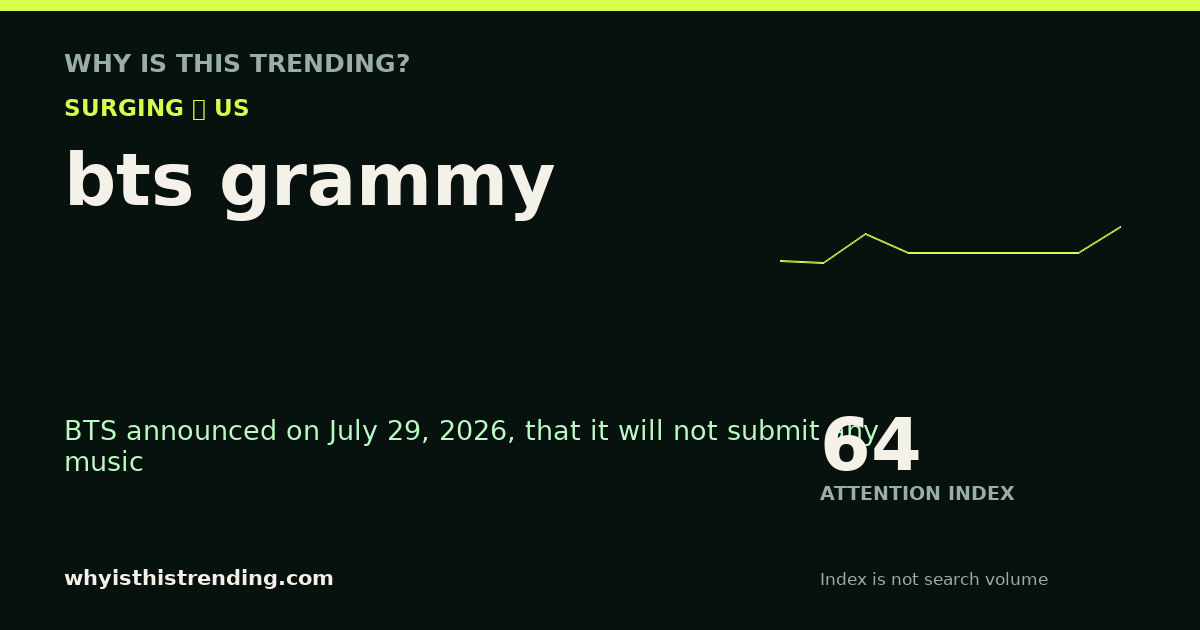
Global music powerhouse BTS has sent shockwaves through the industry by announcing a blanket refusal to submit any music for consideration at the upcoming Grammy Awards (The Hollywood Reporter). On July 29, 2026, all seven members—RM, Jin, Suga, J-Hope, Jimin, V, and Jung Kook—simultaneously posted identical statements across their personal Instagram Stories. The announcement stated We have decided not to submit to the Grammys this year,
and expressed a desire for global art to transcend geographic and linguistic boundaries (The Hollywood Reporter).
The timing of the announcement is far from coincidental. Just over a month prior, in June 2026, the Recording Academy unveiled five brand-new categories for the 69th Grammy Awards, chief among them being the Best Asian Pop Music Performance category (Korea JoongAng Daily). Designed to honor performances originating from or widely recognized within Asian markets that make meaningful use of an Asian language, the new field immediately sparked heavy debate across international music spaces (Korea JoongAng Daily, The Hollywood Reporter).
As the online entry period for the 69th Grammy Awards runs its course—having opened on July 7 and closing on August 21, 2026—this refusal places an immediate spotlight on how elite cultural institutions handle non-English language art (Korea JoongAng Daily). Rather than quietly entering songs into the newly minted slot, the septet chose a public, unified exit.
Signal Versus Noise in the Grammy Boycott
When major artists pull away from premier institutional platforms, it is crucial to separate temporary friction from systemic critique. Observers immediately noted that BTS entered this cycle riding an incredible commercial wave. Following the completion of their mandatory military service in South Korea, the group returned with their massive spring comeback album, Arirang, which seized the top spot on the Billboard 200 with 641,000 units—marking the biggest week for a group album in more than a decade—while its lead single, Swim,
debuted at No. 1 on the Billboard Hot 100 (The Hollywood Reporter, The Korea Times).
Industry analysts previously positioned BTS as frontrunners to capture a historic first competitive Grammy win via the newly minted Asian pop field (Forbes). Despite earning three consecutive nominations for Best Pop Duo/Group Performance from 2021 to 2023 alongside other nods, the group has remained winless (Forbes, The Korea Times). However, rather than viewing the genre-specific slot as an open door, BTS and many critics view it as an institutional velvet rope—a mechanism that cordons international acts away from general categories like Record of the Year or Album of the Year (The Korea Times, THE STANDARD).
We hope that music can be heard and loved for what it is, rather than being divided by region or language.
BTS
By explicitly highlighting language and region in their refusal, the members of BTS are challenging the Recording Academy's structural tendency to ghettoize non-English language art into dedicated genre enclaves instead of evaluating them on the main global stage (Korea JoongAng Daily, The Hollywood Reporter).
Broader Implications for the Global Music Economy
The ramifications of this boycott extend far beyond a single boy band's relationship with a voting body. K-pop and broader Asian popular music markets command massive, record-breaking shares of worldwide consumption (Forbes, THE STANDARD). When the industry's biggest standard-bearer steps away from contention, it forces other major labels and management agencies—such as those housing peer groups under HYBE, SM, JYP, and YG, including sister acts like TXT—to reevaluate their own submission strategies for upcoming ceremonies (THE STANDARD).
As the August 21 closing date for 69th Grammy submissions draws near, the Recording Academy faces mounting pressure to address how it categorizes international excellence (Korea JoongAng Daily). Whether other prominent Asian acts follow BTS's lead or choose to compete within the new parameters remains one of the most critical storylines in contemporary pop culture (THE STANDARD). What is clear, however, is that BTS has successfully reframed the conversation from whether they can win an American award to whether the award itself is equipped to measure global music fairly.