The Anatomy of a Legal Search Spike
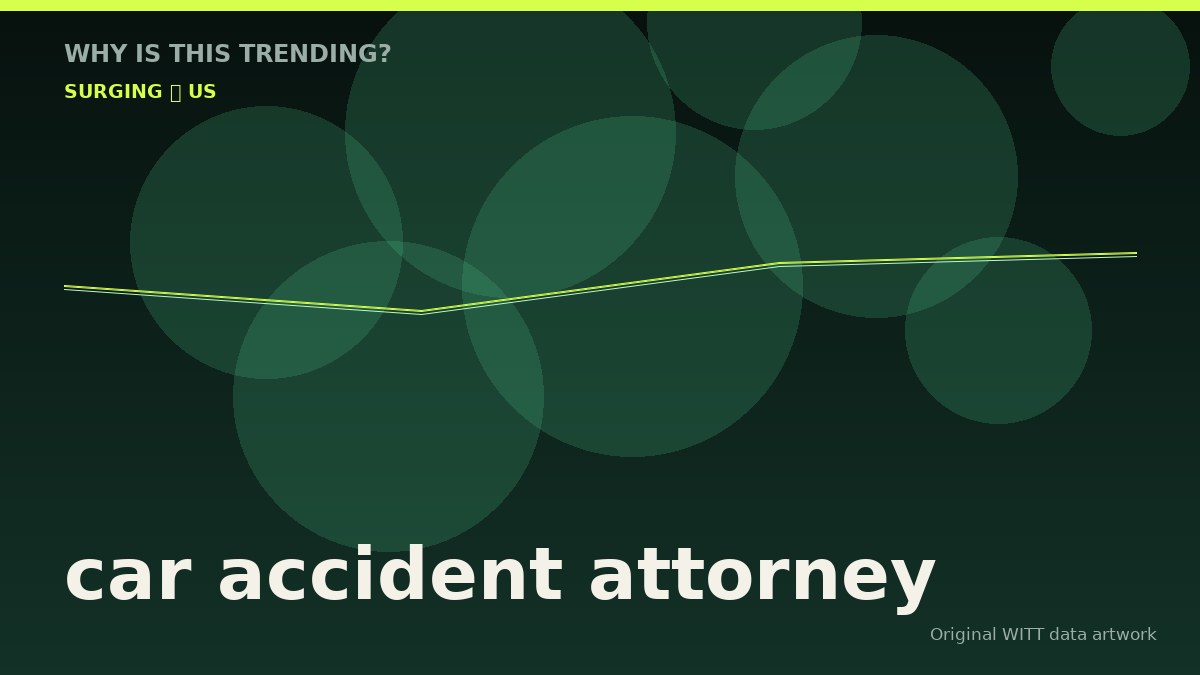
When unexpected emergencies disrupt local roadways, public attention pivots almost instantly from initial rescue efforts to questions of liability and recovery. Google Trends reflects this sudden psychological shift, documenting a sharp upward trajectory in searches for car accident attorney
beginning August 6, 2026. This digital surge did not materialize out of thin air; it directly tracked heavy public interest following a high-profile collision involving an emergency vehicle in Springfield, New Jersey.
To interpret what changed in the information landscape, we have to examine the intersection of breaking local news, public anxiety, and aggressive digital marketing. While search trends quantify a genuine swell in user curiosity and concern, they also lay bare the sophisticated mechanics of modern legal client acquisition. In this ecosystem, breaking news reports are rapidly converted into search engine optimization targets, ensuring that anyone searching for details on a recent crash is immediately greeted by legal consultation offers.
From Emergency Response to Legal Landing Page
The sequence that catalyzed this trend began on Monday, August 3, 2026. An ambulance operated by the America Emergency Squad was actively transporting a patient when it collided with another vehicle at the intersection of Monmouth Road and Route 206 in Springfield, as reported by the Moorestown Patch. The impact resulted in non-critical injuries for five individuals: two EMTs, an EMT student, the patient, and the driver of the opposing vehicle. While local officials confirmed that the emergency personnel were subsequently treated and released, the incident commanded immediate local attention.
Within 48 hours of the crash, the digital footprint expanded from standard journalism into commercial legal publishing. On August 5, 2026, Metro Law published a dedicated webpage detailing the Route 206 collision directly on their firm's platform. The published text systematically framed the accident through a legal lens, explicitly outlining how injured parties might seek financial compensation for medical expenses, lost wages, and rehabilitation costs under New Jersey law.
This rapid turnaround is a textbook example of incident-driven content creation. By publishing precise geographic and vehicular details immediately following a safety incident, legal marketers capture search traffic from local residents who are attempting to make sense of breaking news in their neighborhoods.
Signal Versus Noise in Accident-Driven Trends
Discerning readers must carefully separate genuine public information-seeking from manufactured urgency. When local residents type legal terminology into search engines after reading about a nearby collision, they are frequently navigating shock, confusion, or uncertainty regarding insurance policies and medical recovery. However, the timing of specialized web content publishing hours after an event demonstrates how closely law firms monitor public safety reports to intercept high-intent traffic.
Similar patterns emerge across broader transportation debates. Observers in commercial sectors note that digital content frequently concludes by urging readers to keep legal representation on speed dial, illustrating an industry-wide practice of leveraging routine highway and transit incidents for lead generation as highlighted by industry analysts. The presence of explicit disclaimers noting that such pages constitute attorney advertising materials confirms that client acquisition remains the primary driver behind these digital responses.
What Readers Should Know
It is vital to recognize that spikes in search volume do not prove widespread legal wrongdoing, nor do they establish fault while an official investigation remains active. Investigators continue to review the exact cause of the Springfield collision, and official determinations take time. For anyone affected by roadway incidents, rushing to digital legal advertisements can often bypass the critical first steps of medical evaluation, insurance notification, and official fact-finding. Understanding the difference between a community news report and a targeted marketing funnel helps consumers navigate digital information safely and deliberately.