Breaking Through at the Brickyard
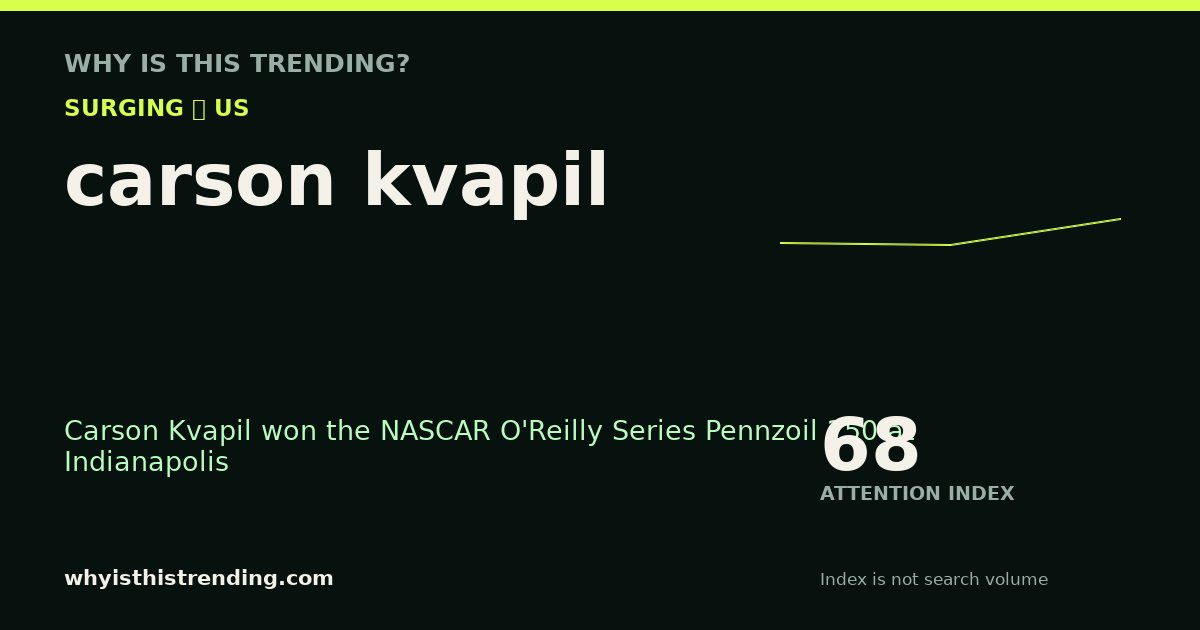
When the digital footprint surrounding stock car racing suddenly spikes, it usually follows a high-stakes finish, a dramatic tactical duel, or a milestone moment that alters the competitive landscape. On July 25, 2026, the attention mechanism in search trends locked onto Carson Kvapil exactly within a twenty-minute window of the checkered flag dropping at Indianapolis Motor Speedway. The catalyst was concrete and undeniable: Kvapil out-dueled his teammate and series points leader Justin Allgaier on the final laps of the Pennzoil 250 to secure his first career O'Reilly Series victory.
The 2.5-mile rectangular oval test was not merely a personal triumph for a rising driver carving out his path in national competition; it culminated in a historic organizational sweep. JR Motorsports locked out the entire top four finishing positions—with Cup Series regulars Ross Chastain and Chase Elliott slotting in directly behind Kvapil and Allgaier—marking the first time in O'Reilly Series history that a single team claimed the top four spots in a single race event.
Decoding the Attention Spike
Google Trends data shows that curiosity surrounding Kvapil surged immediately following the conclusion of the event, perfectly mirroring the publishing timeline of race results across major sports outlets and live timing feeds. This pattern illustrates how modern sports fandom operates in real-time: a physical event concludes on the track, instantaneous data feeds distribute the outcome, and fans immediately flood search engines to verify statistics, review stage points, and understand the context of a breakthrough performance.
It is crucial to distinguish this surge in public attention from search-volume estimates or proof of direct commercial causation. A spike in search queries demonstrates heightened informational interest and digital curiosity, but it does not automatically quantify broader economic impact, long-term viewership loyalty, or guaranteed sponsorship retention. What it does prove, however, is that milestone achievements by rising names create an immediate informational vacuum that fans look to fill the moment the race goes final.
Signal Versus Noise in the O'Reilly Field
It is easy to mistake a single afternoon's leaderboard for a straightforward display of raw horsepower, but the underlying narrative points to a broader structural evolution within the series. Kvapil's victory arrives amid a modern racing ecosystem defined by multi-team involvement and flexible driver development pipelines. Rather than relying on a single dominant car or a rigid stable throughout an entire schedule, top-tier operations are increasingly rotating talent, sharing technical data, and leveraging multi-car alliances to maximize competitive output across diverse track types.
This strategic depth alters how teams approach sponsorship acquisition and driver evaluation. Regional investments—such as localized corporate partnerships supporting primary entries—benefit immensely when a developmental driver breaks through on a national stage. For instance, localized corporate backers often view these partnerships as avenues for employee engagement, internal pride, and community connection rather than immediate transactional returns. The visibility generated by a marquee win at Indianapolis translates directly into long-term organizational morale and validates the unconventional schedules younger drivers often navigate.
Looking Ahead in the Regular Season
With only two races remaining before the Chase begins at Darlington Raceway, the competitive depth of the O'Reilly Series is sharper than ever. Kvapil's victory not only stamps his arrival as a bona fide national series winner but also tests whether multi-car development strategies can successfully convert intermittent speed into a deep, sustained championship run.
As the garage prepares for the upcoming stop at Iowa Speedway on August 8, the margin for error continues to shrink for teams fighting to lock down their postseason fates. While specific track setups and race conditions will dictate how those upcoming weekends unfold, the baseline pressure on developmental drivers and veteran crews alike has permanently shifted. For fans and analysts tracking the grid, Kvapil's Indianapolis triumph serves as a clear signal that the next generation of stock car talent is fully capable of seizing the spotlight when it matters most.