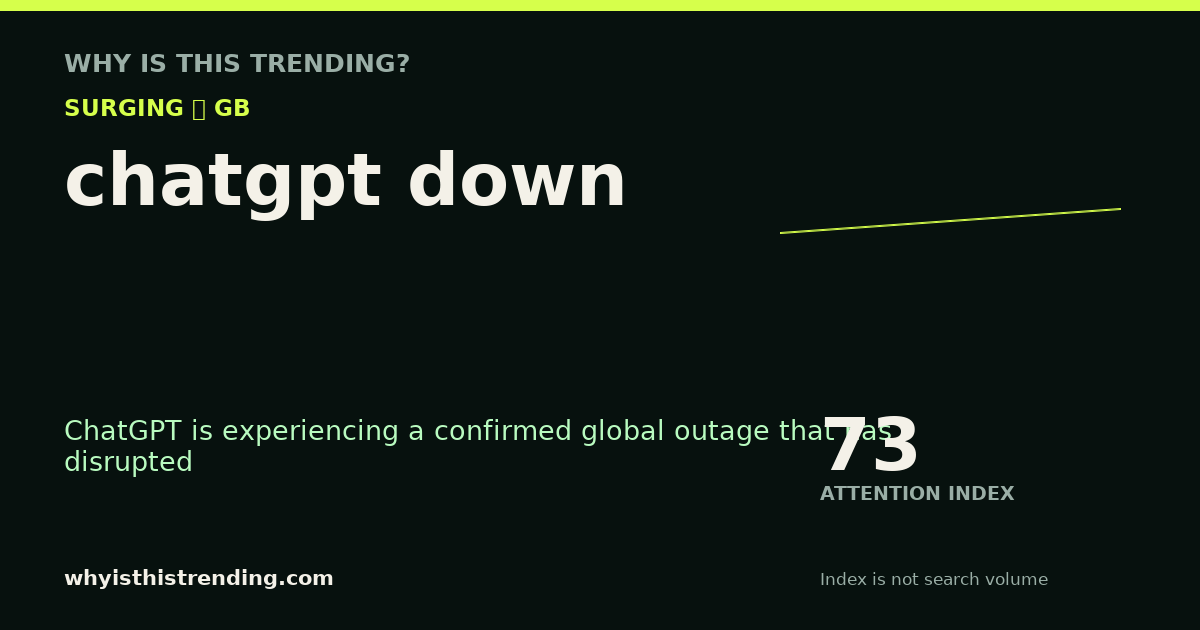
Decoding the Attention Spike and Worldwide Impact
When millions of professionals, students, and developers simultaneously stare at endless loading loops or Application Error
prompts, the digital reaction is instantaneous. Attention metrics and independent tracking systems registered a sharp, vertical surge in complaints starting around 4:47 AM Eastern Time (The Sunday Guardian). This sudden spike in user friction directly coincided with public confirmations from OpenAI that its core infrastructure was stumbling under elevated error rates.
Unlike localized routing hiccups or minor browser glitches, this event quickly manifested as a classic infrastructure-level disruption. Users attempting to send prompts, execute code via Codex, or initiate fresh conversations found themselves stranded mid-workflow (The Sunday Guardian). The velocity of the attention spike mirrors the deep integration that generative artificial intelligence now holds in daily global operations, turning a routine software hiccup into an international news event within minutes.
To understand why public attention scales so violently around these incidents, one must examine how heavily modern work depends on uninterrupted cloud access. When a utility tool like ChatGPT ceases to function, the ripple effects hit software engineering pipelines, creative copywriting tasks, customer support chat infrastructure, and academic schedules all at once. The resulting wave of search queries and panic-refreshing creates an unmistakable signature on global monitoring tools, demonstrating how quickly society notices when an essential cognitive utility goes dark.
Anatomy of the Worldwide Disruption
The technical footprint of the incident spanned multiple layers of OpenAI's ecosystem. Telemetry and user submissions confirmed that the failure spared virtually no region, striking users heavily across the United States, Europe, India, Japan, Australia, and the UAE (BleepingComputer, Gulf News). This widespread geographic dispersion rules out local internet service provider routing errors or regional undersea cable faults, pointing squarely at centralized server infrastructure strain.
- Core Interfaces: Both web browsers and mobile applications suffered persistent connectivity failures, missing chat histories, and stalled responses (The Sunday Guardian). Free, Plus, and Enterprise tiers all experienced identical degradation.
- Developer Tools: Codex and API integrations encountered heightened latency, dropped connections, and rejected requests, disrupting automated workflows (The Sunday Guardian). Software engineering pipelines relying on these endpoints stalled out mid-compilation.
- Multimodal Features: Voice transcription and interactive audio features failed to connect or process inputs properly (The Sunday Guardian).
We are investigating the issue for the listed services.
OpenAI Status Dashboard
As telemetry data poured in from independent outage trackers like DownDetector, it became clear that the disruption was systemic. The concentration of failures pointed straight at server-side backend infrastructure failures rather than isolated user errors or client-side application bugs. This global footprint explains why public forums and social media platforms flooded with identical error reports in multiple languages simultaneously.
Signal Versus Noise in Platform Reliability
When major technology platforms stumble, distinguishing between local device issues and server-side collapses saves valuable time. In this case, the signal was unambiguous: official dashboard admissions matched widespread telemetry spikes across independent monitors. While social media channels quickly filled with anecdotal complaints, the underlying reality pointed firmly toward backend infrastructure strain rather than isolated user error.
Users frequently waste precious minutes clearing browser caches, reinstalling mobile applications, or switching Wi-Fi networks when a platform goes dark. However, when an outage is confirmed at the global infrastructure level, none of those local troubleshooting steps will bypass server-side rejection errors. Recognizing the difference between a local glitch and a systemic collapse prevents unnecessary frustration and stops users from corrupting their local application states.
As engineering teams work to deploy mitigation patches and stabilize services, availability typically returns in stages—usually prioritizing core API functions before fully restoring browser and mobile app responsiveness (The Sunday Guardian). Users facing lingering connectivity hurdles are advised to monitor official status channels rather than repeatedly purging local application caches or panicking over missing chat logs.