The Catalyst: Live Rounds in the English Channel
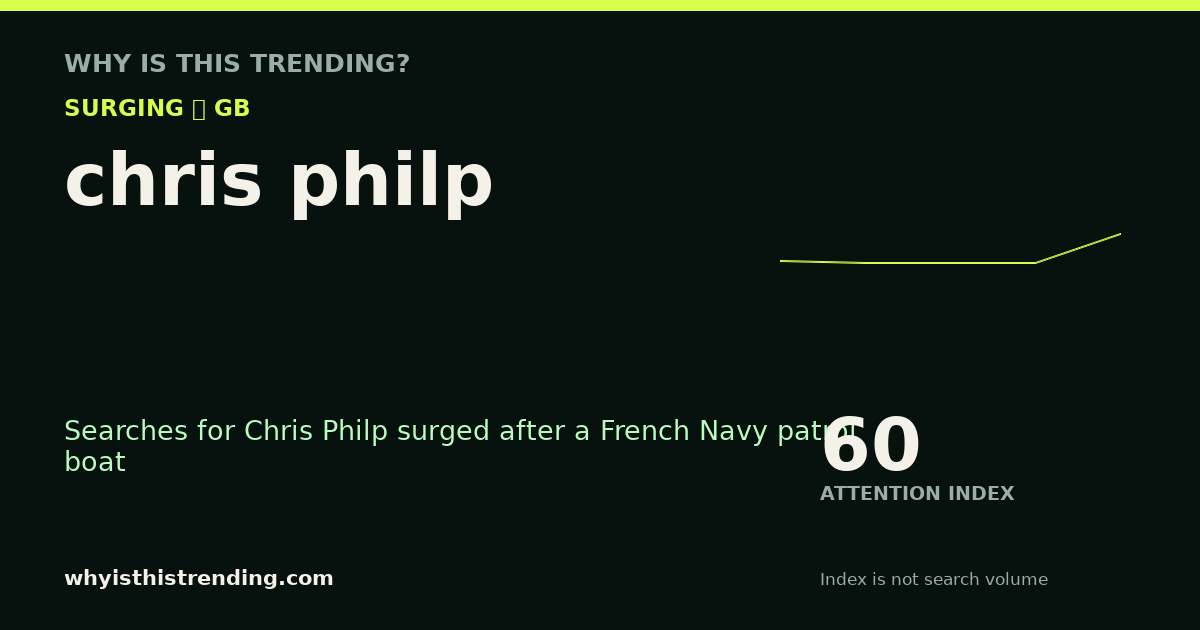
Public attention surrounding Shadow Home Secretary Chris Philp intensified following an extraordinary security incident in the English Channel. At approximately 09:15 BST on 28 July 2026, Philp was aboard a fishing boat roughly three miles from the French coast, participating in a BBC News interview with journalist Michael Keohan concerning small boat crossings. As a French Navy patrol boat passed within 300 meters, a series of noises sounding like 17 successive gunshots rang out across the water, with an officer aboard the French vessel seen pointing a handgun toward the sea.
The stark juxtaposition of a high-profile domestic political figure reporting on maritime migration while live ammunition was discharged nearby immediately captured public and media attention. Contemporaneous reporting from major newsrooms rapidly amplified the event, driving a sharp surge in digital interest across the United Kingdom. This attention spike reflects a direct reaction to a breaking geopolitical spectacle rather than a gradual shift in political discourse.
For readers tracking this trend, it is important to distinguish between raw public curiosity and verified operational facts. Digital tracking tools register sudden spikes in search queries following news alerts, but these metrics measure public attention rather than prove malicious intent or military protocol breaches.
Dueling Interpretations: Intimidation Versus Training
At the heart of the public debate are two sharply conflicting narratives regarding the intent behind the gunfire. The immediate reaction from those on board the British fishing vessel leaned heavily toward friction and warning.
- The Political View: Chris Philp asserted that the timing and proximity pointed toward a deliberate message, stating that it
felt to me like an attempted intimidation to stop us covering migrant crossings
as reported by The Independent. He further argued that it was extraordinary for the French navy to deploy live rounds near a visiting British politician while Channel crossings continued unabated. - The Eyewitness View: Fishing boat captain Matt Coker remarked that he had never witnessed anything similar, noting that the vessel only fired when directly alongside them despite miles of open water being available.
- The Official French Explanation: The French coastguard countered that the ship, the PSP Flamant, was participating in a routine training exercise entirely unrelated to the British media presence or migrant monitoring operations, asserting that the British boat was kept out of the range of fire.
These divergent viewpoints highlight the friction points in cross-border maritime management. While French authorities characterize the event as a standard domestic drill, British political observers view the proximity and timing through the lens of ongoing tensions over migration policy and enforcement efficacy in the Channel.
Signal Versus Noise in the Political Aftermath
When evaluating why this event dominates current news feeds, it is vital to separate verified developments from political posturing. The noise surrounding the incident includes sweeping generalizations about cross-border cooperation and heightened diplomatic friction. However, the concrete signal lies in the official diplomatic and administrative response.
The UK Home Office confirmed it is actively in contact with French authorities to understand the full context of the episode. Whether the incident was an unfortunate coincidence during a standard military drill or an unprecedented operational misstep remains unproven by independent oversight, but the political fallout has placed immediate pressure on bilateral channels regarding maritime enforcement.
As discussions continue between London and Paris, readers should monitor official updates rather than unverified commentary on social media. The situation underscores the delicate operational reality of the English Channel, where domestic political campaigning, media documentation, and foreign naval operations routinely intersect in constrained waters. Furthermore, it demonstrates how rapidly breaking visual media can transform a local maritime occurrence into a national digital focus point, driving sustained engagement across multiple news platforms.