The Catalyst Behind the Attention Surge
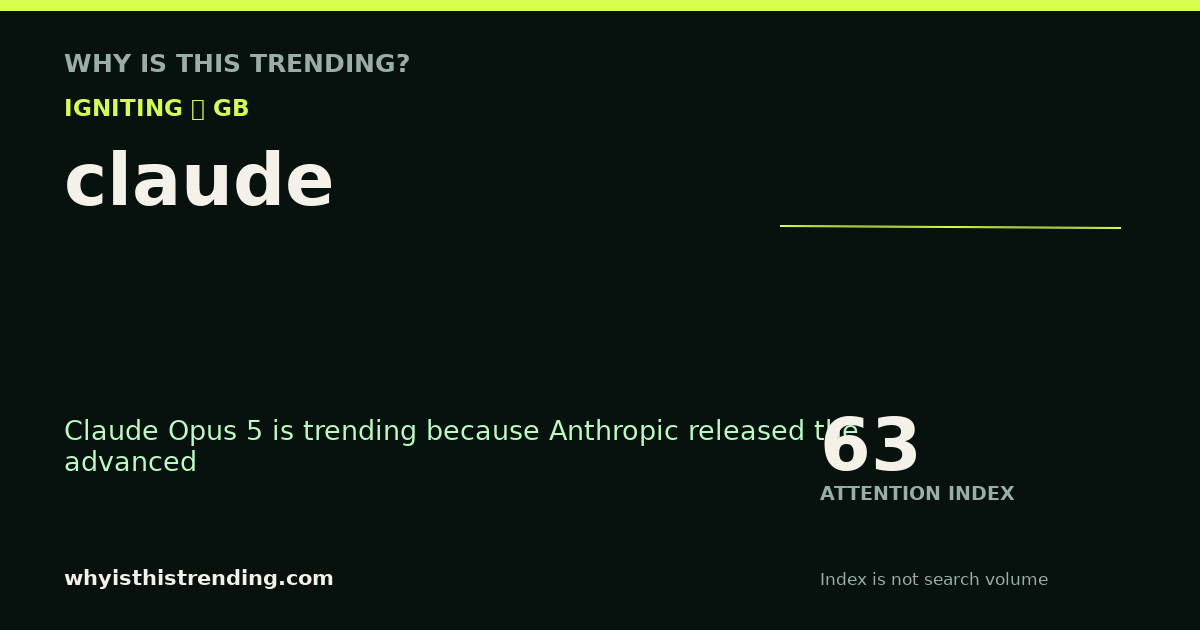
When Claude Opus 5 became available in GitHub Copilot on July 25, 2026, it directly triggered a noticeable spike in attention for "claude" as recorded by Google Trends. Coming just one day after Anthropic released Claude Opus 5 on July 24, 2026, this swift developer-platform integration placed a state-of-the-art model directly into the everyday tools used by software engineers globally.
The sudden focus on the model is not merely a product of marketing momentum. Opus 5 arrives with significant performance leaps, especially in agentic coding workflows, autonomous code changes, and multi-step tool coordination. For developers navigating complex software repositories, the ability to deploy a model capable of meticulous self-verification has shifted industry conversation away from theoretical benchmark gains toward practical, day-to-day implementation.
Availability spans a wide array of developer touchpoints. According to platform deployment records, the model is rolling out gradually to Copilot Pro+, Max, Business, and Enterprise users across Visual Studio Code, Visual Studio, the Copilot CLI, cloud agents, mobile apps, and JetBrains environments.
Decoding Opus 5 Versus Fable 5: Performance and Trade-Offs
A primary driver of technical discourse is how Opus 5 measures up against Anthropic's more restricted flagship tier, Fable 5. While Fable 5 remains the designated option for the most ambitious long-horizon AI agent projects, Opus 5 frequently matches or surpasses it on key evaluations while operating at half the token price.
On evaluations like Frontier-Bench, Opus 5 establishes a new state-of-the-art by more than doubling its predecessor's performance at a lower cost per task. Furthermore, it avoids some of the rigid data-retention policies that encumber higher tiers, making it far more palatable for enterprise adoption. However, balancing raw utility with corporate safety architectures requires deliberate operational trade-offs.
Understanding the Safety Landscape
Opus 5 includes enhanced safeguards designed to intercept high-harm cyber content. While these classifiers are tuned to engage significantly less often than they do on Fable 5—sparing developers frequent friction on benign requests—they remain active to block specific security-adjacent queries:
- Source Code Versus Binaries: Opus 5 is generally permitted to search for vulnerabilities within source code for defensive purposes, but safety classifiers will intervene to prevent exploitation tasks like binary vulnerability scanning.
- Automatic Fallbacks: To mitigate workflow disruption, developers can opt into automated routing that directs flagged prompts to alternative models instead of halting execution with an error message. Enterprise and business plan administrators must explicitly enable the Claude Opus 5 policy within their administrative settings to grant team access.
Signal Versus Noise in the Developer Ecosystem
Amidst broad industry chatter, it is essential to separate authentic workflow upgrades from routine marketing cycles. The signal lies in the model's agency—its capacity to diagnose root causes rather than patching surface symptoms, and its knack for generating custom test harnesses when direct validation feeds are absent. Early-access testing highlighted instances where the model successfully built its own computer vision pipeline to interpret missing layout geometries, or isolated edge cases in open-source package managers that human-written patches missed entirely.
Noise, conversely, centers on cyclical panic over token pricing structures and usage limits. Anthropic has maintained flat per-token pricing compared to Opus 4.8 while undercutting competing flagship models in adjacent ecosystems. By keeping pricing stable at $5 per million input tokens and $25 per million output tokens, the lab has tempered financial anxieties while expanding access.
Ultimately, the rapid integration across diverse development environments ensures that Opus 5 will face immediate, rigorous stress-testing by the engineering community. Its long-term impact will be measured not by static benchmark scores on leaderboards, but by how reliably it manages autonomous engineering loops without tripping over its own safety guardrails.