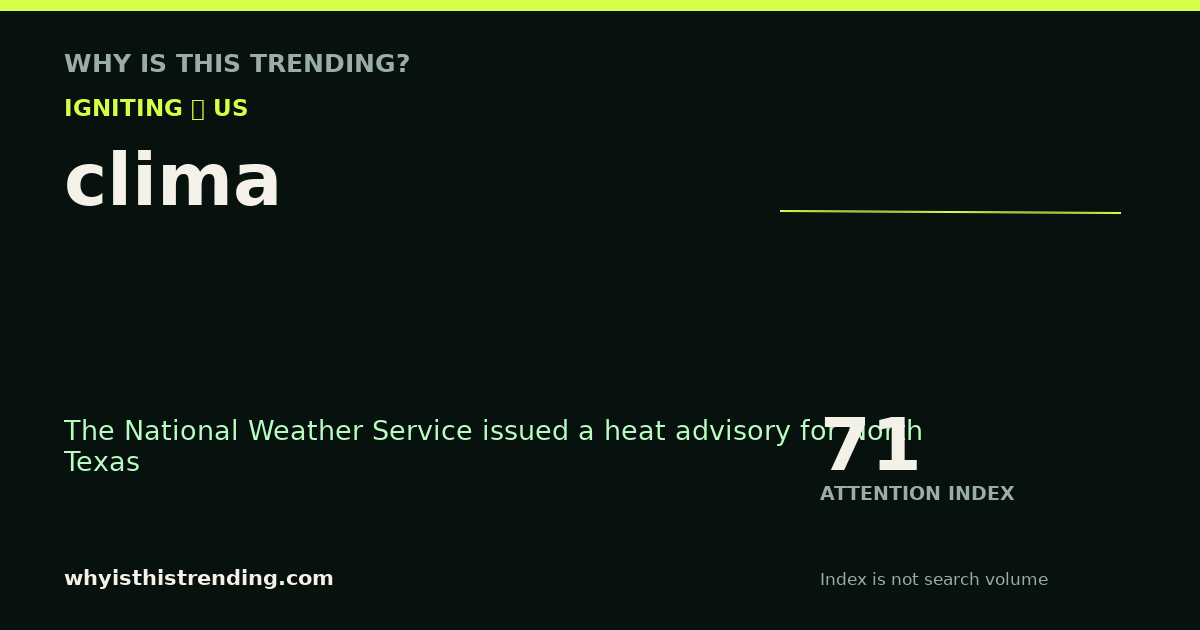
The Mechanics of a Heat Advisory
On July 20, 2026, the National Weather Service (NWS) triggered a Heat Advisory for large swaths of North and Central Texas. While residents may be accustomed to triple-digit temperatures in mid-summer, this specific alert is not merely a reaction to the mercury hitting 100°F. Instead, it is a response to the heat index—the "feels like" temperature—which is projected to climb as high as 108°F.
The distinction between raw temperature and heat index is the core of this trend. When humidity levels are high, the human body’s primary cooling mechanism—the evaporation of sweat—becomes significantly less efficient. The air is already saturated with moisture, leaving nowhere for that perspiration to go. As a result, the body retains heat, raising the risk of exhaustion or heat stroke even if the air temperature remains steady. The NWS alert, effective from noon until 8 p.m. on the day of issuance, serves as a formal notification that the environment has reached a threshold where the body can no longer effectively regulate its core temperature without intervention.
Who Is Most at Risk?
The NWS advisory specifically highlights the danger to those who cannot escape the elements. The risk profile is highest for individuals whose livelihoods depend on outdoor labor, including those in construction, landscaping, delivery services, and maintenance. For these workers, the advisory serves as a formal signal to prioritize hydration and implement mandatory rest breaks. The guidance is clear: for those working under the sun, las pausas y el acceso al agua pueden marcar la diferencia
(breaks and access to water can make the difference).
Beyond the workforce, the advisory targets vulnerable populations who face compounding risks:
- Adults over 65 and young children, who may have less efficient thermoregulation.
- Individuals with pre-existing heart conditions, for whom heat stress places an additional burden on the cardiovascular system.
- Residents in housing with limited access to air conditioning, where indoor temperatures can remain dangerously high even after the sun sets, as minimum temperatures are expected to hover around 80°F.
Distinguishing Signal from Noise
In the current information environment, the term "clima" is being pulled in several directions, creating significant noise for those trying to track the meteorological event. It is vital to distinguish between the weather event in Texas and other unrelated search trends that share the same keyword:
Contextual Noise: Why these are not the DFW Heat Event
- Consumer Goods: Recent searches for "Clima" may refer to luxury stainless steel water bottles from brands like Smeg and 24Bottles, which are marketed for their thermal insulation properties (Yahoo Shopping).
- Sports Collectibles: The term is also associated with special edition thermal bottles produced in collaboration with football clubs like Inter Milan (Yahoo Sports).
- Corporate Compliance: In professional and human resources contexts, "clima organizacional" refers to workplace culture and satisfaction, which is distinct from the environmental risks managed under safety regulations like Brazil's NR-1 (G1).
The meteorological signal is clear: the NWS is forecasting a sustained period of heat stress. The current advisory is expected to be the first of several, with heat index values likely to fluctuate between 105°F and 112°F throughout the week. This is not a one-day event, but a sustained atmospheric condition that requires ongoing monitoring.
A Defensible Point of View
The issuance of this advisory is a reminder that in modern heat events, humidity is the silent force multiplier. When the NWS issues an advisory rather than a warning for extreme heat, it is often a strategic choice to emphasize that the danger is manageable if proper precautions—such as seeking air-conditioned spaces and increasing water intake—are taken early. The most important takeaway for residents in the affected areas is to look past the thermometer. If the forecast calls for a heat index of 108°F, the physical demand on your body is equivalent to that temperature, regardless of what a standard outdoor thermometer might display. As the week progresses, residents should remain vigilant, as the NWS anticipates that these conditions may necessitate repeated advisories. Always check the latest local forecasts, as conditions can shift rapidly based on localized humidity and cloud cover.