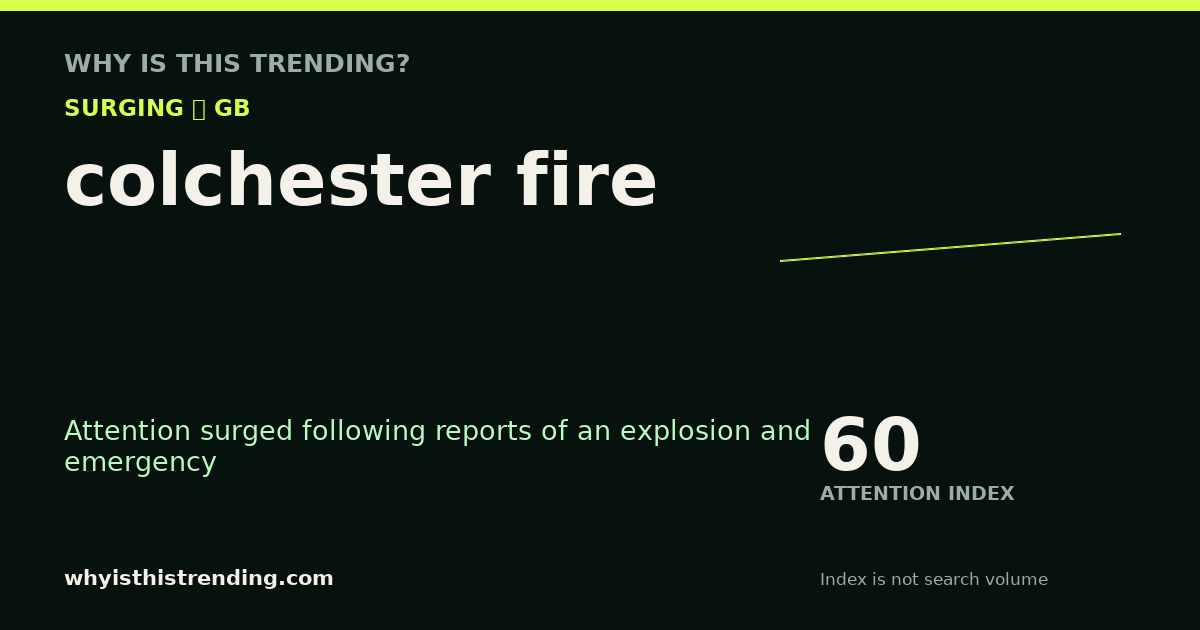
Understanding the Colchester Fire Attention Surge
When sudden public interest spikes around a localized incident like the Colchester fire, it is usually driven by a stark gap between initial dramatic accounts and verified official details. Google Trends recorded a sharp vertical spike in queries regarding a fire on the Greenstead estate, aligning precisely with the publication of morning news reports. On social media, imagery of emergency vehicles and firsthand accounts of loud noises can rapidly accelerate public curiosity long before a full institutional assessment is available to contextualize what is happening on the ground.
It is important to distinguish this surge in digital curiosity from broader search-volume metrics or any indication of systemic danger. The spike reflects an intense, localized information-seeking wave rather than proof of a widespread crisis or escalating community threat. When neighbours hear unexpected noises late at night, online speculation often outpaces official reporting, creating a brief window where public interest peaks dramatically before receding as facts are established by emergency services.
What Actually Happened on Stanley Wooster Way
The incident began at approximately 9:15pm on Tuesday, July 28, 2026, when emergency services were alerted to a property on Stanley Wooster Way within the Greenstead estate, as detailed in local reporting. Residents living nearby raised the alarm after hearing what they described as an explosion
when the fire initially broke out, a sound that understandably heightened tensions across the residential neighbourhood.
However, the physical reality discovered by responding professionals contrasted sharply with the alarming nature of the initial reports. The Essex County Fire and Rescue Service arrived to find that the blaze was already out. According to service statements, the incident was localized entirely to a small outdoor tool storage area. Fire crews methodically checked the surrounding area to ensure complete safety and fully wrapped up their operational duties by 9:44pm, leaving the scene secure.
Emergency Response and Official Findings
While the fire itself was minor and swiftly handled, medical responders also attended the scene out of an abundance of caution. The East of England Ambulance Service dispatched an ambulance and an ambulance officer vehicle following emergency calls at 9:20pm, ultimately transporting one patient to the hospital for further medical treatment.
Local political figures stepped in to provide reassurance to the community as details emerged the following morning. Greenstead ward councillor Tim Young visited the neighbourhood, describing the late-night event as undoubtedly frightening for the family involved and their neighbours, while expressing relief that the situation did not escalate further. Investigators officially recorded the cause of the fire as accidental, putting to rest initial community fears of a more sinister or complex origin.
Signal Versus Noise in Localized Emergencies
Incidents involving emergency vehicles in residential areas routinely generate outsized digital footprints because visual evidence—such as a photograph of a fire engine and an ambulance posted to social media—travels faster than verified municipal statements. In this case, the noise consisted of unverified neighbourhood chatter regarding a suspected major explosion, while the signal was the precise, measured update provided by the Essex County Fire and Rescue Service confirming a minor, accidental outdoor storage fire.
For readers attempting to interpret sudden regional trends, separating the emotional impact on those living nearby from the actual technical scope of the incident is essential. Local authorities praised the swift response of the emergency services, and subsequent morning checks confirmed that the neighbourhood returned to a quiet, normal state without lingering structural hazards. Keeping perspective on such events helps prevent minor domestic accidents from being misinterpreted as broader public safety emergencies, ensuring that local residents can distinguish between alarming social media speculation and verified municipal facts.