The Anatomy of the July 23 Disruption
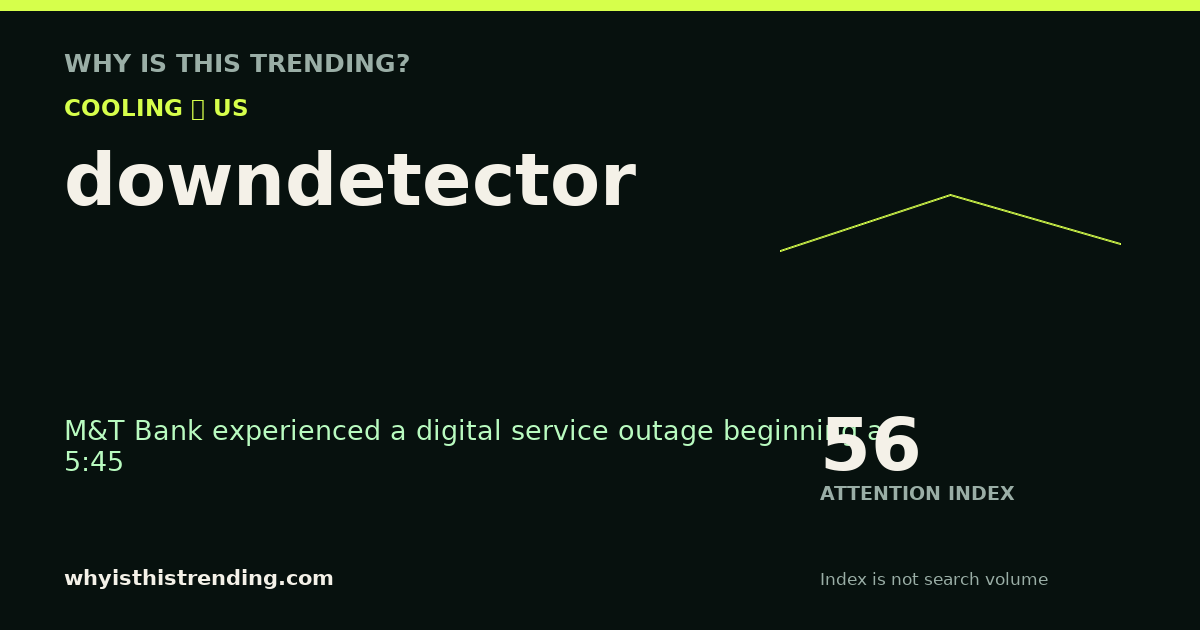
On the morning of July 23, 2026, M&T Bank customers encountered a sudden and widespread inability to access their digital financial tools. The disruption, which began at approximately 5:45 AM Eastern Time, triggered an immediate surge of activity on outage-monitoring platform Downdetector. Within the first hour of the incident, the site recorded over 1,000 user reports, a volume that serves as a clear indicator of a systemic failure rather than isolated connectivity issues.
The outage was characterized by its specific impact on the bank’s digital ecosystem. Customers reported being unable to log into the mobile banking application or the online banking portal. Other common grievances included website loading errors, difficulty checking account balances, and an inability to process online transactions. Notably, the disruption did not extend to physical infrastructure; branch banking and ATM services remained fully operational throughout the event, providing a necessary, if limited, alternative for those needing immediate access to funds.
Signal Versus Noise in Outage Reporting
In the digital age, a spike in reports on platforms like Downdetector is often the first, and sometimes only, signal of a service failure. However, it is essential to distinguish this user-reported data from an official technical diagnosis. Because Downdetector aggregates reports from users, a surge in activity confirms that a significant number of people are experiencing the same frustration simultaneously, but it does not reveal the underlying root cause—be it a server configuration error, a failed software update, or a network-level issue.
As of the latest reports on July 23, M&T Bank had not released an official statement regarding the cause of the outage. This silence is common in the immediate aftermath of technical disruptions, as internal teams prioritize restoration over public relations. For customers, the lack of a formal timeline for resolution created a period of uncertainty, leading many to seek updates through social media or by repeatedly attempting to log in—the latter of which can sometimes exacerbate service instability by increasing traffic to already struggling authentication servers.
Contextualizing the Digital Landscape
The M&T Bank event occurred against a backdrop of heightened sensitivity to digital service reliability. The week of July 23 saw a series of high-profile technical hiccups across various platforms, including Microsoft Teams and various Meta-owned services. While these outages are often unrelated in terms of technical infrastructure, their proximity in time tends to amplify public scrutiny and consumer anxiety regarding digital dependency. When multiple major platforms experience issues within the same 48-hour window, the collective perception of "systemic instability" often grows, even if the individual events are isolated technical failures.
Furthermore, the M&T Bank incident mirrors patterns seen in other recent banking disruptions, such as the DBS PayLah! service disruption, where banks often have to manage both the technical recovery and the reputational fallout. In such cases, banks typically focus on refunding affected transactions or providing clear communication once the service is restored, rather than providing real-time commentary during the heat of the outage.
Practical Takeaways for the Digital Consumer
To navigate such disruptions, users are generally advised to follow a standard triage process to minimize personal impact:
- Verify the scope: Check official bank social media channels or status pages for confirmed updates before assuming the issue is with your specific account.
- Diversify access: If the mobile app is failing, attempting to log in via a web browser can sometimes bypass app-specific cache or update issues.
- Avoid redundant traffic: Repeatedly refreshing or attempting to log in during a known outage can contribute to server load, potentially delaying the recovery process for everyone.
- Maintain physical backups: As evidenced by the M&T Bank outage, digital services can fail, but physical infrastructure like ATMs often remains unaffected. Keeping a small amount of cash or alternative payment methods can mitigate the urgency of a digital-only outage.
Ultimately, while the M&T Bank outage was significant enough to disrupt the daily financial routines of thousands of users, the absence of impact on physical banking services provided a critical safety net. As digital banking continues to evolve, the reliance on centralized servers means that these periodic, localized outages remain an unavoidable, if frustrating, reality of modern finance. Consumers should treat these events as reminders to maintain multiple avenues for accessing their financial assets.