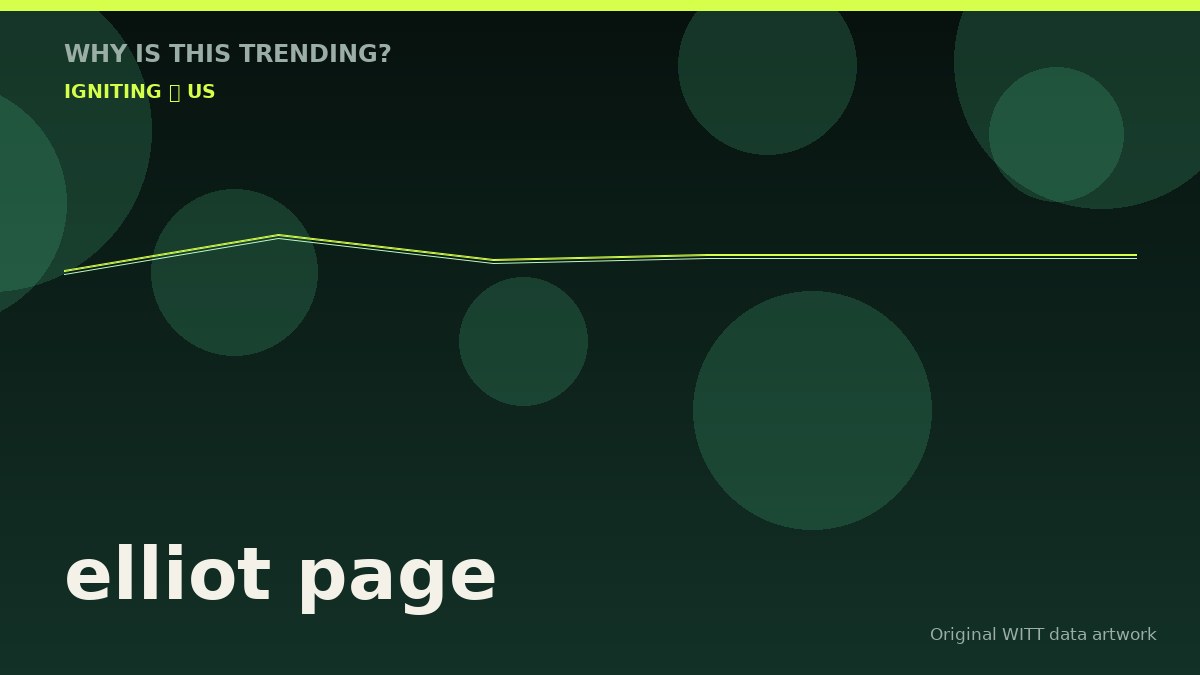
The Anatomy of an Attention Surge
When public figures occupy two completely different cultural lanes at the exact same moment, attention tends to compound rapidly. The surge surrounding Elliot Page highlights how modern media cycles amplify when a provocative interview lands alongside a massive commercial release. Rather than springing from a single isolated headline, this wave represents the intersection of political discourse and blockbuster entertainment marketing.
It is important to clarify what tracking platforms measure. Google Trends reflects shifts in the volume of user queries and online interest over a given timeframe, but it does not measure public sentiment, establish direct cause-and-effect, or serve as a proxy for absolute search volume. What we can observe is a distinct spike in curiosity driven by two concurrent catalysts operating across separate spheres of public life.
Cultural Commentary Meets the Press Tour
The primary narrative trigger arrived on August 4, 2026, when Page appeared on the TransLash podcast hosted by Imara Jones. During the conversation, the actor criticized traditional biology education, arguing that standard school lessons are frequently deployed to marginalize LGBTQ+ people by framing queer identities as maladaptive or contrary to nature. As reported by Scene Magazine, Page stated that the natural world encompasses wide variations in behavior and gender expression that standard curricula often ignore.
Elaborating on this theme during the interview, Page remarked, The natural world and what we learn in biology class in terms of it seemingly being this cis hetero-patriarchal system... I feel is used against queer and trans people in terms of us being made to seem maladaptive, like there's something wrong with us or we're some modern thing, which we of course know is untrue.
The actor further argued that human beings are unique in their hostility toward gender diversity compared to the rest of the animal kingdom.
The remarks immediately polarized commentators across the political spectrum, generating sharp rebukes from conservative outlets like Townhall while rallying support among queer advocacy platforms. This ideological friction ensured heavy social media sharing and extended the life of the interview well past its initial airdate, driving waves of users online to investigate both the podcast and the actor's broader body of work.
Blockbuster Momentum and Global Reach
Amplifying this cultural debate was Page's high-profile involvement in Christopher Nolan’s blockbuster feature adaptation of The Odyssey,
which hosted its star-studded red carpet premiere in New York City on July 14, 2026, as noted by Xpointchurch and Manchestercameraclub. In the film, Page portrays Sinon, a character caught up in the legendary Trojan Horse deception. During the podcast, Page discussed the emotional weight of the role, noting that his character remains unaware of the true conspiracy and suffers intense guilt and regret following the resulting destruction.
As the film continued its theatrical run into August, it shattered international box office milestones. According to reports tracked by Rediff, the movie surpassed previous benchmarks to become India's highest-grossing IMAX release, overtaking Nolan's earlier work *Oppenheimer* by grossing Rs 63 crore across 34 IMAX screens in just 17 days. Studio-led promotional campaigns kept the ensemble cast—including Page—firmly in the international entertainment news cycle through exclusive merchandise, digital clips, fan activations, and limited-edition character pins.
Signal Versus Noise in the Current Cycle
For observers trying to parse what matters in this trend, separating the signal from the noise requires looking at how separate media streams merged into a single focal point:
- The Signal: A substantive public debate regarding how scientific education interprets biological diversity, paired with the enduring commercial footprint of a major international film release that keeps the actor visible across global markets.
- The Noise: Reflexive outrage cycles on social media, recycled red-carpet fashion commentary, and partisan point-scoring that add little new context to either the actor's artistic output or his political advocacy.
Ultimately, the convergence of podcast commentary on educational frameworks and record-breaking box-office milestones explains why audiences turned to search engines to connect the dots. The resulting spike demonstrates how contemporary digital attention frequently bridges disparate worlds, uniting political discourse with cinematic spectacle.