Decoding the Surge in Digital Attention
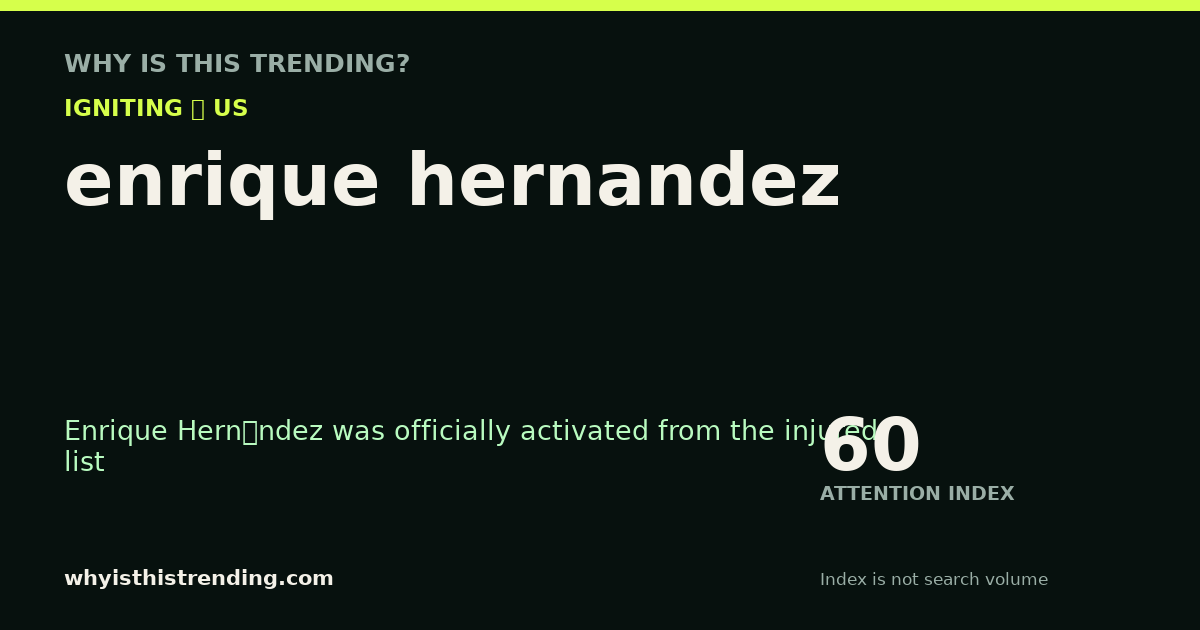
When digital interest spikes around a specific professional athlete, it usually follows a definitive organizational milestone that demands immediate public explanation. For utility player Enrique Hernández, that tangible catalyst arrived when the Los Angeles Dodgers officially announced his activation from the injured list on July 29, 2026 (NBC Sports). Google Trends recorded a sharp surge in attention for his name within 48 hours of the transaction, capturing public curiosity about how the veteran will slot back into the club's active lineup during their series against the Seattle Mariners.
It is essential to separate this measurable surge in search interest from proof of direct causation or broader search-volume metrics. The attention spike reflects an acute informational wave: fans seeking confirmation of his health status, lineup placement, and the broader roster implications of his recovery timeline. Observers are tracking whether a player returning from such a severe core issue can immediately regain his competitive rhythm.
The Anatomy and Exhausting Recovery of a Grade 3 Oblique Strain
To understand why Hernández’s return has captivated baseball observers and generated substantial online curiosity, one must look closely at the severity of the injury he sustained back in late May. What initially felt like standard game discomfort turned out to be a Grade 3 full tear of the left oblique—an affliction that frequently carries a timeline requiring surgical intervention or extensive months of rehabilitation (EssentiallySports).
Hernández detailed the harrowing psychological and physical hurdles of his initial diagnosis, noting the anxiety of receiving news of a major tear from team trainer Thomas Albert while sitting in traffic. Eschewing surgery, his recovery demanded rigorous daily discipline involving hyperbaric chamber sessions, stem cell therapy, saunas, cold plunges, and precise core rotation exercises (EssentiallySports). Returning from a core injury of this magnitude without undergoing an operation makes his active roster return a fascinating physical gamble for the organization.
Enrique Hernández / Dodgers Nation
Never done an oblique before, and I was expecting it to be a Grade 1 or Grade 2 at worst,Hernández said, per Dodgers Nation on X.When I heard the Grade 3, I thought it was surgical.
The daily toll of the rehabilitation process tested his resilience. Basic human movements like coughing and sneezing brought severe discomfort, showcasing just how vital an intact, functioning oblique is to an athlete's baseline physical existence long before they ever pick up a bat.
Navigating a Season of Continuous Attrition
The 2026 major league campaign has been a continuous battle of physical management for the 34-year-old veteran. Prior to missing nine weeks of action due to his oblique tear, Hernández had already missed the first 53 games of the season owing to a left elbow injury sustained during the winter (EssentiallySports). When he briefly returned on May 25 against the Colorado Rockies, he flashed immediate brilliance by going 4-for-4 across his first two games with a home run and two doubles, only to exit early with the core discomfort that led to his extended absence (EssentiallySports).
His injury history introduces genuine volatility into the Dodgers' tactical planning. When evaluating what matters versus what is mere digital background noise, fans must filter out generalized speculation regarding whether any single player can remain completely healthy down the stretch. Instead, the hard signal is the team's immediate willingness to deploy him in his customary multi-positional capacity right out of the gates (NBC Sports).
Signal Versus Noise on the Late-Season Dodgers Roster
Amidst ongoing chatter regarding various organizational adjustments and parallel rehab milestones across the club—such as pitcher Blake Snell's ongoing progress toward an August return—the core signal for Hernández is his unique defensive and offensive versatility (SpeakingOutForAnimals).
The noise surrounds sensationalized predictions about regular-season dominance or panic over past missed games. The definitive signal, however, is his immediate re-integration into the manager's active plans as the club navigates the heat of a demanding summer schedule. For a Dodgers franchise balancing multiple health variables across its roster, getting a proven veteran back onto the diamond provides an invaluable injection of depth—provided his heavily rehabilitated core holds up under the daily grind of major league competition.