Decoding the July 28 Search Spike
When millions of people simultaneously turn to their search bars for euro lottery results,
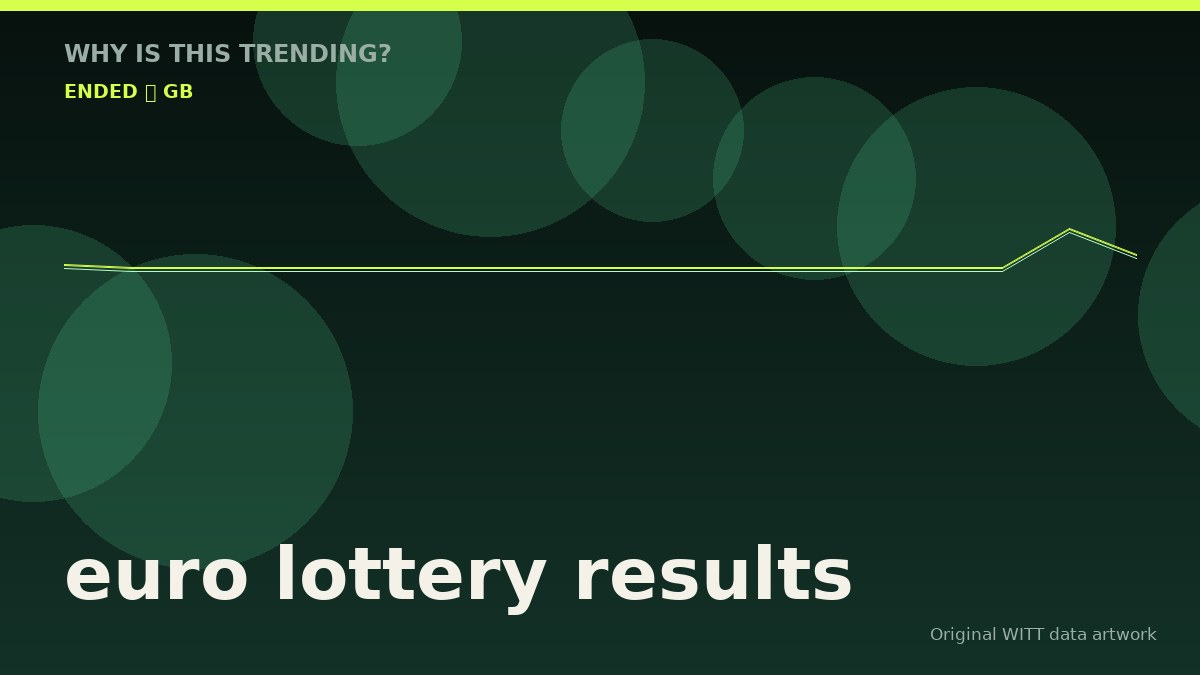
it is rarely a coincidence. On 28 July 2026, Google Trends recorded a sharp, immediate climb in attention starting at 23:40 UTC, mirroring the public release of the evening's winning numbers. This sudden surge was fueled by a potent combination: a high-stakes £50 million jackpot and real-time live-blog coverage from news organizations tracking the outcome as reported by the Liverpool Echo.
While routine bi-weekly draws attract steady participation, multi-week rollovers change the psychological and digital landscape. When top-tier prizes go unclaimed across consecutive events, successive draws compound the pool, drawing casual players back into the market and inflating public curiosity. The build-up to the 28 July draw created precisely this kind of high-visibility environment, transforming a standard Tuesday evening into a focal point for cross-border digital engagement.
Understanding this attention mechanism requires looking at how modern information ecosystems operate. As soon as the draw window closes and official numbers are verified, a cascade of search queries hits search engines instantly. People are not merely curious about abstract financial figures; they are actively cross-referencing physical or digital slips against published data in real time.
The Numbers That Captured Public Attention
For players rushing to verify their tickets, the critical data points arrived shortly after the evening draw window. The official winning combination for the main EuroMillions draw consisted of the numbers 5, 7, 24, 30, and 49, paired with Lucky Stars 10 and 11 as detailed by the Liverpool Echo. Concurrently, UK participants tracked the separate Millionaire Maker code—HKBC34948—alongside the Thunderball numbers 1, 7, 33, 34, and 36, with the Thunderball itself drawn as 14 according to The Independent.
This cross-border multi-tier structure means that even when the ultimate jackpot remains a subject of intense verification, hundreds of thousands of smaller secondary prizes sustain public engagement across participating nations. From the United Kingdom and Spain to France, Switzerland, and beyond, millions of participants rely on rapid digital dissemination to find out whether their specific combination secured anything from a multi-million-pound windfall down to a modest tier-matching return.
In addition to the main EuroMillions draw, concurrent games like the UK's Thunderball provide an auxiliary layer of digital interest. Offering a £500,000 top prize for matching five numbers plus the Thunderball, these secondary games amplify total search volume by giving participants multiple winning avenues to check during the exact same evening window.
Signal Versus Noise in Lottery Trend Analysis
It is vital to separate verifiable digital behavior from generalized speculation. Google Trends measures relative changes in search interest, not absolute ticket sales or direct proof of causation regarding who purchased winning slips. However, the exact timing of the attention spike leaves little ambiguity about its origin: it directly mirrored the publication of the evening results and the resolution of a multi-week rollover cycle that had captured widespread public imagination.
Media framing also played an amplifying role. Outlets across Europe synchronized their live updates to capture the post-draw rush, providing immediate verification portals for anxious participants. This synchronized reporting loop acts as a reliable accelerant for search queries, turning a standard administrative event into a trending digital phenomenon that ripples across social feeds and search engine indexation charts alike.
Observers should note that while high-profile rollovers reliably drive spikes in search attention, they do not guarantee a first-rank winner in every single instance. The interplay between massive advertised prize pools—such as the £50 million threshold reached on 28 July—and the inherent statistical improbability of matching every ball ensures that public fascination will continue to oscillate dynamically with each successive rollover cycle.