The Anatomy of an Overnight Emergency Diversion
When an airliner declares an emergency shortly after departure, public attention surges instantly. That exact dynamic fueled the sharp spike in interest surrounding American Airlines Flight 1009. Bound for Chicago O’Hare International Airport from Los Angeles International Airport, the Boeing 737-800 departed from Runway 25R shortly after midnight as detailed in live aviation tracking reports.
The flight initially proceeded through standard departure procedures, executing its eastward turn and climbing toward an assigned cruising altitude of 31,000 feet. However, roughly 30 minutes into the journey—while the aircraft was traveling over the Coachella Valley—the flight crew initiated an abrupt U-turn and declared an emergency, directing the twin-jet back toward its origin.
In modern aviation, real-time flight tracking platforms allow observers to watch a transcontinental route unravel in seconds. When a flight path abruptly reverses, digital speculation naturally follows, turning standard operational safety procedures into major online talking points before official explanations even clear the desk.
Signal Versus Noise: Decoding the Cockpit Indicator
In the hours following an unexpected aviation turnaround, digital speculation often races ahead of verified facts, imagining catastrophic engine failures or structural crises. Yet primary news reports quickly clarified the exact mechanism behind the emergency declaration. According to airline statements cited by local news coverage from ABC7 Los Angeles, the diversion was precipitated by an avionics fault rather than an active mechanical disaster.
Specifically, an indicator light malfunctioned, notifying the flight deck that the aircraft would be unable to properly detect hazardous weather conditions ahead. Commercial aviation safety protocols treat forward-looking weather radar integrity with extreme caution, particularly on overnight transcontinental routes crossing diverse meteorological zones. Rather than continuing a multi-hour flight without operational weather-detection instrumentation, the pilots exercised procedural conservatism by turning back to their departure hub.
It is important to separate what this signal means from what it does not prove. An emergency declaration is a mandatory legal and operational step to secure priority handling from air traffic control; it does not automatically indicate that the aircraft is falling out of the sky or facing imminent structural peril. In this case, the crew utilized the proper channels to manage a non-standard equipment reading safely.
Weighing Risk, Precaution, and Passenger Impact
For passengers on board, seeing a flight reverse course mid-journey is inherently jarring, regardless of the root cause. Emergency response vehicles were placed on standby along the tarmac as a standard safety precaution as noted by aviation observers at Airlive, and the Boeing 737 touched down safely on runway 25L roughly 45 minutes after takeoff. Following touchdown, the plane vacated the runway and was escorted by Aircraft Rescue and Fire Fighting personnel.
Passengers faced schedule disruptions but experienced an orderly resolution. The airline accommodated affected travelers by rebooking them onto an 8 a.m. flight to complete their journeys to Chicago O’Hare, bringing a swift and secure conclusion to an otherwise disruptive nocturnal detour.
Travel disruptions of this scale highlight the delicate balance airlines must strike between schedule maintenance and absolute safety compliance. While a delayed itinerary is frustrating for travelers attempting to make morning connections, the strict adherence to avionics integrity checks ensures that potential hazards are addressed on the ground rather than thousands of feet in the air.
Interpreting the Google Trends Spike
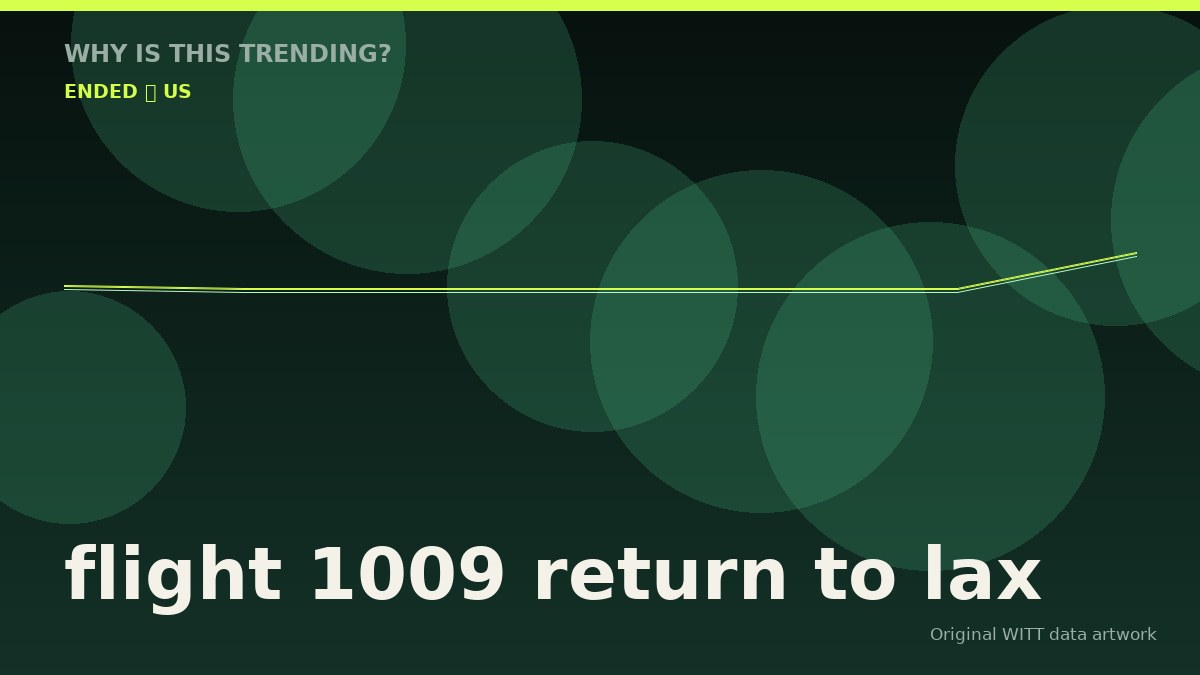
The sudden surge in online interest surrounding flight 1009 maps directly to the real-time reporting window. As local news outlets and aviation tracking networks published updates on the midnight turnaround, search queries naturally climbed. It is vital to separate this surge in attention from proof of systemic peril; search-volume spikes reflect public curiosity triggered by breaking headlines, not an escalation in aviation risk.
Whenever an emergency landing hits the news cycle, public curiosity peaks as people search for flight numbers, causes, and safety records. However, a trending search query is purely a measurement of attention and information-seeking behavior, not a scientific metric of airline safety or an indicator of causation regarding broader industry trends. Observers looking at the data should view the spike as a reflection of transparency and rapid news dissemination in modern travel reporting.