Decoding the August 7 Attention Peak
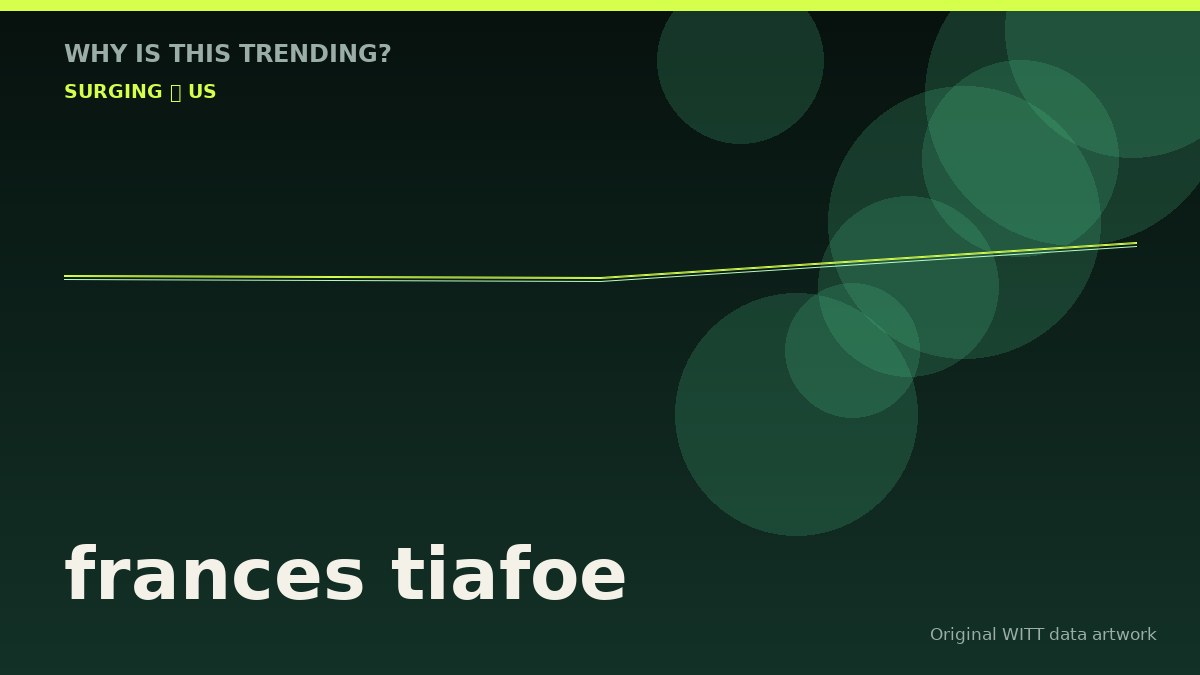
When public curiosity surges around a professional athlete outside of a traditional championship podium, the catalyst is usually structural rather than spontaneous. For American tennis standout Frances Tiafoe, public attention metrics climbed sharply, reaching an attention index peak of 67.61 on August 7, 2026, at 02:00 UTC [3].
A superficial glance at search trends might suggest a major upset, an injury drama, or an unexpected trophy run. However, forensics of the digital footprint point elsewhere. The timing of this attention apex aligns perfectly with published preview content circulating across sports analysis and prediction platforms [2], [3].
Understanding this mechanism requires looking past the raw numbers to see how digital sports ecosystems operate today. Modern fans do not merely wait for the umpire to call the score; they digest columns of data, implied probabilities, and win-loss projections hours before the players ever step onto the hard court. The convergence of algorithmic discovery feeds and proactive sports wagering content creates predictable waves of online inquiry whenever a popular athlete is scheduled for a high-stakes fixture.
Furthermore, the way modern sports information is distributed ensures that a single high-profile tournament match initiates multiple ripple effects across the web. Fans searching for injury updates, head-to-head records, or streaming options contribute to an aggregate surge that search algorithms register as a unified spike in public interest. This environment transforms routine tournament preparation into a major digital event.
The Pre-Match Content Pipeline and Statistical Backdrops
The immediate engine behind the search activity was scheduled tournament play at the National Bank Open in Montreal, where Tiafoe was slated to face France's Arthur Rinderknech in the Round of 32 [3]. On August 6, 2026, major prediction markets and sports culture platforms released comprehensive breakdowns of the fixture [2], [3].
Platforms such as PrizePicks and Sports Betting Dime published detailed head-to-head evaluations, win-probability metrics, and total-games projections [2], [3]. These articles analyzed everything from Elo ratings and hard-court form to historical tiebreakers, priming sports enthusiasts and bettors to search for live odds and player status updates.
When analysts unpack matches like Tiafoe versus Rinderknech, they often highlight complex statistical narratives. For instance, reports noted that Tiafoe held a notable ranking and Elo advantage entering the match—sitting at No. 20 in the ATP rankings compared to Rinderknech at No. 29—while also pointing out their deadlocked 1-1 head-to-head history [3]. This statistical depth gave fantasy players, casual fans, and pick-makers plenty to parse, directly fueling the digital conversation long before a single point was played in Montreal.
Additional context provided by these analysis platforms revealed that Tiafoe carried a superior year-to-date campaign and solid hard-court metrics into the contest, contrasting with Rinderknech's lower ranking position [3]. Such granular breakdowns naturally invite comparison and discussion across social media channels, compounding the velocity of the original media publications.
Signal Versus Noise in Modern Sports Trends
It is vital to distinguish between Google Trends attention indices—which measure relative query interest over time—and actual search-volume estimates or proof of direct causation. The data shows correlation with media publication schedules rather than definitive proof that every reader placed a wager or tuned into the broadcast.
| Metric / Event | Timestamp | Context |
|---|---|---|
| Preview Articles Published | August 6, 2026 | Outlets like PrizePicks and Sports Betting Dime release Tiafoe vs. Rinderknech breakdowns [2], [3]. |
| Attention Index Peak | August 7, 2026 at 02:00 UTC | Google Trends metric hits 67.61 during the global publication and evening viewing window [3]. |
| Tournament Context | August 2026 | Round of 32 clash at the National Bank Open in Montreal on hard courts [3]. |
When tracking digital trends, it is easy to mistake promotional velocity for raw athletic achievement. The spike surrounding Frances Tiafoe serves as a textbook example of how pre-match analysis drives search behavior. Readers examining similar spikes should look past the headline names to examine the underlying publishing timestamp; more often than not, the digital crowd is simply reacting to the digital content placed in front of them.
Ultimately, recognizing the mechanics behind these trends helps separate manufactured digital attention from genuine historic milestones. While public interest in professional tennis players will always fluctuate alongside their tournament schedules, the precise timing of search peaks is increasingly dictated by the digital publishing rhythm of the modern sports entertainment complex.