The Anatomy of a Digital Hoax and the Mechanics of Speed
On July 30, 2026, an unfounded claim surfaced asserting that legendary AC Milan and Italy defender Franco Baresi had passed away at the age of 66. Despite an immediate category denial issued by the Milan club on the same day, the false report continued to cascade across social media networks and news aggregators into the following morning.
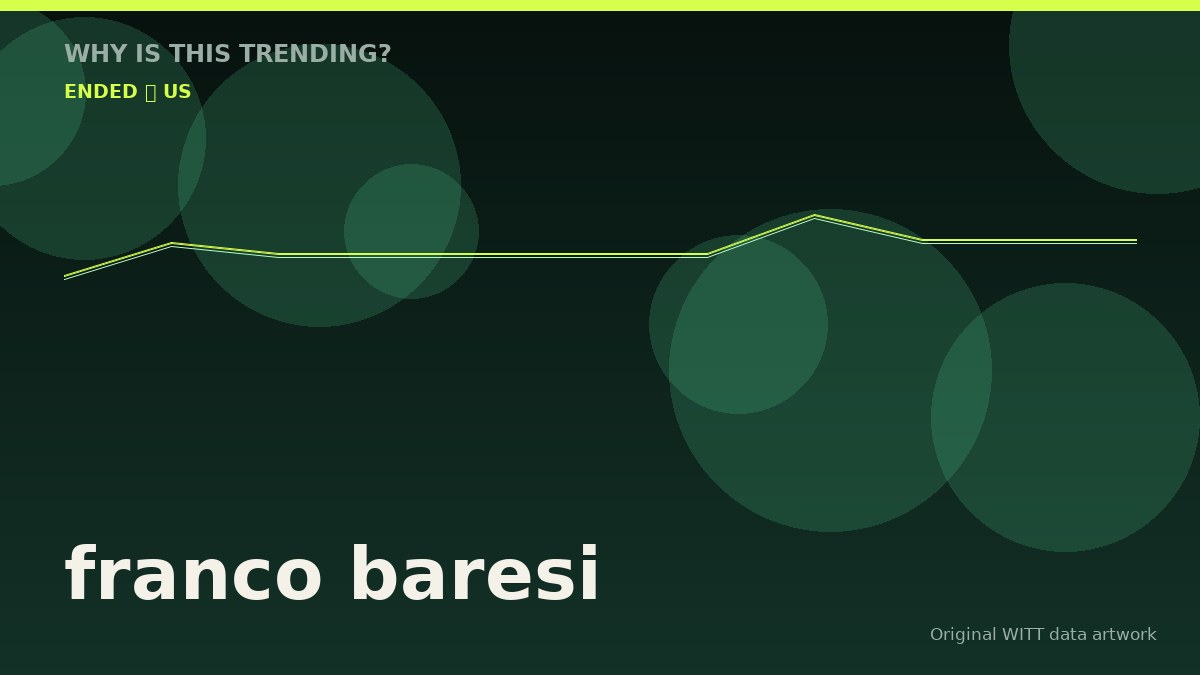
In trend-forensics terms, this viral spike illustrates a hazardous intersection: a vulnerable public context colliding with algorithmic and professional incentives that prioritize velocity over verification. While search engine data tracks a massive surge in user curiosity, this spike reflects public reaction to breaking news rather than any underlying shift in reality. Baresi was alive, navigating a delicate personal health recovery.
The speed at which the rumor traveled highlights a broader structural vulnerability in how news is consumed today. When a prominent figure occupies a revered place in sports history—having played 719 matches for Milan, won six scudetti, three European Cups, and the 1982 World Cup—any announcement regarding their wellbeing commands instantaneous attention. Unscrupulous platforms and automated aggregators recognize this dynamic, turning collective reverence into an opportunity for rapid-fire engagement capture.
As the digital landscape evolves, the barrier to entry for publishing breaking claims has dropped to zero. Automated content scrapers and unverified social media profiles now interact in a closed loop, where a single fabricated post can trigger cascading automated rewrites across dozens of secondary sites before human editors have time to intervene.
Why the Rumor Felt Plausible to the Public
False narratives do not materialize in a vacuum; they succeed by attaching themselves to believable pre-existing storylines. In February 2026, the Milan club had publicly updated supporters that Baresi was undergoing ongoing medical treatment following a mini-invasive surgery in August 2025 to remove a pulmonary nodule, which was subsequently followed by a course of immunotherapy.
Because followers were already aware that the former captain was facing a complex medical chapter, the fabricated announcement did not sound entirely absurd to casual observers. Malicious or careless actors exploited this transparent medical backdrop, turning a delicate personal situation into raw material for shock value. This context acts as a force multiplier for misinformation: when an audience already knows an individual is vulnerable, they are statistically far less likely to question a sudden tragedy.
The timeline shows how quickly the rumor locked in before institutional actors could intervene. The false notice appeared late on July 30, and while the club issued prompt categorical denials, the narrative possessed enough momentum to persist across various feeds into July 31. This persistence demonstrates that once a high-emotion rumor achieves initial velocity, corrective statements face an uphill battle against cognitive bias and algorithmic distribution models that reward engagement over accuracy.
Furthermore, public figures who maintain a revered status often become targets because their names reliably drive high-volume traffic. The psychological impact on fans who read these false notices creates a wave of collective grief and confusion that persists even after official retractions are issued.
Signal Versus Noise in Modern Digital Publishing
Analysis of commentary from outlets covering the incident points directly to structural flaws in digital information ecosystems. Commentators noted that modern publishing incentives foster an uninhibited race to be first, where outlets prioritize immediate traffic acquisition over foundational journalistic checks like calling primary sources.
- The Noise: Viral social media posts, unverified memorial tributes, and reactionary headlines designed to capture algorithmic distribution before facts are confirmed.
- The Signal: Official club disavowals, direct statements regarding privacy, and deliberate pauses by credible newsrooms choosing verification over speed.
When false information drops into this environment, it holds an asymmetrical advantage. As IlFaroOnline observed, falsehoods travel swiftly because they weaponize shock and emotional surprise, leaving institutional denials struggling to catch up once the narrative has already embedded itself into private messaging channels.
Ultimately, readers navigating sudden breaking news spikes involving sensitive health topics must separate emotional resonance from verified data. The surge in attention around Baresi was a product of reckless digital publishing exploiting a genuine medical context, reminding audiences that speed in journalism is frequently an enemy of truth. Responsible information consumption requires cultivating a healthy skepticism toward unverified social media announcements, particularly when those announcements touch upon vulnerable personal health narratives.