Decoding the July 29 Search Spike
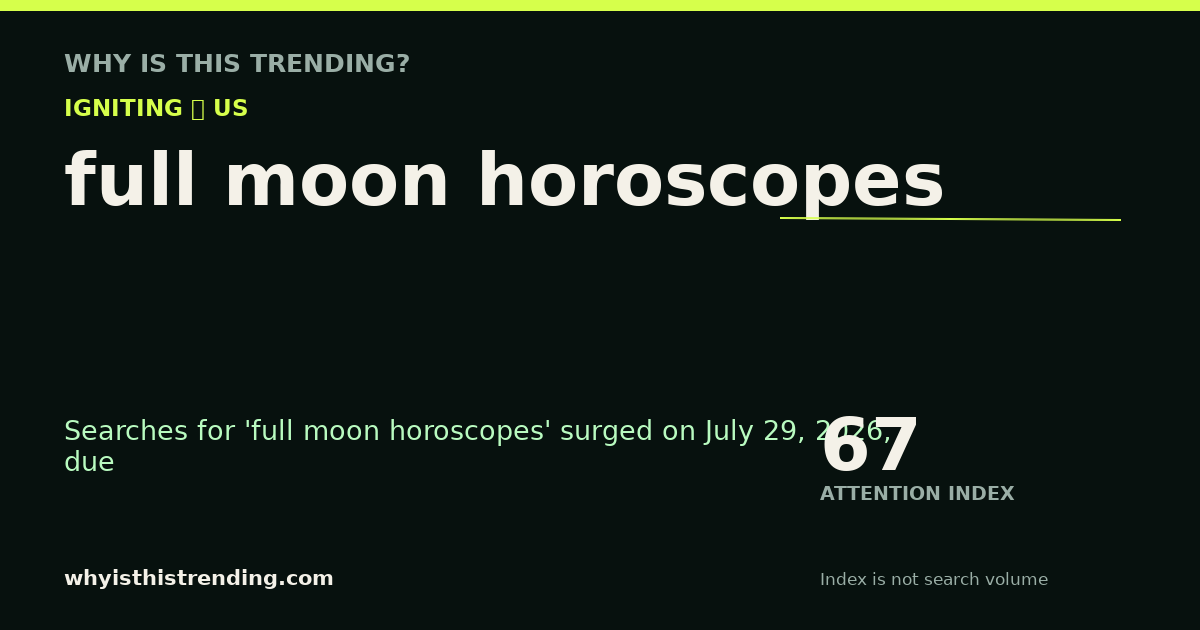
When internet search traffic pivots sharply toward astrological content, it rarely happens in a vacuum. On July 29, 2026, Google Trends recorded a distinct surge in attention for full moon horoscopes
as reported by TODAY.com. This spike was not a random anomaly; it was the direct byproduct of a crowded celestial and cultural calendar that gave lifestyle publishers, spiritual commentators, and daily horoscope writers a unified hook.
At the center of this attention mechanism lies a classic convergence of nomenclature, traditional observance, and synchronized media publishing. By examining how these elements overlapped, we can separate the actual cultural drivers—the signal—from the routine churn of daily search optimization—the noise. Google Trends records relative shifts in query volume, but it is vital to remember that these metrics reflect public curiosity rather than proving any direct causal link between planetary movements and human behavior.
The Signal: Names, Moons, and Cultural Moments
Three primary factors collided on July 29 to pull readers toward astrological guidance:
- The Buck Moon Moniker: Following historical naming conventions popularized by the Old Farmer's Almanac, July's lunar peak is widely recognized as the Buck Moon, named because male deer antlers reach full growth during this period according to TODAY.com. Other Indigenous traditions similarly reference the period through seasonal changes, such as the Cree's Feather Moulting Moon and the Tlingit's Salmon Moon noted by AOL.com.
- The Aquarius Full Moon: Astrologically, the lunar peak occurred in the sign of Aquarius, sitting opposite a powerful Sun-Jupiter alignment in Leo as detailed by Saffarazzi. Horoscope writers framed this air-sign energy as an invitation to evaluate community, independence, and personal growth.
- Guru Purnima Convergence: In Vedic tradition, the date coincided with Guru Purnima, a sacred full moon dedicated to expressing gratitude toward teachers, mentors, and spiritual guides noted by The Economic Times.
This multi-layered significance provided a rare narrative bridge connecting traditional astronomy, Indigenous seasonal naming, and Eastern spiritual observances into a single digestible media package.
Publisher Synchronization and Audience Response
The spike in search interest was heavily amplified by institutional momentum. Major international outlets—including TODAY.com, The Economic Times, VICE, Saffarazzi, AOL, and Vogue India—simultaneously deployed targeted astrological breakdowns, zodiac forecasts, and ritual advice [1], [2], [3], [4], [5], [6].
When prominent lifestyle platforms coordinate their publishing schedules around a specific lunar calendar date, they create an echo chamber of search intent. Readers encountering morning newsletters, social media feeds, and search aggregators all referencing the Buck Moon and Aquarius horoscopes naturally turned to search engines to find personalized readings for their specific zodiac signs. Astrologers featured across these platforms highlighted the air sign's communicative energy, advising readers to use words, writing, and community gatherings to harness the moment as explained by celebrity astrologer Kyle Thomas.
Signal Versus Noise
It is important to distinguish between organic curiosity and manufactured trend loops. Google Trends records changes in query volume; it does not measure scientific cause or validate astrological claims. The underlying driver of the July 29 spike was media saturation fueled by a calendar rich in overlapping cultural touchstones. While skywatchers looked toward the southeast after sunset to view the physical moon as outlined by the Old Farmer's Almanac, digital audiences sought out structured frameworks to make sense of the emotional intensity commonly attributed to full moon cycles.
For readers navigating these recurring astrological spikes, the most useful takeaway is recognizing how media timing shapes internet behavior. When multiple cultural traditions and lifestyle publications highlight the same calendar day, search interest inevitably follows. Understanding this mechanism allows readers to appreciate the rich history of lunar naming traditions and spiritual celebrations without mistaking a coordinated publishing cycle for an objective scientific phenomenon.