Decoding the Surge in Interest
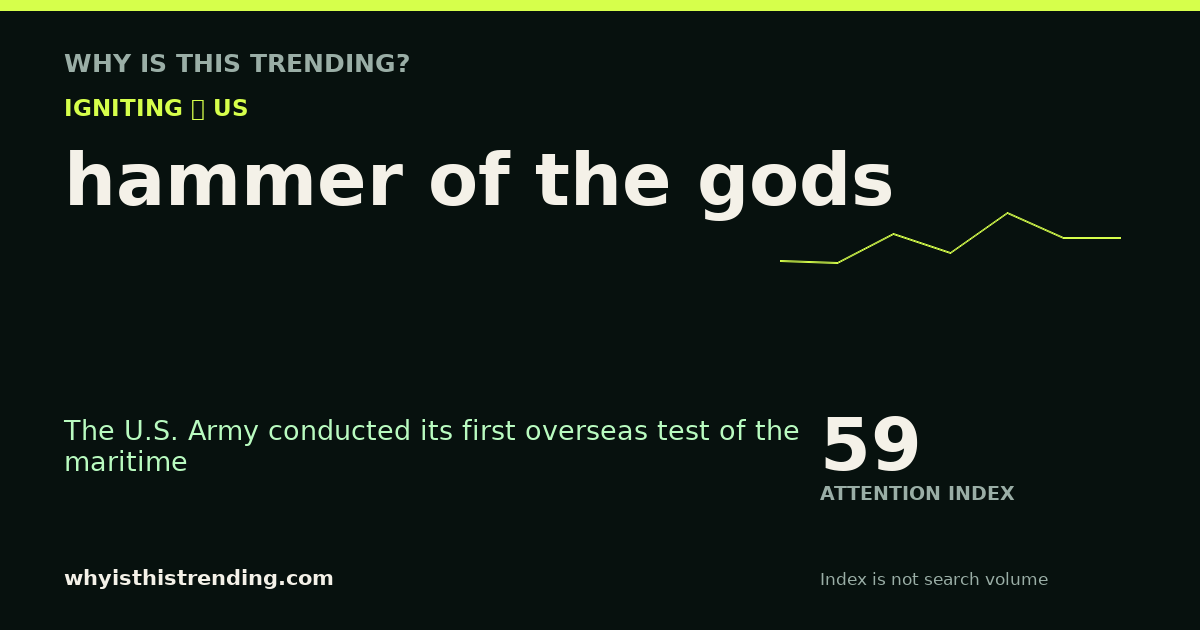
When public curiosity spikes around an unfamiliar military moniker like Hammer of the Gods, it is easy for online speculation to outpace verified facts. Google Trends recorded a sharp increase in public inquiries beginning July 30, 2026, perfectly mirroring the official public disclosure of a high-stakes military experiment as reported by Fox News. Rather than a sudden fictional or cultural phenomenon, the attention surge stems directly from concrete defense reporting detailing the first overseas deployment of a specialized electronic warfare capability.
The public relations and operational announcements surrounding this test have given observers a rare glimpse into modern electronic warfare development. By cutting through the noise of unrelated online chatter, analysts can examine what this deployment actually represents: a deliberate operational stress test of America's evolving electronic counter-measures in contested operational environments where command of the electromagnetic spectrum is paramount.
Inside the Maritime Test of Project Convergence Capstone 6
The core of the recent revelation centers on a mid-July 2026 exercise conducted off the U.S. West Coast as detailed in defense coverage. Operating under the umbrella of Project Convergence Capstone 6, the U.S. Army, Navy, and Space Force joined forces to evaluate how cutting-edge technology performs when integrated across space, cyber, and conventional domains. This multi-service collaboration highlights a modern push toward joint-force interoperability, blending tactical hardware with broader strategic defense architectures.
While land-based variants of the system had undergone demonstrations over the preceding two years, the mid-July exercise marked the official operational debut of the sea-based maritime variant according to official military disclosures. Visual documentation from the exercise captured personnel actively employing the equipment in coastal waters, proving that the hardware can be successfully launched, operated, and recovered in challenging maritime environments.
Understanding Counter-PNT Technology
To understand why military planners care about the Hammer of the Gods system, one must look at how modern precision weaponry operates. Contemporary advanced munitions—including long-range artillery, guided missiles, and cruise missiles—rely heavily on positioning, navigation, and timing (PNT) signals, most notably GPS data, to pinpoint and destroy targets with exact accuracy.
The Hammer of the Gods is an electronic counter-PNT system specifically engineered to disrupt these vital data streams:
- Signal Disruption: The portable signal emitter jams and scrambles GPS and PNT data, severely degrading the accuracy of enemy precision-guided weapons and forcing adversaries into mission delays or missed targets.
- Degraded Environment Resilience: Beyond blinding adversaries, the system establishes a resilient communications network for friendly forces, linking military devices together so personnel can continue to operate seamlessly.
- Operational Mobility: Designed to function smoothly in real-world maritime conditions, it ensures that troops can maintain the ability to shoot, move, and communicate despite heavy electronic interference.
By denying adversaries reliable PNT data, the system aims to cause missed targets and delayed missions, fundamentally altering the tactical math of modern long-range combat as military officials outlined.
Signal Versus Noise in the Current Landscape
When tracking trending topics, separating genuine defense developments from unrelated digital noise is vital. For instance, concurrent sports news cycles frequently reference unrelated uses of the term Hammers—such as football transfer discussions surrounding West Ham United—which can occasionally muddy algorithmic search results as seen in sports reporting. Similarly, intense ongoing coverage of international kinetic strikes and missile attacks dominates separate global news feeds, creating a complex web of defense-related information spanning different geographic theatres. However, the distinct spike in search interest for the specific phrase matches precisely with the dissemination of the Army's maritime test data.
It is equally important to contextualize what search trends can and cannot prove. Google Trends data reflects shifting public curiosity and media consumption; it does not measure absolute search volume, nor does it serve as proof of broader strategic outcomes or geopolitical causation. What is clear, however, is that the public release of the Hammer of the Gods maritime debut has successfully captured widespread attention, highlighting the military's ongoing pivot toward advanced electronic and electromagnetic warfare capabilities.