Decoding the Sudden Surge in Interest
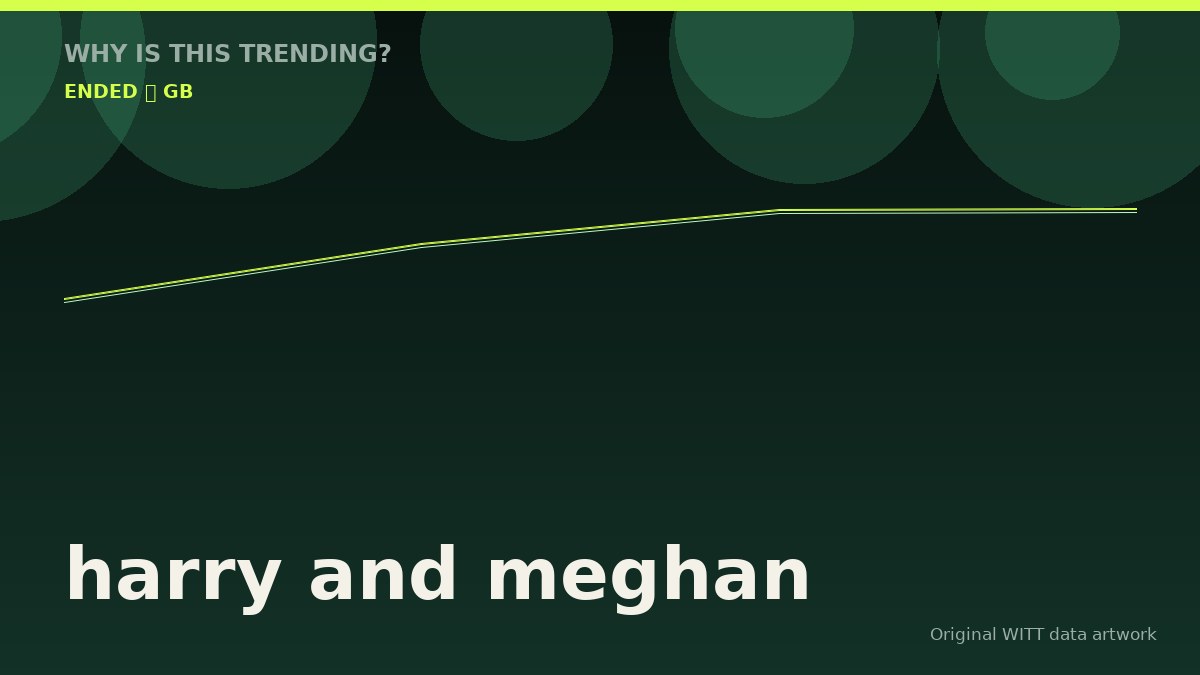
Google Trends data registers a sharp upward trajectory in searches for "Harry and Meghan" beginning late on August 19, 2026. This sudden spike in digital curiosity was catalyzed by contemporaneous media reports breaking the news that the Duke and Duchess of Sussex intend to return to Britain for an extended period, bringing their children, Prince Archie and Princess Lilibet, with them to enroll in a British school (Page Six). For trend-forensics observers, this represents a classic institutional trigger: a major, unexpected lifestyle shift from high-profile figures that immediately upends years of established narrative status quo.
When public figures who have defined a multi-year epoch of cultural debate—such as the Sussexes' 2020 departure to California—suddenly reverse or modify their geographic footprint, public attention naturally accelerates. The digital reaction reflects not just casual curiosity, but a fundamental reassessment of what the next chapter holds for the family, crossing boundaries between celebrity culture, institutional history, and international media coverage. As algorithms ingest the breaking headlines, audiences worldwide immediately look for verification of what a cross-Atlantic return actually entails for a family whose every logistical choice carries immense symbolic weight.
Separating Signal From Noise in the News Cycle
In moments of high-velocity news cycles, the gap between verified fact and speculative commentary widens rapidly. Understanding why this story captures widespread attention requires filtering out the noise to examine the verified operational facts:
- The Signal: Prince Harry and Meghan Markle are scheduled to move back to the UK at the end of August 2026, and their children, Prince Archie and Princess Lilibet, will be enrolled in a British school (Nine.com.au). King Charles was informed of these plans ahead of the public disclosure.
- The Noise: Widespread speculation regarding official reconciliations, institutional roles, or precise real estate transactions. Early reports explicitly clarify that the couple will reside in a non-royal, private residence and will not return as working members of the royal family.
Much of the early commentary attempts to frame this transition through the lens of institutional duty and royal reconciliation. However, the core mechanics of the announcement point firmly toward a personal and family-oriented repositioning, with the couple intending to maintain their business enterprises and continue splitting time internationally rather than stepping back into traditional court functions.
Contextualizing the Shift After Six Years
To fully grasp why this moment resonates so deeply across digital platforms, we must look back at the architecture of their departure. In January 2020, the couple announced their intention to step back as senior members of the royal family, seeking financial independence and establishing a base in North America. At the time, they articulated a vision of balancing their time between the United Kingdom and North America while carving out a progressive new role. For six years, however, the dominant narrative has been anchored firmly across the Atlantic, punctuated by intermittent visits, legal battles, and ongoing media commentary.
Now, the impending enrollment of Prince Archie and Princess Lilibet in a UK school marks a concrete operational change in how the family structures its daily life. While reports indicate they will retain their home in Montecito, California, the shift toward an extended British residency bridges a geographic divide that has defined their public identity for over half a decade. This physical relocation introduces an entirely new logistical framework for a family whose private choices remain intensely scrutinized by global audiences seeking clues about their long-term trajectory.
A Defensible Perspective on the Trend
The attention surrounding this announcement is sustained by the sheer narrative whiplash of a return after years of physical and institutional separation. Observers should view this development through a pragmatic lens: it is a logistical and familial relocation, rather than an institutional reinstatement or a retreat back into the royal fold. As the family transitions back to Britain within the coming weeks, public fascination will likely remain high as observers look for signs of how this dual-continent lifestyle functions in practice. Rather than signaling a permanent undoing of their 2020 exit, the move underscores a calculated, independent effort to manage family and business interests across multiple jurisdictions on their own terms.