The Anatomy of a Search Spike
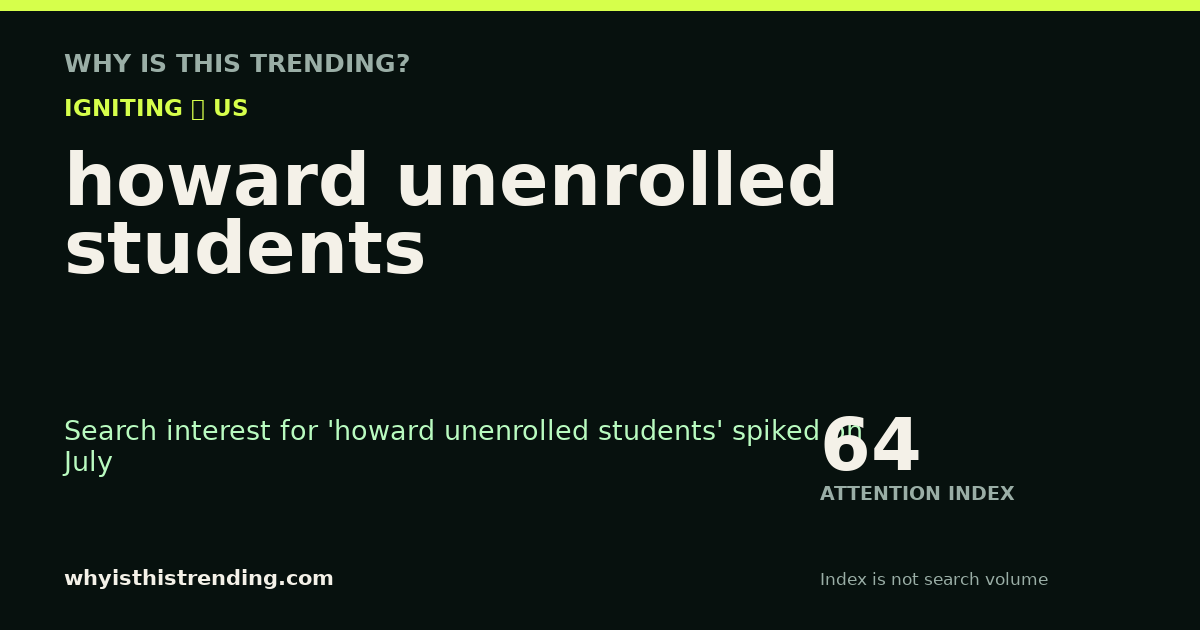
On July 23, 2026, the digital footprint surrounding Howard University shifted abruptly. At 16:10 UTC, the university released an official statement via The Dig, its internal newsroom, addressing a difficult reality for a segment of its incoming class: the withdrawal of enrollment spots for first-time-in-college students who had failed to meet critical administrative deadlines. By 23:40 UTC, search interest for the query howard unenrolled students
reached its peak, demonstrating a near-instantaneous correlation between the university’s public disclosure and the information-seeking behavior of the affected community.
This spike is a classic example of an information-gap surge. When an institution releases high-stakes news that impacts individual futures—in this case, the ability to attend university for the fall 2026 semester—the affected parties immediately turn to search engines to validate rumors, find official guidance, or seek a path to resolution. The term unenrolled
became the shorthand for a complex administrative process, serving as the primary anchor for those trying to navigate the university's decision.
Contextualizing the Administrative Move
To understand the intensity of the reaction, one must look at the administrative pressure points identified in the university's July 23 media release. Howard University noted that the decision to withdraw spots was not a sudden act, but the culmination of a months-long notification process. Throughout March, April, May, June, and July, the university utilized emails, personalized financial aid data, and Bison Prep sessions
to communicate the necessity of finalizing tuition payments, payment plans, and scholarship reporting.
The university framed the decision as a logistical necessity. With the fall semester beginning August 17, 2026, the administration emphasized that confirming enrollment is essential for the planning academic programs, housing, financial aid, and student support services.
By the time the public announcement was made, the university had reached a point where it could no longer hold spots for students who remained non-compliant with these established requirements.
Signal vs. Noise: Disentangling the Trends
In the digital landscape, it is common for unrelated events to occur simultaneously, creating a noisy environment for analysts. In this instance, several other stories involving the name Howard
circulated in the days leading up to the July 23 spike, yet they remain distinct from the enrollment trend:
- Corporate Partnerships: On July 22, HBCU Gameday reported that Howard University Athletics entered a multi-year sponsorship with McDonald’s. This is a positive institutional development and bears no relationship to the enrollment administrative updates.
- Local Legal Matters: A separate report from July 21 regarding a lawsuit involving the Howard County Board of Education in Maryland created regional search interest, but this is geographically and organizationally separate from the university in Washington, D.C.
- Broader Educational Research: Studies regarding dual enrollment, such as those published by the Annenberg Institute, often generate academic discussion, but they do not account for the specific, time-sensitive search behavior observed on July 23.
The signal here is clear: the search spike was driven exclusively by the university's direct communication to its incoming students. The public's focus was not on athletics or unrelated legal disputes, but on the immediate, personal impact of the enrollment status update.
Navigating the Aftermath
For those caught in the wake of this announcement, the university designated specific channels for resolution. The Office of Enrollment Management was established as the primary point of contact for status inquiries, while the Office of Financial Aid and the Office of the Bursar were tasked with handling specific questions regarding scholarship funding and account balances. The university’s statement acknowledged that some students with pending outside scholarships
may have been unfairly impacted, signaling a willingness to review individual circumstances where appropriate.
Key Takeaway: When institutions communicate high-stakes changes, the speed of the public's search response is a direct reflection of the perceived urgency of the news. For students and families, the unenrolled
status was not just a bureaucratic label; it was a signal to act immediately. The trend serves as a reminder that in the age of instant information, the clarity and accessibility of an institution’s follow-up communication are just as critical as the initial announcement itself.