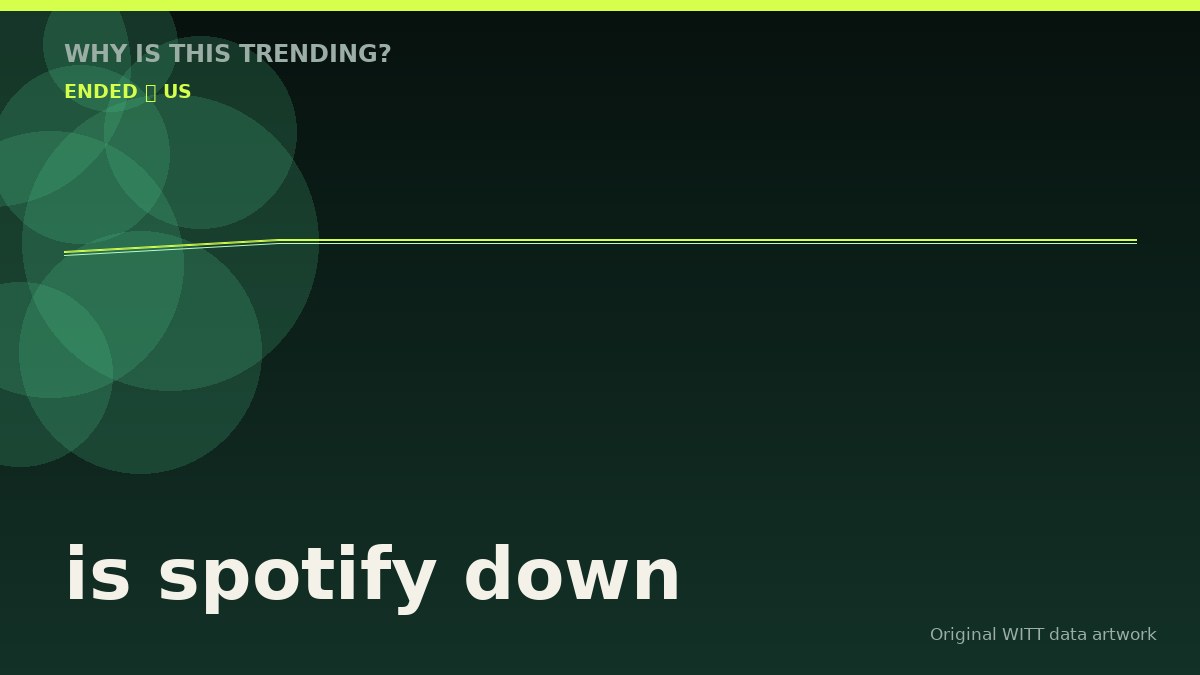
Decoding the Sudden Spike in Search Interest
When your daily soundtrack abruptly cuts out with a cryptic warning, the modern reflex is immediate: head straight to a search engine to ask is spotify down
. That exact pattern played out when Google Trends recorded a significant increase in search interest for is spotify down
starting at . Users flooded tracking platforms, support forums, and social channels as audio streaming stalled and questions mounted across active communities.
Yet, understanding these attention spikes requires looking past raw panic. While search volume trends and user-submitted outage maps offer a real-time pulse of community frustration, they do not automatically point to a catastrophic global platform failure. Dissecting the exact timing and error codes reveals a much more nuanced picture of regional technical friction rather than a worldwide blackout, helping listeners avoid unnecessary troubleshooting steps while back-end engineers work toward a resolution.
What Actually Happened on July 27
The disturbance was far from a uniform, global collapse. Spotify experienced a regional service disruption on July 27, 2026, affecting users in the Asia region with Something went wrong
or Page not available
errors, according to ongoing platform disclosures published by the Cincinnati Enquirer.
Concurrently, broader user reports of Spotify outages peaked on July 27, 2026, accompanied by error messages including Spotify can't play this right now
alongside frustrating audio streaming interruptions. Thousands of listeners encountered playback drops, app freezes, and website loading blocks during the afternoon hours, as detailed by the Asbury Park Press. But because these issues clustered heavily in specific geographies and touched different access points—such as web players versus desktop applications—it became clear that localized server routing and endpoint synchronization were to blame rather than a universal system wipeout.
In some instances, external applications and third-party software integrations have encountered name-resolution difficulties when attempting to reach backend partner endpoints, demonstrating how localized network blocks, DNS translation hiccups, or API authentication timeouts can occasionally mimic a major platform outage for specific user bases.
Signal Versus Noise: Differentiating Outages from Local Glitches
When troubleshooting streaming anomalies, it helps to separate widespread server hiccups from everyday device quirks. A sudden logout, a skipped track, or an unexpected authentication prompt can easily be mistaken for a server crash, but the root cause is frequently local to your device, browser cache, or home network configuration.
Spotify's automated session management is built to protect user security, meaning automated logouts and re-authentication prompts frequently trigger after periods of inactivity or when device synchronization fails. Understanding what is actually happening requires evaluating several distinct operational indicators:
- Error specificity: Genuine platform-wide outages typically generate specific error codes or widespread region-locked notices rather than isolated browser cache failures or single-device login loops.
- Device-wide behavior: If an error manifests on only one device while your mobile phone or desktop loads the service perfectly, the bottleneck is likely local cache corruption, an outdated app version, or a home network DNS hiccup.
- Ecosystem integration: Third-party software integrations—such as external hardware controllers or cross-platform apps attempting to reach backend partner endpoints—can occasionally throw connection errors that mimic a main service outage without affecting the standalone application.
Recognizing these boundaries ensures that users do not spend hours resetting routers or reinstalling software when the underlying problem is simply a temporary regional server adjustment managed cleanly by the platform provider.
Navigating Future Service Disruptions
Spikes in search engine interest tell us when people are looking for answers, but they remain separate from direct proof of a permanent or total network failure. When an error message disrupts your listening session, checking official status trackers and observing whether mobile data bypasses a home Wi-Fi block will quickly clarify whether you are waiting out a regional server repair or simply need to clear your local app cache.
Ultimately, modern streaming ecosystems rely on vast webs of microservices, content delivery networks, and regional cloud routing. When a single node encounters friction, the ripple effect triggers thousands of automated reports and sends search traffic soaring. By keeping a cool head, verifying error text against official company advisories, and testing secondary devices, listeners can safely navigate these temporary turbulence windows without missing a beat.