The Anatomy of an Instantaneous News Surge
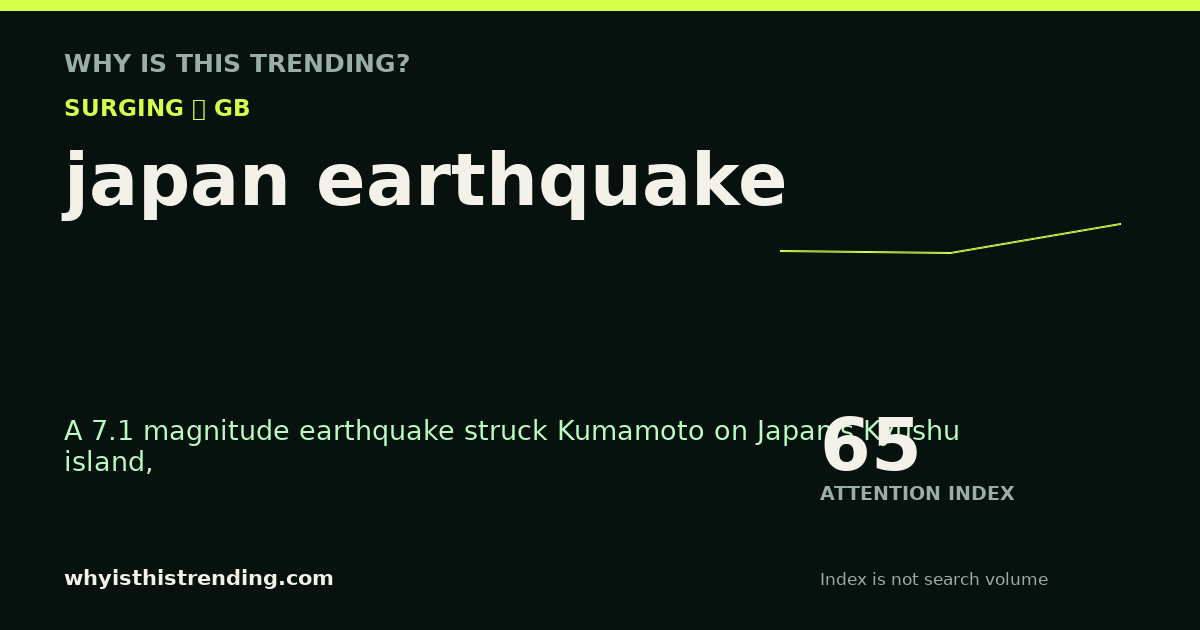
When a natural disaster strikes a nation with as robust an emergency infrastructure as Japan, the information loop moves at incredible speed. Attention surged globally following reports that a powerful earthquake had struck the southern Japanese island of Kyushu as detailed by the Daily Mirror. Rather than a slow-build narrative, this trend ignited because multiple high-urgency thresholds were crossed simultaneously: a preliminary magnitude of 7.1, a maximum Shindo shaking intensity scale rating, an official tsunami advisory, and immediate political mobilization.
It is crucial to distinguish between raw digital attention and physical causation. The spike in digital searches and social media engagement reflects public anxiety, a search for real-time safety updates, and international monitoring of the unfolding events—not the underlying tectonic forces themselves. Search-engine interest tracks human reaction and institutional warnings, providing a window into how modern populations consume crisis information, while Google Trends attention data highlights the sheer velocity at which breaking disaster coverage ripples across international borders.
Furthermore, understanding this attention cycle requires looking at how media ecosystems amplify regional events. Because modern communication networks transmit breaking alerts within seconds, a localized tremor in Kumamoto instantly reverberates through international news feeds, prompting anxious queries from observers worldwide who look to official channels for confirmation and guidance.
What Actually Happened on the Ground
The Japan Meteorological Agency recorded the temblor striking Kumamoto prefecture at a shallow depth of 10 kilometers (CBS News reporting notes the 7.1 magnitude). The shaking reached the maximum possible level of seven on Japan's rigorous Shindo scale in heavily impacted areas. In response, the Japan Meteorological Agency issued a tsunami advisory for nearby coastal areas, specifically targeting Ariake bay and the Yatsushiro seas to warn residents of incoming waves.
The human and logistical footprint of the quake was felt immediately across Kyushu and beyond, altering daily routines and triggering contingency plans:
- Tsunami Advisory: Authorities warned residents to stay away from the coastline anticipating waves of up to 1 meter (3 feet), prompting swift coastal evacuation notices.
- Government Mobilization: Prime Minister Sanae Takaichi urged citizens via social media to prioritize safety and avoid coastal zones while a dedicated task force was established (AP News notes the prime minister's directive).
- Infrastructure Disruption: Approximately 45,600 households in Kumamoto Prefecture lost electricity, and transport operators such as JR Kyushu suspended high-speed Shinkansen services to inspect tracks.
- Regional Reach: The tremors crossed national boundaries, with authorities in the southeastern port city of Busan, South Korea, reporting numerous phone calls from residents feeling the shaking and prompting local evacuations.
Despite the violence of the shaking, initial safety checks brought reassuring news regarding critical infrastructure. Japan’s Nuclear Regulation Authority and regional operators confirmed that no abnormalities or irregularities were detected at nearby nuclear power facilities, including the Sendai and Genkai power stations.
Historical Echoes and Public Memory
Part of what intensifies public reaction to events in Kumamoto is the heavy shadow of recent history. The region was struck by devastating earthquakes a decade prior in April 2016, which resulted in extensive structural damage and loss of life. Landmarks like the 17th-century Kumamoto Castle suffered severe blows during those prior events, with long-term restoration projects scheduled decades into the future. When a magnitude 7.1 tremor hits the exact same prefecture, it naturally reawakens collective trauma and heightens public sensitivity to every aftershock warning.
This deep-seated historical vulnerability ensures that any significant seismic shift in Kumamoto commands immediate institutional and public respect. Emergency drills, rigorous building codes, and rapid public messaging systems are continually tested by these sudden natural stress tests.
We are putting people's lives as the top priority.
Prime Minister Sanae Takaichi
For readers monitoring developments, international authorities such as the US Pacific Tsunami Warning Center confirmed there was no wider tsunami threat beyond local Japanese coasts. However, with local officials warning of potential strong aftershocks, ongoing vigilance remains paramount for anyone operating within or tracking conditions across the affected prefectures.