A Strategic Pivot Toward the Center
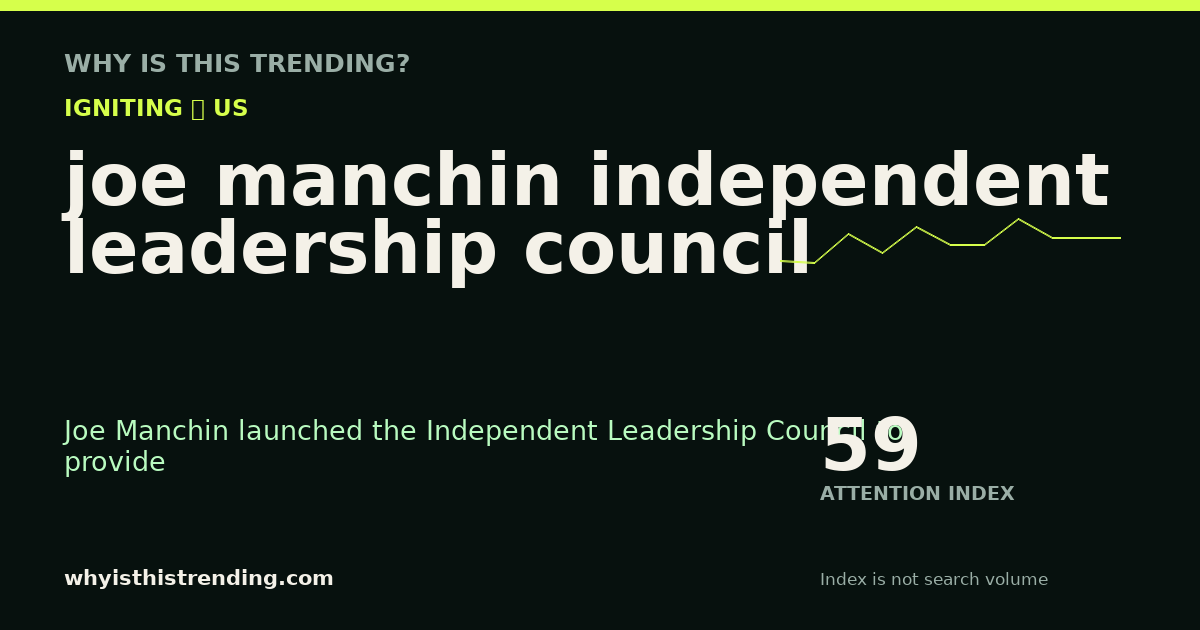
On July 24, 2026, former Senator Joe Manchin announced the formation of the Independent Leadership Council, a new political entity designed to support independent candidates in competitive congressional races. Unlike traditional efforts that aim to establish a formal third party, Manchin has explicitly framed this initiative as a movement to build a true independent network
that pulls the political spectrum toward the center. By combining the resources of his daughter Heather Manchin’s organization, Americans Together, with the Independent PAC led by Adam Brandon, the council is positioning itself as a pragmatic, donor-backed alternative to the current binary system.
The timing of this launch is not incidental. It follows a period of intense ideological strain within the Democratic Party, particularly regarding policy toward Israel. This friction has provided a backdrop for high-profile speculation about the loyalty of sitting lawmakers, most notably Senator John Fetterman. Manchin’s public encouragement for Fetterman to set yourself free and become an independent
underscores the council’s broader goal: to normalize the idea of independent candidacy for legislators who feel alienated by their party’s shifting ideological boundaries.
The Fetterman Factor and Party Realignment
The emergence of the Independent Leadership Council serves as a structural response to the growing vulnerability of the two-party establishment. Senator Fetterman’s recent actions—including his launch of the Common Ground PA joint fundraising committee with Republican Senator Dave McCormick and his vocal concerns that the Democratic Party might become anti-Israel
—have turned him into a symbol of the very political instability Manchin seeks to harness. While Fetterman has not yet left the Democratic Party, the mere possibility has created a fertile environment for Manchin’s pitch.
This is not merely about one senator; it is about the mechanics of the 2026 election cycle. The council is focusing its initial efforts on competitive seats, prioritizing winnable races where an independent candidate might act as a spoiler or a bridge-builder. By targeting these specific contests, Manchin is attempting to prove that a centrist, independent path is a viable electoral strategy rather than a symbolic protest vote.
| Factor | Significance |
|---|---|
| Strategic Focus | Prioritizing competitive congressional seats to maximize electoral impact. |
| Institutional Support | Merging Americans Together and Independent PAC to provide immediate financial and tactical resources. |
| Ideological Vacuum | Capitalizing on centrist dissatisfaction with perceived polarization in both parties. |
| Legislative Precedent | Leveraging the public discourse surrounding Senator Fetterman’s potential party switch. |
Signal Versus Noise
For observers, it is critical to distinguish between the noise of political theater and the signal of genuine infrastructure building. The launch of the council is a concrete organizational step. By hosting donors and strategists in West Virginia to discuss candidate support, Manchin is moving beyond rhetoric and into the realm of professional campaign management. This distinguishes his effort from the many short-lived, personality-driven third-party movements that have historically struggled to gain traction in the U.S.
However, the challenge remains significant. The American political system is heavily optimized for two-party dominance, from ballot access laws to the Senate’s internal procedural hurdles. Manchin’s council is not trying to dismantle this system but to navigate it by finding candidates who can operate within the gaps. Whether this movement can actually secure seats in Congress—or if it will simply serve as a pressure valve for frustrated politicians—remains the central question of the 2026 cycle.
The Path Forward
As the August recess approaches, the political environment in Washington is increasingly volatile. With Senate leadership currently embroiled in disputes over the SAVE America Act and other legislative priorities, the appetite for alternatives to the status quo may grow. Manchin’s council is betting that the exhaustion felt by voters and lawmakers alike will translate into support for candidates who prioritize institutional stability over party orthodoxy.
The council’s success will likely be measured by its ability to recruit candidates who possess both the name recognition to be competitive and the ideological flexibility to avoid being pigeonholed by either party. For now, the council represents a deliberate, well-funded attempt to test the limits of independent politics in a polarized era. Readers should monitor the council’s candidate endorsements in the coming weeks to determine if this initiative is gaining momentum or if it remains a niche project confined to the fringes of the political establishment.