Unpacking the Attention Mechanism
When public figures from decades past suddenly re-enter the contemporary discourse, it is rarely by accident or organic coincidence. The surge in interest surrounding former England captain Kevin Keegan is a textbook example of manufactured retrospective attention tied directly to a major public institution's milestone programming. On race day for the landmark 45th anniversary of the world's biggest half marathon, official background material, press releases, and broadcast retrospectives highlighted the rich heritage of the Tyneside fixture, explicitly invoking Keegan's inaugural celebrity appearance to anchor modern event coverage [6].
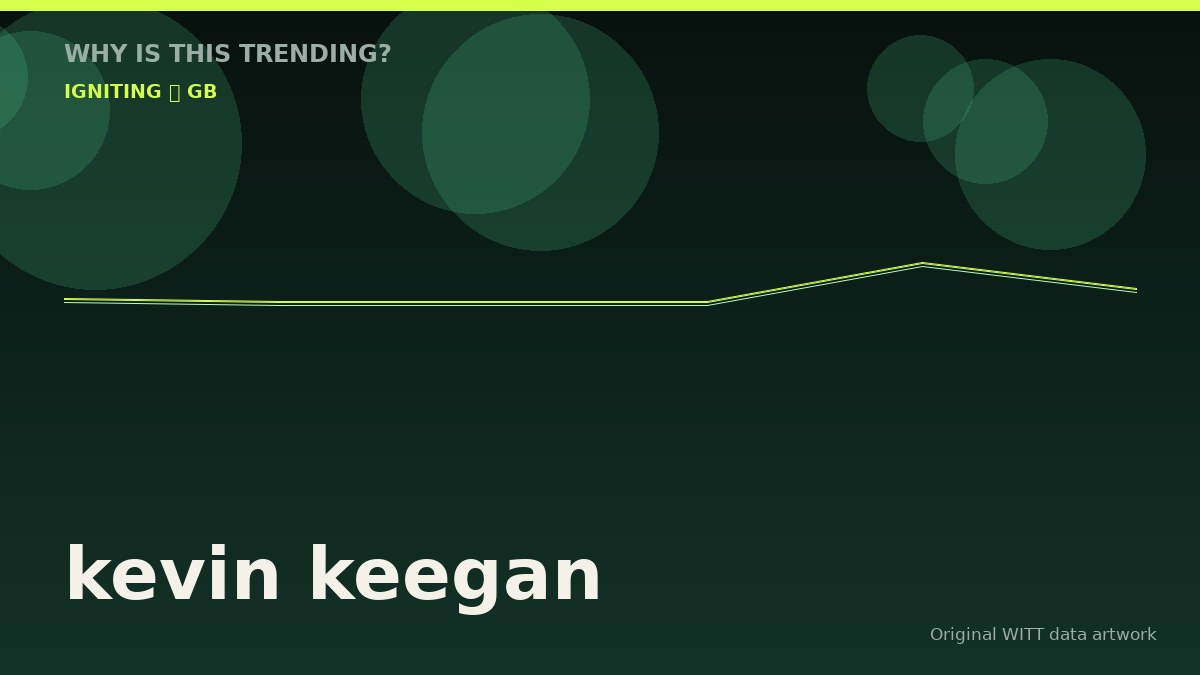
It is crucial to distinguish this driver from direct search intent driven by breaking news, personal announcements, or active competition entries. Google Trends attention measures the relative velocity and acceleration of search queries within a specific geographic area, not absolute search volumes, and it does not serve as direct proof of causation between a historical trivia note and mass public curiosity. Instead, the sudden upward spike represents a classic downstream reaction: event organizers explicitly linked current milestones to past legends in their promotional announcements, prompting curious sports fans and casual observers alike to search for the archival context behind the headlines.
The 1981 Milestone and Regional Symbolism
To understand why Keegan's name carries such enduring weight in this context, one has to look back to the inception of the world-famous Tyneside race. In 1981, Kevin Keegan stepped up as the Great North Run's very first celebrity runner, capturing the imagination of sports fans across the country [6]. In a region famously defined by fierce football tribalism—where local rivalries between clubs like Newcastle United and Sunderland run generations deep [4]—Keegan executed a remarkable gesture by navigating the course wearing a split shirt that represented both North East football institutions [6].
That symbolic act remains a potent piece of North East sporting folklore. Flash forward to the milestone 45th anniversary event, which brought together a record 63,000 runners to tackle the grueling 13.1-mile course stretching from Newcastle across the River Tyne through Gateshead and on to South Shields [1], [2], [6]. To honor that foundational legacy and the spirit of regional pride, race organizers invited Newcastle United club captain and England star Dan Burn to serve as the official starter for the massive field [6].
“Since the first event, we’ve seen countless special moments. Kevin Keegan, as England Captain, was our first celebrity runner back in 1981, running the course in a split shirt representing both Newcastle United and Sunderland FC. It seemed also a fitting tribute to Kevin by inviting Newcastle United, and Dan as current captain, to start the race this year as we remember Kevin’s impact on the game across the region.”
Sir Brendan Foster, Founder of the Great North Run [6]
Signal Versus Noise in Digital Trend Analysis
In modern digital trend analysis, it is exceptionally easy to mistake a nostalgic nod for a hard news development or an unexpected personal update. The genuine signal in this data pattern is the institutional effort by event organizers and sports journalists to connect the historic roots of Tyneside running culture with contemporary sporting icons. By framing the 45th anniversary around past touchstones, they successfully steered public attention toward the event's rich history [6].
Conversely, the noise is any assumption that Keegan himself is personally returning to compete, taking on a physical role in the weekend's events, or making news outside of archival references. He is trending strictly as an architectural pillar of the race's origin story—a piece of living history invoked to contextualize why modern figures like Dan Burn occupy the starter's platform today [6].
As millions of viewers tuned into BBC One coverage or tracked elite fields featuring defending champions and international distance runners [1], the broadcast and digital retrospectives naturally looped in the archives. For casual observers wondering why a decades-old football memory suddenly populated their feeds, the answer lies entirely in the deliberate storytelling of a major regional anniversary designed to unite tens of thousands of runners from city to sea [6].