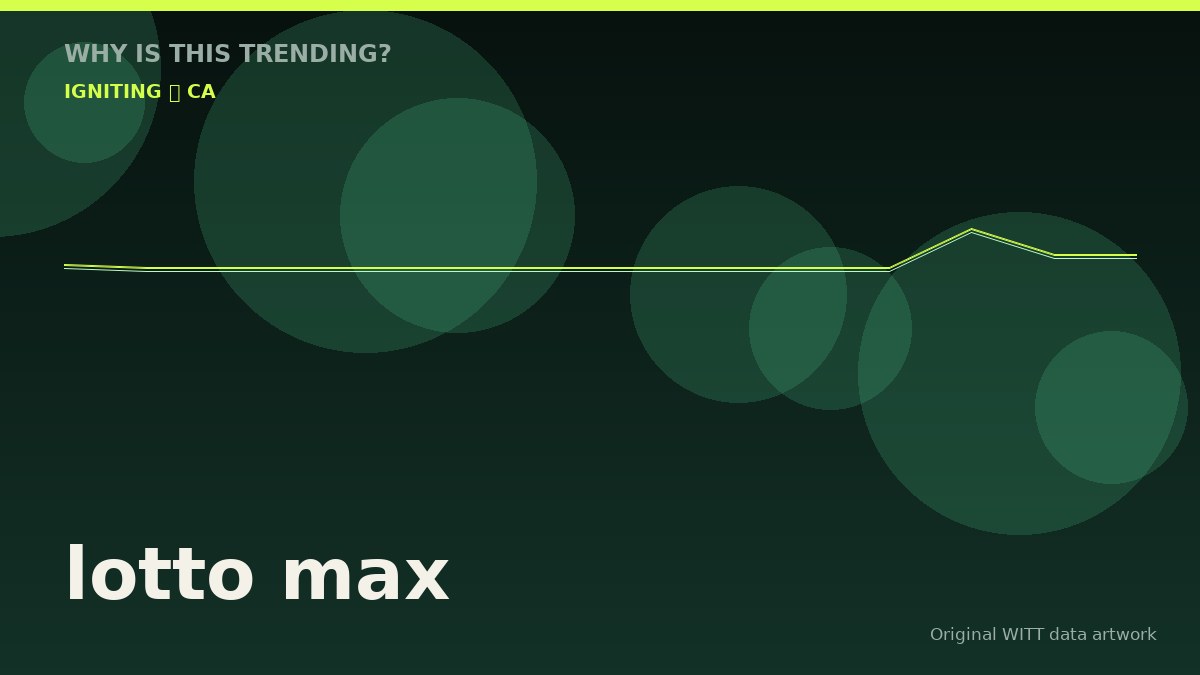
The Anatomy of a $70 Million Surge
When the Tuesday, Sept. 29, 2026 Lotto Max draw concluded without a grand prize winner, the mechanism that reliably captures public imagination kicked into gear as reported by OrilliaMatters.com. The jackpot climbed directly to $70 million for the subsequent Friday, Oct. 2, 2026 draw. In lottery trend mechanics, this ceiling-adjacent figure acts as an immediate attention magnet, shifting casual observers into active participants who might otherwise overlook standard weekly draws.
Beyond the headline jackpot itself, the peripheral prize structure expands proportionally, creating multiple distinct hooks for public engagement. For the Friday draw, the estimated total number of available MaxMillions prizes grew to 10, while MaxPlus prizes expanded to an estimated 70 according to provincial lottery data. This multiplier effect—where players perceive that the entire ecosystem of rewards is swelling simultaneously—underpins the sudden surge in search interest and retail ticket counter traffic across participating provinces.
It is essential to understand that this surge represents shifting public engagement and search-interest momentum rather than any change in mathematical probabilities. The underlying mechanics of national lottery pools dictate that individual odds remain fixed regardless of how many participants flood retail locations or digital platforms ahead of a high-profile draw.
Recent Regional Wins Keep the Conversation Local
While multi-million dollar jackpots pull national focus, the granular details of where tickets are cashed in keep the story alive in local communities. Following the late-September draws, provincial regulators highlighted a flurry of substantial secondary prizes distributed across multiple regions, providing tangible local proof points that sustain public curiosity.
In Ontario, a second-prize ticket worth $111,209.90 was sold in Richmond Hill, while $100,000 MaxPlus tickets were claimed in Brantford, Elgin County, and Simcoe County as detailed by the Ontario Lottery and Gaming Corporation. An additional $100,000 Encore winning ticket was sold in Brampton, compounding the geographic spread of minor and major prizes within a single weekly cycle.
Meanwhile, public excitement extended into Quebec, where CityNews Montreal documented a series of million-dollar claims by three Montreal residents. These accounts included a memorable Lotto Max discovery by a couple who found an unverified ticket from an April 3 draw tucked away inside an old work bag, alongside grand-prize extra claims and guaranteed draws that remind players to thoroughly check neglected pockets, old drawers, and digital accounts.
Signal Versus Noise in Lottery Frenzies
It is easy to misinterpret the mechanics driving public ticket-buying habits during high-jackpot weeks. The noise often surrounds the illusion that past winning locations, retail hot streaks, or personalized lucky numbers
dictate future probabilities. Statistical reality confirms that every single ticket bears the exact same mathematical odds, regardless of whether it was purchased in Simcoe County, Montreal, or via an online portal.
The true signal in this trend is structural: public engagement scales predictably with the absolute size of the annuity pool and the proliferation of secondary million-dollar tiers like MaxMillions and MaxPlus. When media outlets and regional agencies publicize localized wins—ranging from six-figure payouts to forgotten work-bag tickets—they provide visible proof of payout systems functioning in real time, converting abstract odds into relatable local narratives that drive social sharing and word-of-mouth participation.
What to Watch For Next
Attention patterns around major lottery events follow a sharp bell curve that peaks immediately before the evening draw and dissipates shortly after the winning numbers are published. For those holding entries, official channels urge checking tickets promptly through authorized apps or visiting a lottery retailer to ensure no unclaimed prizes slip past validation deadlines. As the $70 million threshold commands widespread public awareness, participation will remain high until the draw closes and the cycle either resets with a new grand-prize winner or rolls forward once more.