Anatomy of a Motorway Standstill
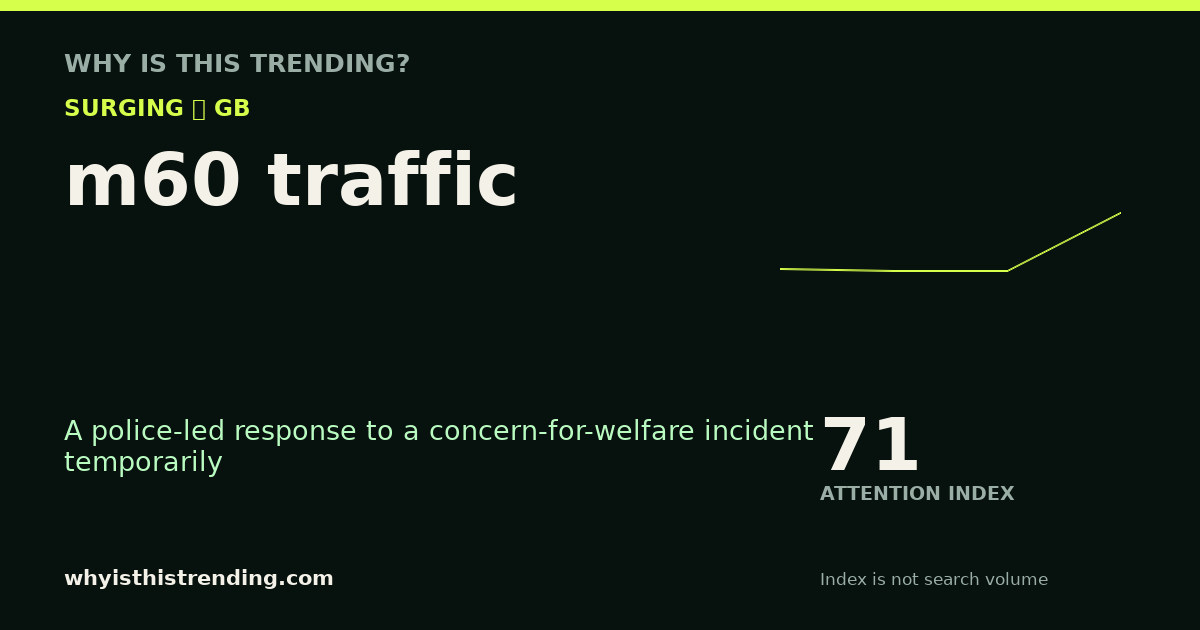
When a major orbital route like the Greater Manchester ring road abruptly freezes, the ripple effects are immediate, systemic, and swiftly mirrored in digital search behavior. On July 25, 2026, motorists traveling clockwise on the M60 faced sudden gridlock when emergency services halted all movement between Junction 22 (Oldham/Failsworth) and Junction 23 (Ashton-under-Lyne) Express.co.uk. Public attention surged sharply as drivers trapped inside the cordoned-off zone shared real-time accounts of a complete traffic stoppage, turning simultaneously to digital mapping apps and breaking news updates to understand why their commutes had evaporated into static queues.
Unlike standard vehicle collisions that typically allow for gradual lane filtering, rubbernecking, or slow crawl speeds, this intervention required a total cessation of movement across all lanes. Greater Manchester Police confirmed that officers were managing a concern for welfare
situation at the location Express.co.uk. Because the response required active engagement across the elevated carriageway and nearby bridge infrastructure, National Highways traffic officers assisted police in maintaining a secure zone while emergency responders managed the sensitive scene Express.co.uk.
As the minutes ticked past, the physical footprint of the backup expanded rapidly, trapping hundreds of vehicles between adjacent interchanges. Traffic officers and regional dispatchers worked in tandem to broadcast warnings, advising motorists to avoid the eastern section of the ring road entirely. Commuters attempting to navigate local alternative paths found themselves caught in secondary bottlenecks as diverted traffic overwhelmed nearby junctions in Oldham, Failsworth, and Ashton-under-Lyne The Sunday Guardian, creating a dual layer of regional disruption.
Managing the Queue: The Logistics of Traffic Reversal
One of the most complex operational challenges during an extended motorway closure is clearing the vehicles trapped directly behind the incident horizon where diversion routes are physically inaccessible. In this instance, traffic authorities and Greater Manchester Police executed a controlled traffic reversal Express.co.uk. Rather than forcing drivers to wait indefinitely in place until the entire incident cleared at the front, officers systematically turned vehicles around from the rear of the backup to safely evacuate stranded motorists off the motorway network Express.co.uk.
This tactical maneuver, while necessary for driver welfare and network relief, underscores the logistical hurdles inherent in high-capacity road networks. Official transport data and live updates captured the full scale of the disruption during its peak operational window:
- Exact Location: M60 clockwise carriageway situated strictly between J22 Oldham and J23 Ashton-under-Lyne Express.co.uk.
- Peak Congestion: Approximately 3 miles of solid tailbacks recorded on the immediate approach Express.co.uk.
- Delay Duration: Queues exceeding 45 minutes for motorists caught near the cordoned area Express.co.uk.
- Resolution Timeline: The police-led incident was successfully resolved, and the M60 officially reopened at 12:53 BST Express.co.uk.
Signal Versus Noise in Transport Disruptions
When sudden travel spikes hit search engines during major incidents like this, it is easy to conflate ordinary commuter frustration with systemic infrastructure failure. However, traffic forensics point to a clear distinction between routine congestion and emergency interventions. The surge in digital attention mapped directly to the active window of the police-led closure and subsided swiftly once National Highways confirmed the reopening of the lanes Express.co.uk.
While residual delays persisted on surrounding local roads as diverted traffic sought alternative paths The Sunday Guardian, the core driver of the online attention—the total standstill of the clockwise M60—ended the moment emergency responders cleared the bridge area. For motorists navigating Greater Manchester, the event served as a stark reminder of how quickly vital transit corridors can transform into managed rescue zones when human safety is on the line. Understanding the mechanics behind these closures helps separate transient emergency responses from permanent structural problems, giving travelers a clearer picture of how regional networks handle unexpected crises.