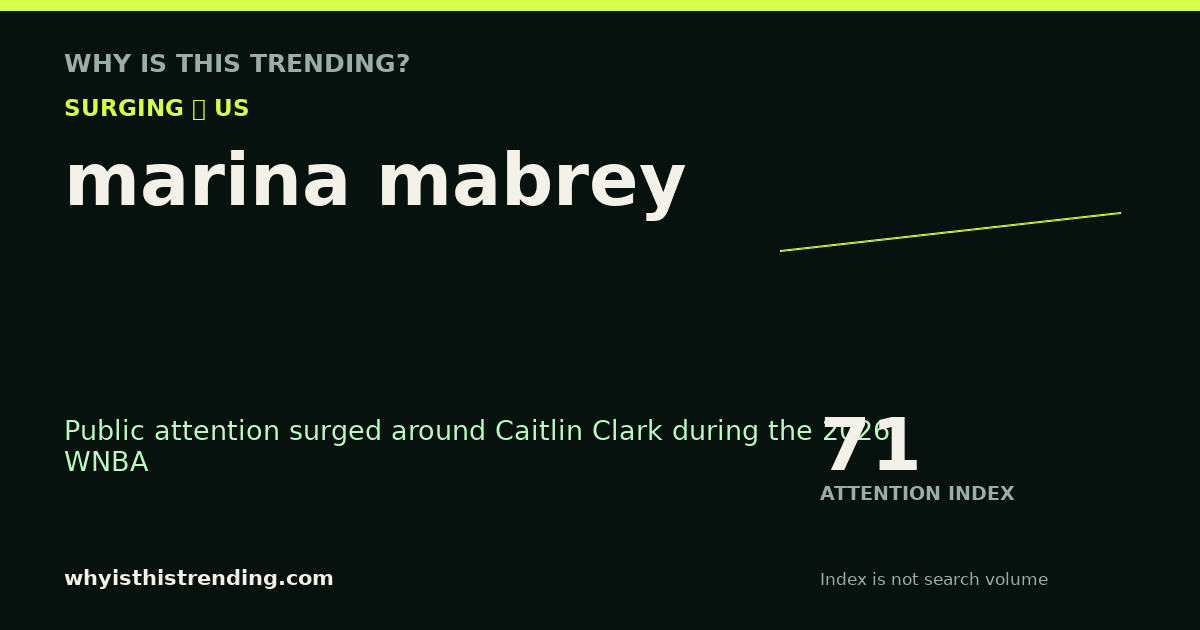
Decoding the All-Star Weekend Attention Spike
When the WNBA gathered in Chicago for the 2026 All-Star Weekend, the atmosphere was already thick with pre-game narratives, expansion success stories like Toronto Tempo star Marina Mabrey, and persistent debates surrounding league voting statistics. Yet, digital tracking tools and public interest metrics reveal that the definitive surge in fan attention was not manufactured by front-office drama, media panels, or pre-event ballot controversy. Instead, it was forged directly on the hardwood during the opening minutes of the main event on July 25, 2026.
As tip-off commenced at the United Center, the contest immediately delivered a high-octane offensive showcase. The attention dynamics shifted away from background discussions and locked squarely onto live-action highlights. Public interest spiked as metrics recorded a sharp digital ascent, reaching an attention index peak of 70.61 on July 26, 2026, at 01:10 UTC as tracked in analytical observations. This wave of interest highlights a recurring pattern in sports trend-forensics: raw, undeniable athletic output acts as an immediate catalyst for digital engagement rather than slow-building administrative narratives.
First-Quarter Fireworks in Chicago
The catalyst for the late-night spike was an incandescent opening quarter that left fans and analysts scrambling to capture the action. Playing for Team Spoon, Caitlin Clark wasted no time demonstrating the deep-range shooting ability that defines her offensive footprint. She poured in 11 points across a blistering four-minute span, featuring three deep 3-pointers from well beyond the arc alongside defensive hustle that included a transition steal and layup according to live game reports.
Across the floor, Team Coop's Marina Mabrey matched the intensity, lighting up the scoreboard with 17 points and five 3-pointers in the first quarter alone as documented by on-site journalists. But because of Clark’s distinct positioning at the center of the sport's cultural footprint, her rapid-fire sequence served as the primary magnet for real-time social media reactions and search interest.
To put this in perspective, the sheer velocity of scoring in the opening frame set a frantic tone for the entire evening. While veterans like Nneka Ogwumike were busy rewriting the league's record books by surpassing Maya Moore for the most career points in All-Star Game history, and players like Dominique Malonga injected energy with a powerful one-handed slam, the digital conversation remained anchored to the perimeter duel between Clark and Mabrey.
Signal Versus Noise: What Drove the Surge
In sports analytics, it is vital to separate sustained cultural noise from genuine event-driven signals. Weeks ahead of the All-Star Game, online discourse was dominated by ballot discussions—specifically the discrepancy between fan voting and player rankings that placed Clark lower on peer ballots relative to her massive popularity. While those debates generated plenty of social media friction and fan outrage, they represent background noise rather than the direct cause of the July 26 attention spike.
It is important to remember that Google Trends attention metrics measure the volume of public inquiry and digital curiosity; they do not automatically prove causation or dictate the underlying quality of a player's broader analytical impact. Even as analysts debate metrics like wins added or true shooting efficiency, public behavior responds dynamically to visual spectacles. When elite players trade deep shots on national television under the bright lights of an All-Star showcase, passive observers and die-hard fans alike converge online immediately.
Navigating the Data
To understand how this particular trend developed during the weekend festivities in Chicago, consider the exact contrast between pre-event storylines and live-game triggers:
- Pre-Game Noise: Voting controversies, media panels, and roster debates that simmered throughout the week but failed to trigger the midnight traffic spike.
- Live-Game Signal: Rapid-fire scoring bursts, such as Clark's 11-point opening quarter and Mabrey's long-range barrage.
- The Result: An immediate, quantifiable surge in public attention matching the exact timestamp of the opening quarter's conclusion.
Ultimately, the weekend reinforced a fundamental truth about modern sports fandom. While narrative controversies create sustained background chatter, nothing accelerates public attention quite like a generational talent putting on an exhibition of pure shooting range when the lights are brightest.