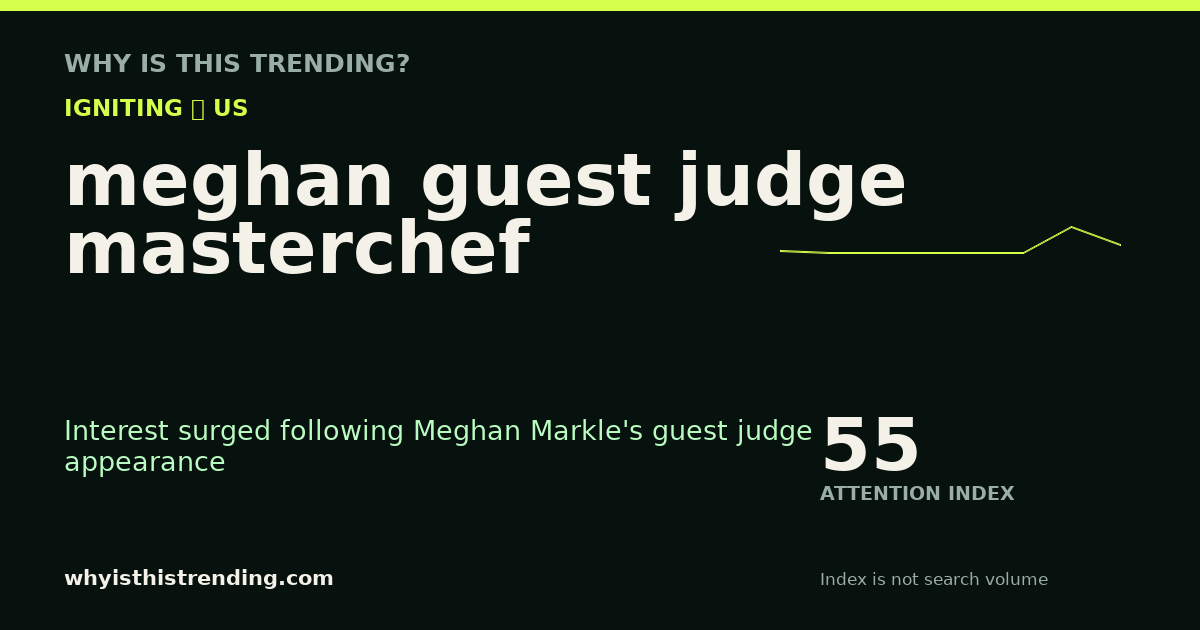
When public figures step out of their scripted environments and into mainstream reality television, the resulting attention is rarely just about the program itself. The surge in interest surrounding MasterChef Australia captures a precise cultural intersection: the modern appetite for unscripted intimacy clashing directly with institutional expectation. When the episode aired on July 26, 2026, viewers tuned in not merely to watch a cooking competition, but to witness how a high-profile figure navigates public identity in real time.
The broadcast immediately generated headlines for two contrasting moments. As co-host Poh Ling Yeow introduced her to the contestants, she was greeted with a formal query regarding her title (“Welcome. Do I call you Duchess?”). Her response—“call me Meghan”—established a deliberate tone of casual accessibility that rippled across social media commentary, morning-show coverage, and entertainment roundups worldwide.
It is crucial to understand that Google Trends data tracks relative spikes in user search interest over a specific period; it does not measure absolute search volume, nor does it serve as proof of direct causation for public sentiment. However, the timing of the search surge aligns precisely with the broadcast schedule of the episode, which was filmed months prior during her trip to Australia in April.
Decoding the Attention Mechanism
The sudden spike in online interest reflects a classic media multiplier effect. Reality television relies on high-stakes emotion and surprise, and inserting a globally scrutinized personality into an established format creates guaranteed narrative friction. Critics and supporters alike parsed every interaction, from her fashion choices—spotlighting Australian designers such as a black Matteau blouse and Camila and Marc skirt (Town & Country)—to a surprise FaceTime interruption from Prince Harry.
Viewers saw an unscripted domestic portrait unfold when Prince Harry called in to check on the production. Described by some commentators as a charming touch of reality and by others as an unnecessary distraction, the cameo amplified engagement across digital platforms. It transformed a standard guest-judging slot into a trending global talking point about boundaries, modern partnerships, and celebrity staging. The digital reaction demonstrated how easily traditional television formats can be leveraged to generate viral commentary across diverse geographic regions.
Signal Versus Noise in the Domestic Reveal
Much of the conversational noise focused on the superficial drama of royal titles and on-screen banter. Commentators argued over whether shedding formal titles was a genuine act of normalization or a strategic public relations move. However, the more revealing signal lies in how public figures curate their private personas through everyday domestic topics.
Asked about her family's culinary habits, she noted a blend of her husband's British preferences—“meat, potatoes and cream sauce”—alongside her own preference for grilled fish and natural spices, capped by the revelation that young children Archie and Lilibet are adventurous enough to eat Brussels sprouts. This framing serves a distinct purpose. By anchoring her public appearance in the universal language of family meals, school-night logistics, and relaxed cooking philosophies, the appearance bridges the gap between elite status and relatable domesticity. It reinforces the themes of her broader media projects, such as her lifestyle work and her Daytime Emmy-nominated series, *With Love, Meghan*.
What This Tells Us About Modern Public Persona
The intense public reaction highlights a broader truth about contemporary media consumption: audiences are hyper-attentive to micro-moments where celebrities attempt to shed formal constraints. Whether viewers interpreted the episode as a welcome display of warmth or a calculated exercise in image management depends largely on pre-existing perspectives. What remains undeniable is that the broadcast successfully bridged her international charity and commercial ventures with mainstream entertainment, proving once again that domesticity, when performed on a global stage, remains one of the most powerful engines of modern digital attention.
For readers observing these cultural moments, the key takeaway is to separate the viral noise of on-screen cameos from the underlying media strategy. Public appearances of this scale are carefully coordinated touchpoints that reinforce a broader personal brand. As future television crossover events occur, looking past the immediate shock value of unscripted moments allows audiences to see the consistent messaging built underneath.