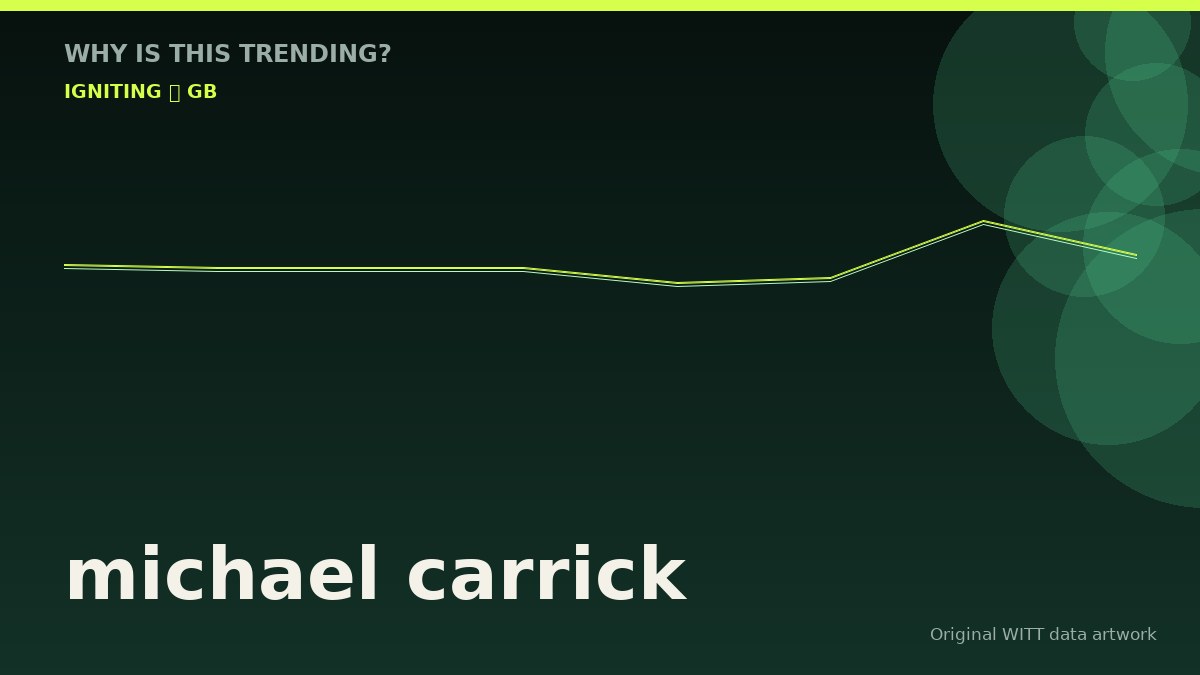
The Old Trafford Pressure Cooker
The attention surrounding Manchester United manager Michael Carrick captures the volatile ecosystem of modern English football management. Following a frustrating 1-1 draw against Tottenham Hotspur at Old Trafford—where Dominic Solanke secured an injury-time equalizer for ten-man Tottenham after Rodrigo Bentancur was sent off—United found themselves lingering in the lower half of the Premier League table with a meager six points from six matches [4].
That late concession ignited a fresh wave of external scrutiny across sports media and digital platforms. Media narratives swiftly pivoted from tactical assessments of the match itself to immediate succession planning, highlighting the precarious nature of a manager's standing when early-season results fall short of baseline expectations. Yet, a sharp divide exists between the noise generated in the press and the reality behind closed doors at Old Trafford, where strategic planning by modern ownership groups often moves at a fundamentally different speed than public panic.
Signal Versus Noise: Boardroom Backing vs. External Speculation
When evaluating why search interest spiked so sharply, it is vital to separate media-driven speculation from concrete operational decisions. The circulating reports linking former Newcastle United manager Eddie Howe to the Old Trafford vacancy underscore how quickly contingency plans and narrative-building take shape in the public imagination [6]. Howe, currently unattached after departing St James' Park during the summer, reportedly views the Manchester United position as a highly attractive opportunity and would be open to discussions if the role became vacant [6]. United officials also reportedly rate Howe highly due to his extensive Premier League background and the Champions League experience he accumulated during his time in the north east [6].
However, the actual signal emanating from the club hierarchy indicates institutional stability rather than reactionary panic. Sources indicate that INEOS and Manchester United’s co-owners are not planning an immediate managerial change and are not currently putting pressure on Carrick to be sacked [4]. Having earned permanent managerial backing after successfully guiding the club back into the Champions League last season, Carrick retains crucial goodwill within the boardroom [6]. The ownership's working perspective is that dismissing a manager after only a handful of league games would be a premature step that disrupts long-term development [6].
Broader Context and Historic Frustrations
Public discourse around Carrick during this stretch has also touched on deeper, reflective conversations taking place across English football. Amid ongoing fallout from separate league-wide controversies—such as the independent commission verdicts and legal scrutiny facing Manchester City—Carrick spoke candidly about the emotional toll of missing out on past title races [2]. Reflecting on the dramatic 2011-12 conclusion where City snatched the trophy on goal difference, Carrick noted that the emotion, the feeling about winning, a lot of it is in the moment,
emphasizing that retrospective medals can never replace the raw, lived experience of sporting triumph [2].
That emphasis on instantaneous, results-driven emotion effectively defines his current professional reality. Google Trends attention measures a measurable spike in public curiosity driven by the disappointing Tottenham draw and subsequent punditry, but it is critical to note that search velocity does not equate to proof of an imminent departure or serve as a causal indicator of a sacking [4]. Observers must remember that search data measures digital volume and media amplification, not boardroom resolutions.
Interpreting the Road Ahead
Sensationalist framing in parts of the press labeling Carrick as a dead man walking
[5] misinterprets INEOS's broader operational patience. While hovering in the lower reaches of the table is undeniably unacceptable for a club of Manchester United's historical stature [4], modern football governance under structured corporate ownership models often resists knee-jerk dismissals during the autumn months.
Carrick is being afforded the necessary runway to correct the slump and rediscover last year's tactical identity, but the margin for error in upcoming fixtures is shrinking rapidly. If performances fail to improve as the autumn schedule deepens, the presence of accomplished free agents like Eddie Howe [6] will ensure that the external pressure cooker continues to boil.