Decoding the Naira's Recent Gains
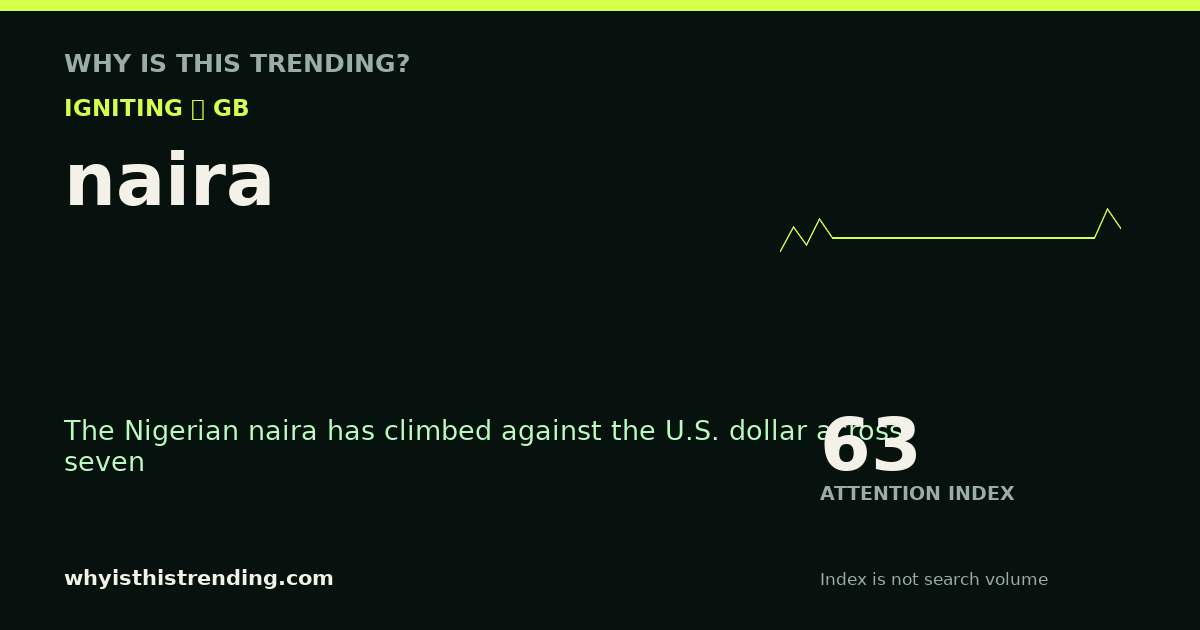
When a national currency puts together a winning streak, market watchers naturally look for the underlying gears turning behind the figures. The Nigerian naira recently achieved seven consecutive sessions of appreciation in the official foreign exchange market, trading at N1,367.76 per U.S. dollar Business Post Nigeria. This movement captured widespread public attention, aligning with confirmed exchange rate metrics that point to shifting dynamics in liquidity, institutional trading windows, and central bank positioning.
To understand what changed, we have to look past simple headlines and examine the interplay between interbank market turnover, institutional market-making deals, and external buffer levels. Currency values do not move in a vacuum; they reflect the immediate supply of and demand for hard currency within regulated windows. Public curiosity surrounding these confirmed figures reflects an immediate market reaction to newly published exchange rate data, though search attention itself does not constitute a direct proof of economic causation.
Financial institutions operating as market makers have faced changing transaction volumes across these windows, with deal counts and daily turnovers fluctuating as participants recalibrate their portfolios. By examining the mechanics of these official sessions alongside secondary parallel markets, we gain a clearer picture of how liquidity flows through Nigeria's complex financial architecture.
Signal Versus Noise in the Foreign Exchange Market
Whenever an exchange rate shifts, separating meaningful structural signals from routine market noise is essential for anyone trying to interpret the economy. In this instance, several verified indicators help clarify what is driving the naira's short-term resilience across official channels:
- External Reserve Buffers: Nigeria's external reserves reached a significant milestone at $52.03 billion as of July 22, 2026, providing the Central Bank of Nigeria with heightened financial capacity to support the currency and meet external obligations Businessday NG.
- Interbank Turnover Shifts: Activity at the interbank segment of the foreign exchange market slowed, with total turnover declining by 19.76% to $334.13 million, illustrating that official rate appreciation can coincide with contracting daily transaction volumes in specific interbank windows Businessday NG.
- Parallel Market Divergence: While the official market posted consecutive gains, the parallel market experienced a simultaneous weakening to N1,407 per dollar, which widened the spread between the two operational segments Businessday NG.
The coexistence of official gains and parallel market softening reminds observers that Nigeria operates across segmented currency channels. A rise in official valuations does not automatically mean uniform conditions across every tier of the financial system. Market analysts note that broader macroeconomic tailwinds, including robust foreign portfolio inflows into fixed-income securities and Open Market Operations driven by elevated domestic interest yields, have collectively contributed to this performance Businessday NG. These capital inflows have helped cushion the foreign exchange market against external shocks.
Navigating Competing Pressures and Forward Risks
While a seven-day appreciation streak underscores short-term stability, currency markets remain highly sensitive to upcoming commercial demands and regulatory friction. Traders and financial commentators point out that potential foreign-currency requirements from fuel importers front-loading dollar purchases to build inventories could introduce new downward pressure on the local currency Punch Newspapers. Independent petroleum marketers have raised questions about price volatility and the ongoing impact of import licenses on foreign exchange demand within the downstream sector Punch Newspapers, arguing that competing demand streams complicate efforts to maintain predictable currency values.
Because exchange rates fluctuate dynamically based on evolving trade demands, reserve allocations, and shifting monetary interventions, participants should monitor official central bank disclosures and verified trading turnover data as conditions continue to develop. Rather than relying on short-term speculative forecasts, stakeholders are advised to track institutional disclosures closely to understand how shifting petroleum import requirements and central bank liquidity interventions will influence the market in the days ahead.