The Anatomy of a Synchronized Launch
On July 24, 2026, the tech sector experienced a concentrated spike in search interest for "Opus 5." This was not a random phenomenon or a grassroots discovery; it was the result of a deliberate, synchronized release. By aligning its official product announcement with coverage across major tech outlets, Anthropic effectively centralized the conversation, ensuring that the model’s debut reached its target audience of enterprise developers and knowledge workers simultaneously.
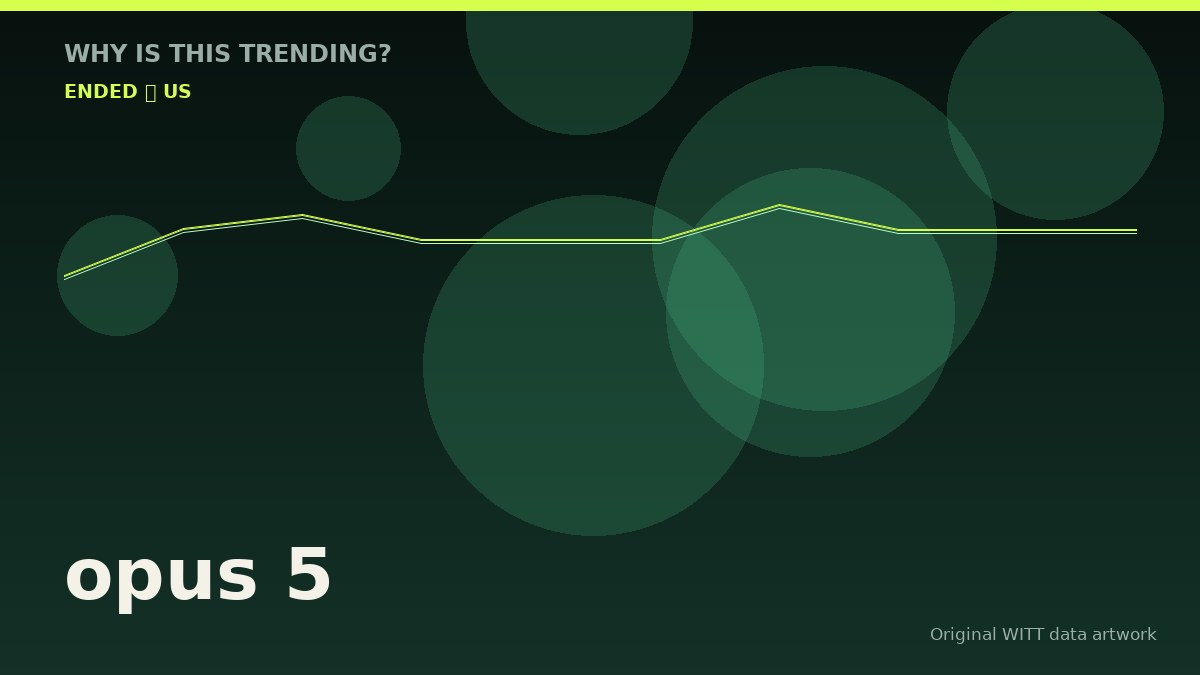
The attention mechanism here is clear: when a major AI lab releases a new iteration of a flagship product, the industry treats it as a bellwether for the broader market. The spike in Google Trends data—recording an attention index of 77.39 on the day of the release—reflects this immediate, high-intent curiosity. Users weren't just looking for news; they were looking for benchmarks, pricing, and, crucially, how this model compares to the existing, more restrictive alternatives.
Positioning: The "Everyday" Workhorse
To understand why Opus 5 gained such traction, one must look at its positioning. Anthropic is explicitly marketing this model as the "everyday" assistant, a strategic move to address the friction points that have plagued its more powerful, yet more restrictive, counterparts like Fable 5. While Fable 5 remains the choice for long-horizon, ambitious agent projects, it has often been criticized for being cumbersome due to its heavy-handed safety guardrails.
Opus 5 is designed to bypass these frustrations. According to reporting from Engadget, the company has tuned the model’s classifiers to intervene roughly 85% less often than they do for Fable 5. This is a crucial signal for enterprise users: it suggests that the model is "aligned" enough to be safe, but "unlocked" enough to actually be useful for daily coding and research tasks.
Signal vs. Noise: What Actually Changed?
It is easy to get lost in the noise of benchmark scores, but the real signal lies in the model’s operational efficiency. Anthropic has introduced an "effort" dial, allowing users to optimize for either speed or depth. This is a direct response to the "AI money squeeze"—the growing concern that the costs of running frontier models are becoming unsustainable for standard business workflows. By offering performance that approaches Fable 5 at half the price, Anthropic is attempting to commoditize high-level intelligence.
The following table highlights the key differentiators that have driven the recent interest:
| Feature | Opus 5 | Fable 5 |
|---|---|---|
| Primary Use | Everyday enterprise tasks | Ambitious, long-horizon projects |
| Cost | Half the price of Fable 5 | Premium |
| Safety Friction | 85% fewer classifier interventions | High (more restrictive) |
| Data Policy | No 30-day retention | 30-day retention policy |
The Regulatory Context
The interest in Opus 5 is also colored by the shadow of recent regulatory scrutiny. With the Trump administration’s previous intervention regarding cybersecurity concerns in models like Mythos 5 and Fable 5, the market is hyper-aware of how new releases handle safety. Anthropic’s preemptive communication—emphasizing that Opus 5 has "stronger cybersecurity safeguards" than its predecessor, Opus 4.8—is a calculated effort to avoid the regulatory friction that slowed previous rollouts.
By positioning Opus 5 as a model that is "harder to trick" while still being more permissive than Fable 5, Anthropic is threading a very narrow needle. They are attempting to satisfy government oversight while simultaneously providing a product that feels less like a restricted tool and more like a capable, autonomous partner.
The Bottom Line
The surge in attention for Opus 5 is a testament to the current state of the AI arms race. Users are no longer just looking for the "smartest" model; they are looking for the most practical one. The interest spike on July 24 was a reaction to the promise of a model that finally balances the competing demands of cost, safety, and raw capability. Whether Opus 5 can maintain this momentum depends on whether it truly delivers on the "everyday" promise in real-world enterprise environments, rather than just on the benchmark charts provided by the lab.