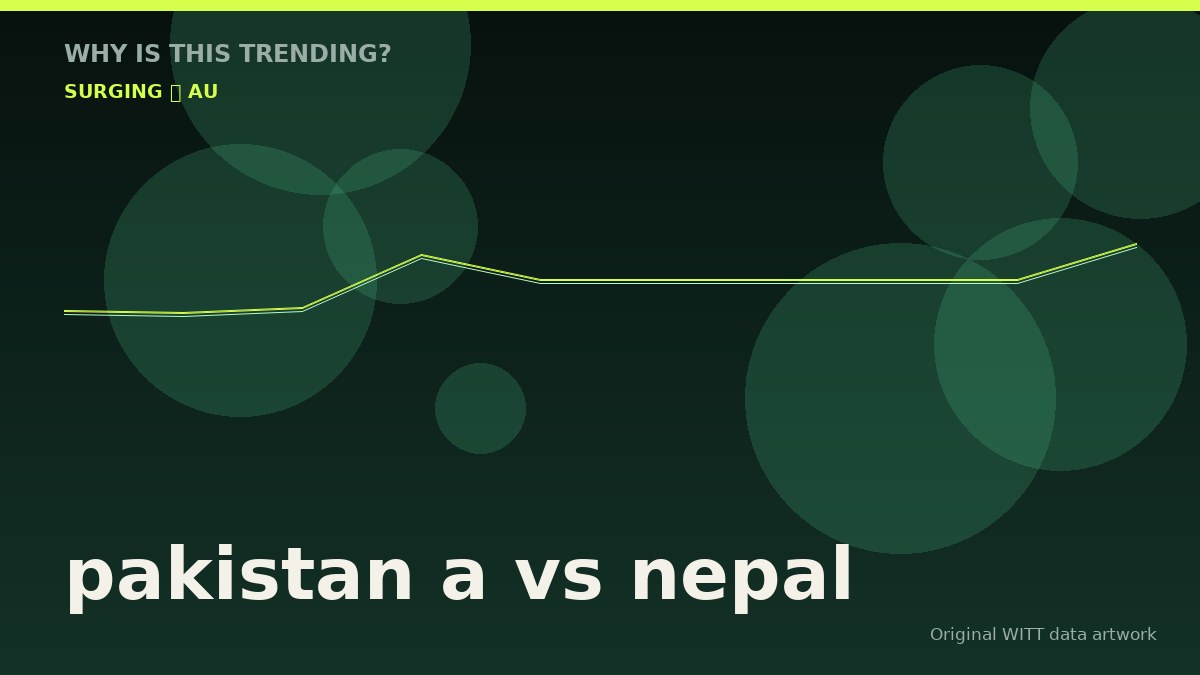
The Match That Drove the Search Spike
The surge in attention centred on a group-stage fixture in the Asia Cup Rising Stars One Day Cricket Tournament, held in Qatar. Nepal played Pakistan A on November 24, 2026, with the match scheduled for 3:45 PM at the University of Doha for Science and Technology cricket ground in Doha.
Google Trends attention measures public curiosity and search behaviour; it does not measure search volume directly, nor does it prove why any individual searched for the match. The timing of the spike is consistent with a same-day sporting event, but attention alone cannot establish causation or predict how many people searched.
What Was at Stake for Nepal
Nepal entered the match in third place in Group B with two points. Its tournament had begun with a heavy 306-run defeat against India, followed by a six-wicket victory over the United Arab Emirates. That recovery win mattered because it offered Nepal a chance to show that its opening loss was an outlier rather than a pattern.
For Nepal, the Pakistan A fixture was therefore about more than one result. A second consecutive win would have converted a single comeback into something closer to sustained momentum in a short tournament where every group game carries weight. The reporting describes Nepal as looking for its second consecutive win and aiming to defeat Pakistan A.
What Was at Stake for Pakistan A
Pakistan A occupied the top position in Group B with four points and had already reached the semi-finals one game in advance. It had defeated the UAE in its opening match and India A in its second match, giving it two wins from two games.
Because qualification was already secured, Pakistan A faced a different calculation. The side could use the match to maintain rhythm and extend its winning sequence to three consecutive victories, but it did not face the same elimination pressure as Nepal. That asymmetry helps explain why the fixture carried more urgency for Nepal than for Pakistan A.
Historical Context Between the Sides
The two teams had met only once before, in the 2023 Emerging Cup. Nepal batted first and was all out for 179 runs in 37 overs. Pakistan chased the target of 180 in 32.5 overs, losing six wickets and winning by four wickets.
That previous result matters because it suggests Nepal was not completely out of its depth against Pakistan A, even though the recent form lines pointed in opposite directions. For Nepal, the Doha match also presented an opportunity to avenge a defeat from three years earlier.
What the Attention Signal Does and Does Not Prove
The search surge is best understood as a signal of public interest around a specific match time and location, not as evidence of a particular outcome or as a measure of audience size. Google Trends reflects relative attention over time and geography; it is not a search-volume estimate, a ranking, or proof that one narrative caused the spike.
What the packet does confirm is the fixture itself: the teams, the tournament, the date, the venue, the scheduled start time, the group standings, the recent results, and the prior head-to-head meeting. Everything else—including how the match ultimately finished—remains outside the supplied record.
Practical Takeaway for Readers
Anyone following this fixture should treat the confirmed details as the schedule, venue, and competitive context, while recognising that search interest does not reveal the match result. The broader lesson is that a single group-stage game can trend when it sits at the intersection of recent form, tournament stakes, and historical rivalry, even when one side has already achieved its primary objective.