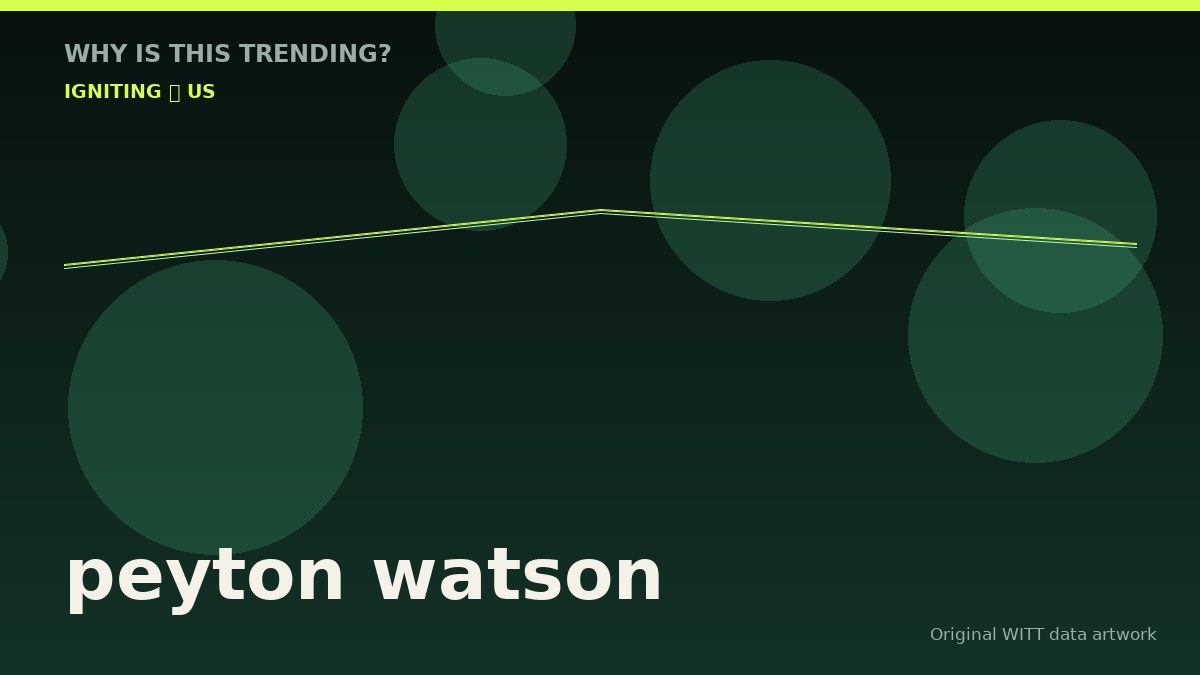
The Catalyst Behind the Search Spike
Google Trends records a sharp surge in searches for Peyton Watson
beginning on August 20, 2026, right as major reports broke regarding his restricted free-agency standoff with the Denver Nuggets coming to an end. This attention spike mirrors the exact window when basketball insiders revealed a complex multi-team arrangement sending Watson to the Cleveland Cavaliers.
It is important to remember what these metrics do and do not tell us. Google Trends data captures immediate public curiosity, shifting queries, and digital reaction; however, it does not measure underlying search-volume estimates, nor does it serve as proof of direct causation. Even so, the precise timeline establishes a clear connection between breaking league reports and a sudden wave of fan engagement across basketball platforms.
Fixing a Difficult Offseason in Cleveland
The Cavaliers entered this offseason facing mounting pressure after missing out on a potential reunion with LeBron James, who ultimately chose the Philadelphia 76ers. With financial flexibility severely constrained and the team sitting well over the cap before accounting for the cost of retaining James Harden, front-office changes became mandatory to prevent a slide in the Eastern Conference hierarchy. Adding talent under these restrictive financial conditions required creative problem-solving and navigating strict apron rules that governed every potential transaction.
To acquire a high-upside young talent like Watson, Cleveland had to shed salary. Max Strus emerged as the primary movable asset outside of the team's core, prompting intense speculation about various multi-team trade structures involving franchises like the Chicago Bulls, Charlotte Hornets, and Memphis Grizzlies before a definitive path forward materialized. Analysts at outlets like FanSided parsed multiple contingency scenarios, including salary dumps and complex four-team frameworks, to illustrate how tightly wound the Cavaliers' cap sheet truly was.
Inside the Roster Reshaping
According to reports detailed by Bleacher Report, the resolved sign-and-trade agreement sends Watson to Cleveland while the Denver Nuggets receive future draft capital, including a 2031 first-round pick from the Cavaliers and a 2032 second-rounder from the Sacramento Kings. To make the financial mechanics work under league rules, Max Strus is rerouted to the Los Angeles Clippers, clearing the necessary breathing room for Cleveland to ink Watson to a four-year, $88 million contract.
At 6'8" and coming off a career-best campaign where he shot 41.1 percent from beyond the arc and averaged 14.6 points per game, Watson fills a glaring need for a modern, athletic wing. He steps into the forward slot to provide head coach Kenny Atkinson with crucial frontcourt depth and defensive versatility, capable of sliding into small-ball lineups alongside or in place of Evan Mobley. This injection of youth and spacing alters the outlook of a team that had otherwise experienced a frustrating summer of missed opportunities.
Signal Versus Noise in the Trade Market
Much of the initial trade chatter involved elaborate hypothetical frameworks—including proposals that looped in the Brooklyn Nets, Chicago Bulls, and Miami Heat. Fans and analysts spent days dissecting trade exceptions and protected draft picks as teams scrambled to manage apron restrictions and luxury tax burdens. Outlets also explored alternative pathways involving different assets, yet the underlying market pressures remained entirely focused on payroll limitations.
The noise centered on whether Denver would match an offer sheet or accept a lesser return, but the underlying signal was always about math: teams holding high payrolls simply faced insurmountable tax penalties under the first-apron hard cap. Watson's breakout offensive performance priced him out of Denver's long-term financial plans, creating a rare window for an aggressive suitor like Cleveland to pounce. For readers tracking the fallout, the practical takeaway is that Cleveland successfully pivoted away from its failed superstar pursuits by securing a young, ascending asset who directly addresses their need for wing scoring and defensive length.