The Mechanics of the Climb
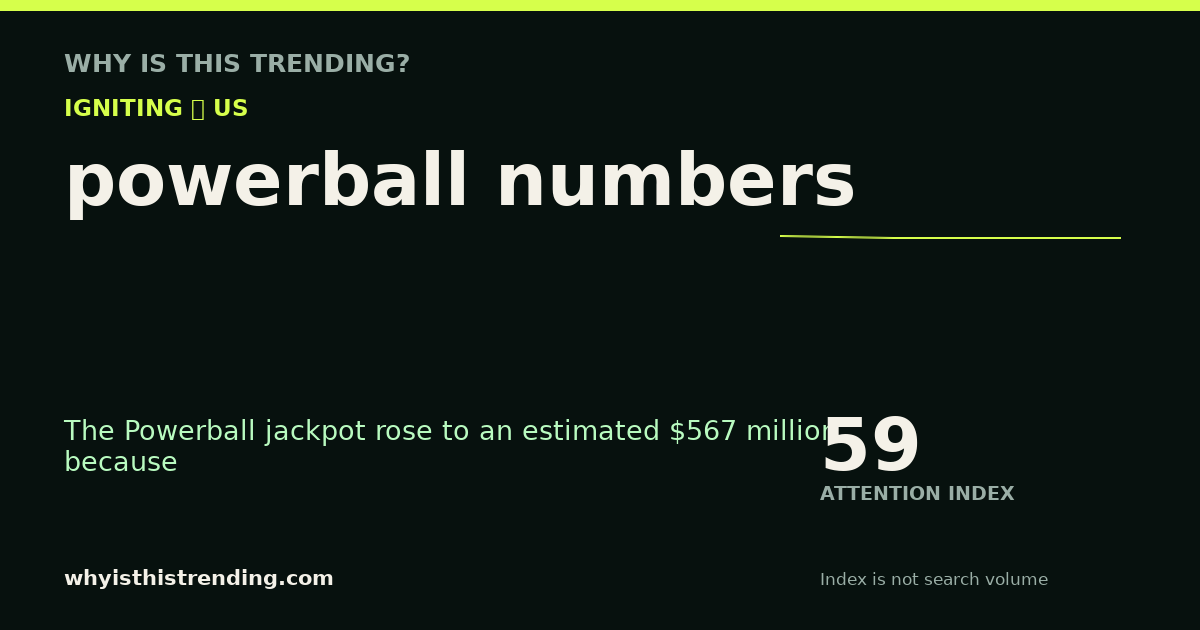
The recent surge in attention surrounding Powerball numbers is a direct result of the game's inherent rollover structure. When no ticket matches all five white balls and the red Powerball, the grand prize pool does not simply vanish; it compounds. Following the drawing on Monday, July 20, 2026, where the winning numbers were 2, 9, 44, 53, 59 and the Powerball was 8, the jackpot went unclaimed. This triggered an increase in the top prize from $544 million to an estimated $567 million for the following drawing on Wednesday, July 22, 2026 [1] [2].
While the jackpot remains elusive, the drawing was not without winners. Two players—one in Colorado and one in Michigan—successfully matched all five white balls, securing $1 million prizes each [5]. Additionally, thousands of smaller prizes were distributed nationwide, including over 72,000 winning tickets in California alone [1]. These secondary wins often sustain public engagement, providing a tangible reminder that while the jackpot odds remain a steep 1 in 292.2 million, smaller wins occur with much higher frequency [3] [6].
Signal vs. Noise: Understanding the Attention
When the jackpot crosses the $500 million threshold, it typically transitions from a routine weekly event to a broader cultural conversation. This shift is driven by the psychological allure of the "lump sum" cash option. For the July 22 drawing, the estimated cash value was $251.8 million [2] [4]. It is important to distinguish between the advertised "jackpot" and the reality of the payout. The $567 million figure represents an annuitized prize paid out over 30 years, whereas the cash option provides a significantly smaller, immediate sum before federal and state taxes are applied [3].
The current trend in search volume is a lagging indicator of this excitement. As the jackpot grows, the barrier to entry—the $2 ticket price—remains constant, while the perceived "value" of the potential return increases. This creates a feedback loop where media coverage of the rising jackpot encourages more ticket sales, which in turn fuels further growth in the prize pool until a winner is eventually declared. The noise here is the expectation that the odds change with the jackpot; the signal is the mathematical reality that the 1-in-292.2 million probability remains static regardless of the prize amount [4].
Contextualizing the Current Prize
To understand where this jackpot sits in the historical landscape, consider the following comparison of recent lottery activity:
| Event Date | Jackpot Status | Outcome |
|---|---|---|
| May 2, 2026 | $20 Million | Won (Florida/Texas) |
| July 20, 2026 | $544 Million | Rollover |
| July 22, 2026 | $567 Million | Next Drawing |
The jump to $567 million is notable because it marks only the second time this year that a lottery prize has crossed the $550 million mark [3]. While billion-dollar jackpots have become more frequent in the last five years, they remain statistical anomalies rather than the norm [5]. For the average player, the mechanics of the game remain identical regardless of the jackpot size; the odds of winning do not improve as the pot grows, yet the public appetite for participation clearly does.
As we move past the July 22 drawing, the primary takeaway for observers is that the lottery remains a game of chance where the "trend" is dictated entirely by the absence of a winner. If the prize remains unclaimed, expect the cycle of speculation and search interest to continue until the jackpot is eventually reset by a winning ticket. Players should remember that while the jackpot is the primary driver of attention, the secondary prizes—such as the $1 million match-5 wins—are the only statistically significant outcomes for the vast majority of participants [6].