Decoding the Sudden Surge in Public Interest
When public curiosity around a foundational term like professor
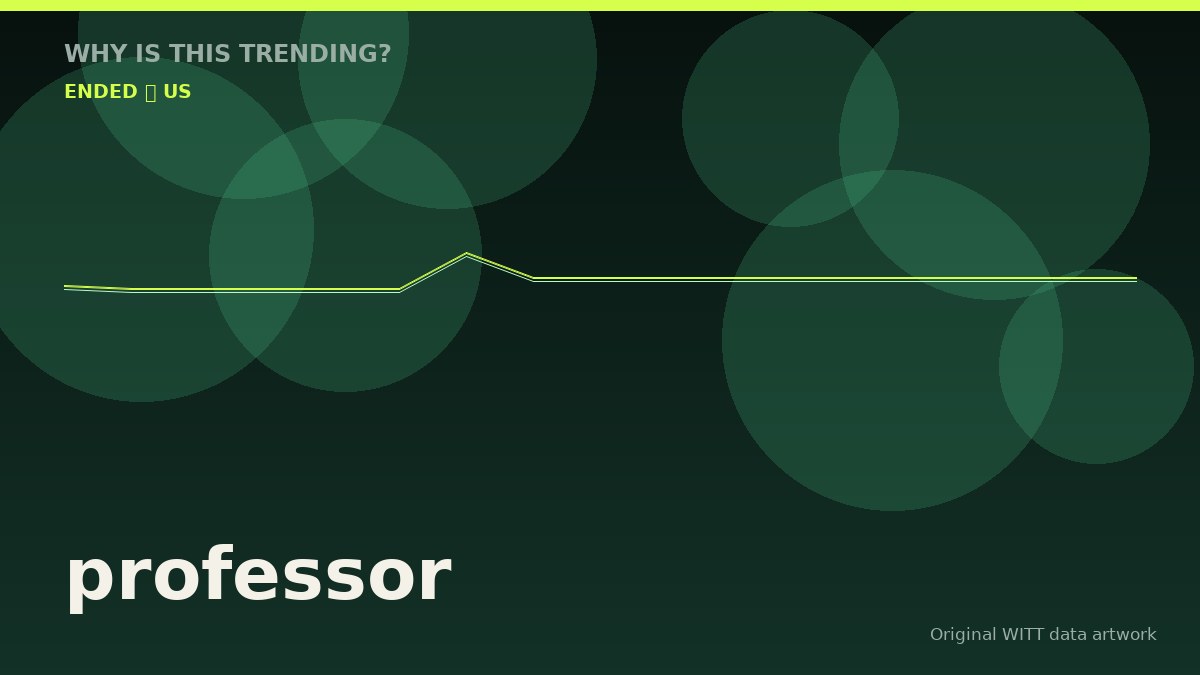
spikes sharply, it rarely happens in a vacuum or as the result of a single isolated headline. Trend tracking reveals that a distinct cluster of high-profile controversies can pull searchers toward a single conceptual bottleneck. In early August, a collision of high-stakes institutional disputes, cultural debates over academic oversight, and viral classroom anecdotes created a brief attention peak lasting from August 1 through August 3, 2026, with search interest culminating explicitly on August 3.
Understanding this movement requires separating the immediate trigger events from the ambient noise of higher-education reporting. While multiple overlapping stories touched on academic roles, testing administration delays highlighted by outlets like EdexLive, and institutional policy during this window, the data points directly to specific investigative journalism and viral social media moments as primary catalysts for the search spike.
The Trigger Event: The Cambridge Controversy and Institutional Scrutiny
The primary driver behind the search surge was a detailed investigative report published by The Guardian on August 1, 2026. The piece examined intense scrutiny facing Jason Arday, the youngest black professor in Cambridge University’s history. According to the coverage, analysis identified numerous passages in his doctoral thesis bearing similarities to an earlier work by a student at Brunel University in London.
The controversy drew broader cultural attention because it intersected with ongoing debates about how academic vetting processes are used and perceived. Months prior at the British Sociological Association’s anniversary conference, Arday had warned peers about a playbook used by activists and right-wing media outlets to target prominent black academics with rigorous plagiarism checks, subsequently pressuring universities for dismissals (The Guardian). This dynamic transformed a standard institutional inquiry into a polarized debate over academic integrity, structural bias, and the potential weaponization of oversight mechanisms.
Furthermore, the context surrounding his critics added layers of complexity to the public discussion. Reports noted that the individuals raising these questions included academics who had themselves faced disciplinary proceedings or controversial dismissals over free speech and critical race theory debates, cementing the story as a fierce proxy war over ideological boundaries within elite institutions.
Amplifying Factors: AI Cheating and Classroom Viral Moments
While the Cambridge investigation provided the core investigative spark, a secondary viral story helped sustain public interest across search engines concurrently. On August 3, 2026, reports circulated about a Mississippi college history instructor who went viral after exposing widespread artificial intelligence use in a midterm exam (IJR).
The instructor, Jason Gibson at Alcorn State University, embedded a hidden white-text instruction into his exam prompt commanding students to insert the word Madagascar
into their essays in a way that made no sense. Dozens of students allegedly submitted AI-generated text containing the bizarre, out-of-context instruction, sparking online discussion about academic honesty, automated cheating, and pedagogical evaluation (IJR). This intersection of doctoral scrutiny and everyday undergraduate shortcuts brought the realities of academic integrity into sharp relief for a mainstream audience.
When combined, these two narratives bridged a wide gap in public consciousness. On one end of the spectrum, elite scholarship faced accusations of methodological shortcuts and textual overlap; on the other, introductory undergraduates stumbled through automated essay generation. Both phenomena forced universities to confront how trust is established, verified, and occasionally dismantled.
Signal Versus Noise in Modern Academic Scandals
It is vital to distinguish between measurable shifts in search behavior and proof of underlying systemic shifts. Search interest directed at the term professor
peaked explicitly on August 3, 2026. It does not gauge public sentiment, nor does it prove a unified causal link between disparate global stories about higher education.
Instead, readers should view these moments as thematic convergence. When elite institutional ethics collide with everyday anxiety over generative technology in the classroom, the word professor
becomes a focal point for broader anxieties about credibility, authority, and fairness in modern institutions. Observers monitoring these trends should look past momentary online outrage and focus on how universities reform both their plagiarism compliance frameworks and their instructional responses to emerging technologies.