A Legacy of Connection
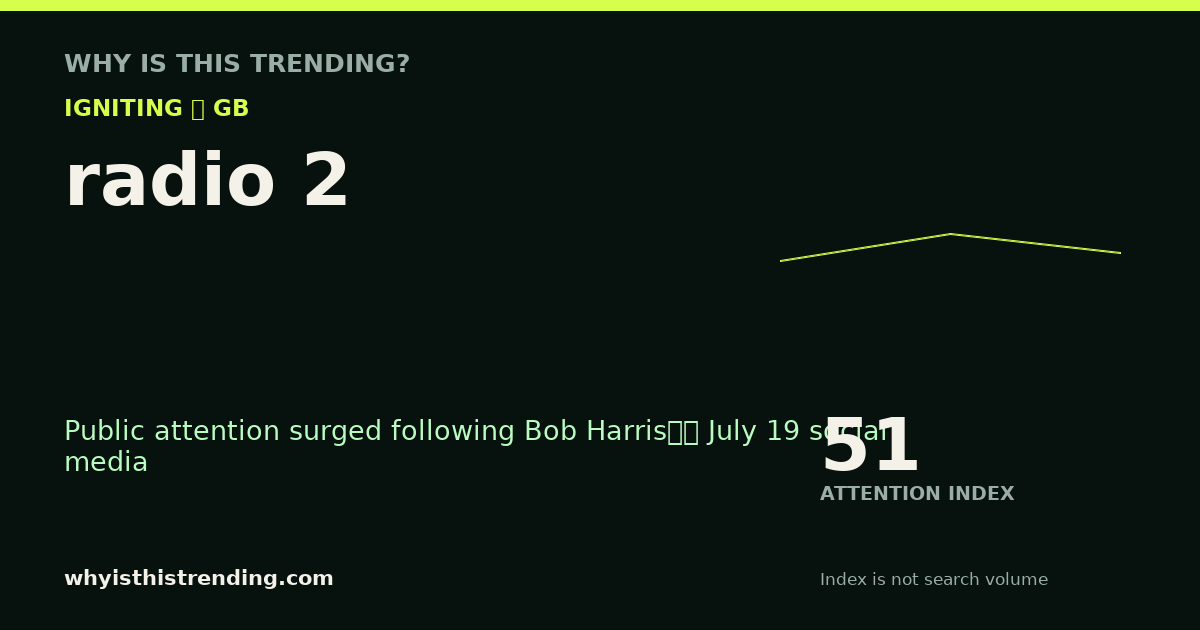
For more than half a century, the voice of Bob Harris has been a constant in the lives of British radio listeners. When he announced his departure from BBC Radio 2 in June 2026, it marked the end of a 56-year career defined by a deep, unwavering loyalty to his audience. However, the recent surge in public attention is not merely a reaction to his retirement; it is a response to the vulnerability he displayed in a follow-up update shared on July 19, 2026.
In his post, Harris offered a glimpse into the reality of a life suddenly slowed down by a diagnosis of prostate cancer that has spread to his spine. By sharing his struggle with the silence of the studio and his journey toward embracing a different version of himself, Harris transformed a professional transition into a deeply human story of resilience.
The Mechanics of the Moment
The spike in search interest surrounding 'Radio 2' on July 20 and 21 was not driven by corporate announcements or programming changes, but by the emotional weight of Harris’s personal narrative. When a figure who has occupied the public consciousness for decades speaks with such raw honesty, the audience response often transcends standard media consumption.
Harris’s statement touched on several themes that clearly struck a chord with his followers:
- The loss of routine: He admitted,
It's impossible for me to even begin to explain how much I am missing @bbcradio2 going on air and creating programmes for you.
- The discovery of 'TIME': He reframed his retirement not as a loss, but as an opportunity to
sit in the garden with my cats... a time to reflect how fortunate and blessed I am to be still here.
- Accepting change: He candidly noted,
I have to accept that I am a slightly different version of myself now,
acknowledging the physical limitations imposed by his ongoing treatment.
The widespread reporting of these comments by outlets like Wales Online and the Manchester Evening News served to amplify the sentiment, turning a personal social media update into a national conversation about aging, health, and the dignity of stepping back.
Signal vs. Noise
It is important to distinguish this surge from other industry news. While the radio landscape remains active—with new plays being produced for the Edinburgh Fringe and ongoing programming shifts—the attention on Harris is distinct. It is a signal of the public’s enduring attachment to broadcasters who have served as companions for generations. The noise, by contrast, is the constant churn of daily media updates that do not carry the same emotional gravity.
The public's reaction—flooding his posts with messages of support and inspiration—suggests that listeners are not just mourning the loss of a voice on the radio, but are actively engaging with the example he is setting in how he handles his health journey. Harris is effectively modeling a transition that many find difficult to navigate: moving from a life defined by high-stamina professional output to one defined by reflection and gratitude.
A Defensible Perspective
The sudden interest in 'Radio 2' is a testament to the power of the personal brand in the digital age. Even when a broadcaster is no longer behind the microphone, their ability to maintain a connection with their audience remains intact if they choose to be authentic. Bob Harris has successfully navigated this shift by inviting his listeners into his garden, sharing his cats, and acknowledging his limitations with grace.
Ultimately, this trend is a reminder that legacy is not just about the work produced over 56 years; it is about the grace with which one exits the stage. As Harris continues his treatment, the public's focus remains on his well-being, proving that the bond between a broadcaster and their audience is built on more than just the music they play—it is built on the shared humanity of their experiences.