Decoding the Post-Episode Search Wave
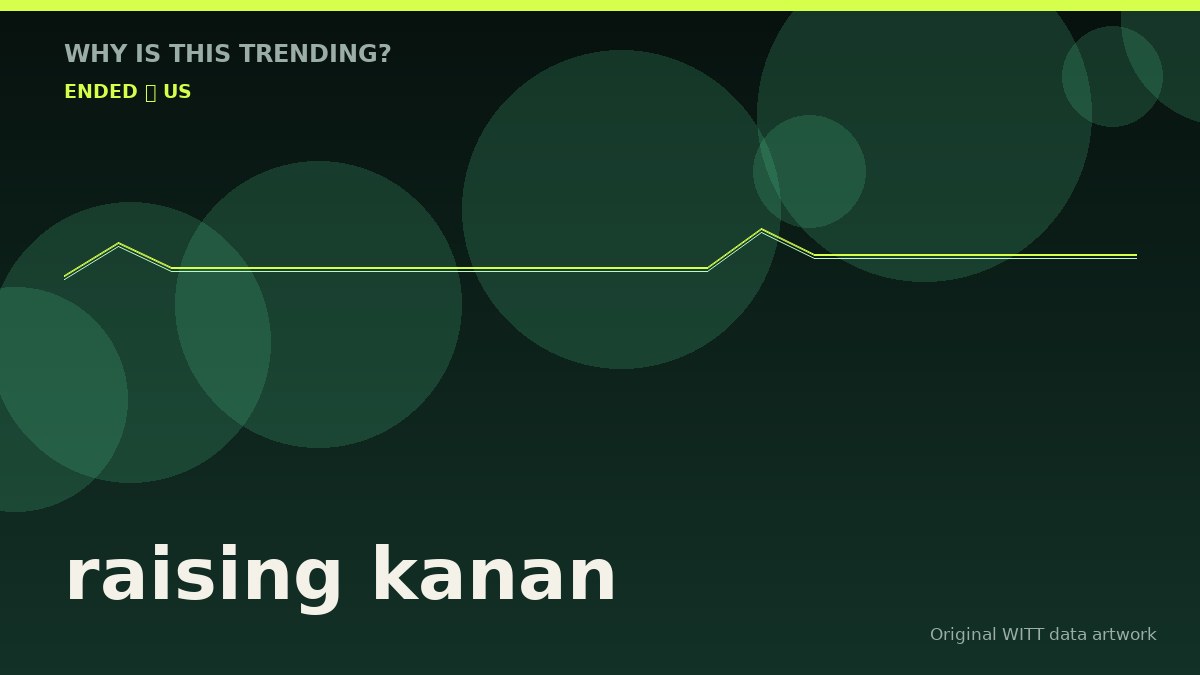
When public attention swells around a specific television title days after a broadcast, it rarely happens by accident. The surge in searches for raising kanan
on August 7, 2026, offers a textbook case of how modern prestige television converts narrative trauma into digital engagement (Source: The Knockturnal). While general interest in the broader Power franchise is ever-present, this particular spike was tethered to a very specific, emotionally exhausting hour of television that aired on August 3, 2026 (Source: The Knockturnal).
In the world of trend forensics, a multi-day delay between an episode's initial airing and a peak search window is a familiar pattern. Viewers catch up on streaming, critical reviews are published, and social media commentary reaches a boiling point. By August 7, the cumulative effect of these discussions translated directly into active search behavior as fans sought out episode breakdowns, character fates, and thematic analysis (Source: The Knockturnal). It is vital to remember that Google Trends attention measures relative query interest rather than exact search volumes, and it should never be misconstrued as mathematical proof of direct causation without examining the surrounding cultural triggers.
Furthermore, analyzing why audiences turn to their devices after a major broadcast reveals a deeply entrenched routine of digital communal processing. Fans do not merely watch a show like Power Book III: Raising Kanan in isolation; they immediately look for validation of their shock, seek out professional criticism to unpack complex moral dilemmas, and dive into forums to debate the long-term trajectory of favorite figures. This ecosystem ensures that a major plot development will continue to ripple outward long after the credits have finished rolling on Sunday night.
The Catalyst: A Devastating Turn for the Thomas Family
The primary driver behind this digital footprint was a slaughter of major players in Season 5, Episode 7 of Power Book III: Raising Kanan (Source: The Knockturnal). By the time the credits rolled, characters like Snaps and Pop had met their long-overdue ends at the hands of Jukebox, but it was the heartbreaking exit of Marvin Thomas that truly galvanized the audience (Source: The Knockturnal).
Marvin's death hit viewers hard because it felt entirely avoidable, stemming from a tragic domino effect of manipulation and misplaced loyalty toward Raq (Source: The Knockturnal). Watching Kanan descend further into moral collapse by turning on his own family accelerated the internet chatter. When an episode delivers a narrative blow of this magnitude, it forces audiences online to process the implications, dissect the writing, and debate what it means for the series' ultimate conclusion. The episode also provided a clearer look at Breeze, whose calculated strike against Marvin's crew established him as a dangerous force heading into the season finale (Source: The Knockturnal). These dense narrative layers guaranteed that casual viewers and die-hard analysts alike would spend days reviewing every single scene frame by frame.
Signal Versus Noise in the Franchise Ecosystem
It is crucial to separate the organic emotional response of viewers from background franchise noise. For instance, announcements regarding related projects—such as early looks at the prequel series Power: Origins highlighting characters like Ghost, Tommy, and a younger Kanan—generate their own steady currents of interest (Source: Faithcomm). However, a sharp, localized attention spike arriving precisely four days after a mainline episode points squarely back to narrative developments rather than general casting news or promotional teasers.
To understand what happened, consider how different types of media output influence audience behavior:
- Episodic Narrative Shocks: High-stakes character deaths generate immediate, visceral reactions, driving fans to search for episode reviews and recap breakdowns.
- Streaming Catch-Up Windows: A multi-day lag between broadcast and peak search volume often reflects viewers tuning in asynchronously over a few days rather than all at once.
- Franchise Expansion Teasers: Prequel announcements and casting updates create a persistent baseline of interest, but rarely account for sharp, short-term search anomalies without a direct narrative trigger.
Ultimately, the August 7 search peak demonstrates that character-driven heartbreak remains the most powerful engine for online engagement. As Raising Kanan barrels toward its seasonal and structural conclusions, the audience's willingness to follow Kanan down his dark path guarantees that future twists will spark similar digital shockwaves.