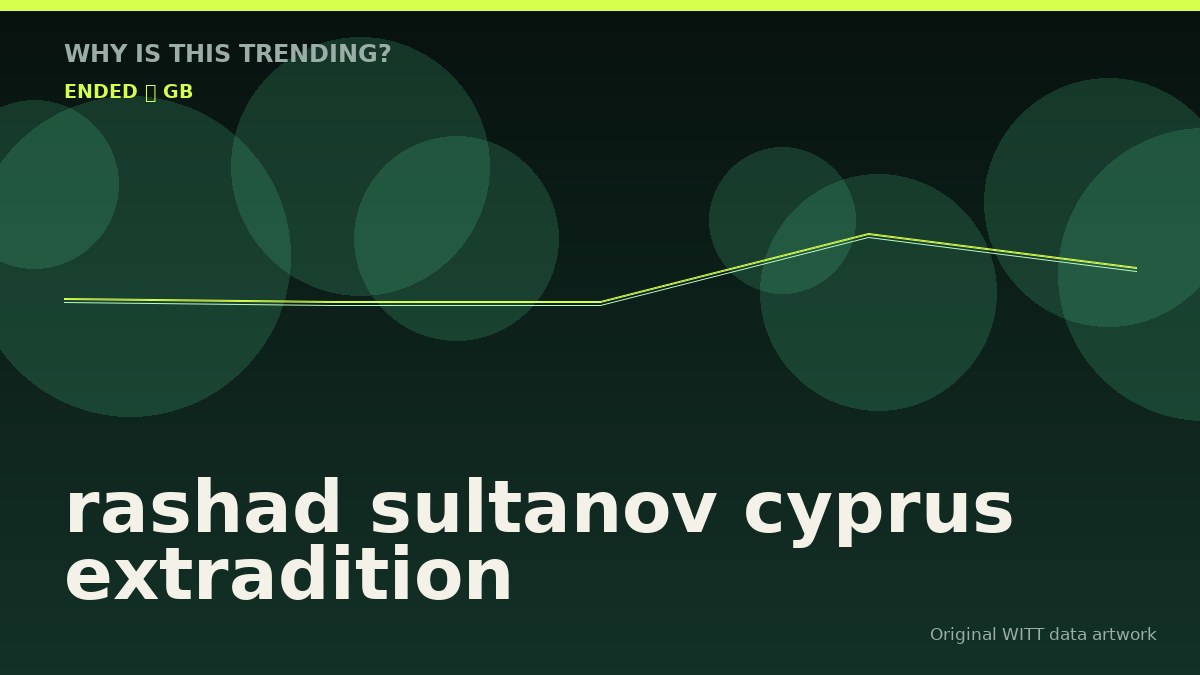
Decoding the Attention Spike
When digital attention data captures a sharp vertical surge around a complex international legal dispute, it points to a rare intersection of hard law, geopolitics, and institutional friction. The sudden public focus on the extradition proceedings of Rashad Sultanov is not a random fluctuation or an algorithmic artifact; it represents a convergence of a groundbreaking domestic security charge applied across international borders and concurrent parliamentary inquiries into regional hybrid threats.
According to reports from BBC News, the 44-year-old British-Azerbaijani citizen was arrested by Cypriot police on 17 July 2026 and remains in custody pending extradition. What pushed this case from a standard cross-border legal matter into a major trending topic is the Crown Prosecution Service's confirmation that Sultanov faces allegations under the 2023 National Security Act—marking the first time this specific legislation has been deployed in an overseas territory.
This unprecedented legal maneuver instantly elevated a localized detention into a matter of international legal precedent. Observers, legal analysts, and regional news outlets quickly seized upon the announcement because it tests the extraterritorial boundaries of British counter-terrorism legislation in real time, setting a potential baseline for how foreign intelligence operations targeting UK military assets abroad will be prosecuted in the future.
The Legal Mechanism: The 2023 National Security Act Abroad
At the heart of the public interest is the expanding jurisdictional reach of British counter-terrorism and national security laws. Investigators allege that Sultanov carried out hostile surveillance on RAF Akrotiri—a permanent UK military base in Cyprus—and transmitted sensitive information to the Islamic Revolutionary Guards Corps. The alleged espionage window spans between 11 May 2025 and 22 June 2025.
By invoking the 2023 National Security Act outside domestic borders, the Crown Prosecution Service and Counter Terrorism Policing London are testing a powerful statutory tool. Commander Helen Flanagan emphasized that the operation demonstrates the state's capacity to target hostile activity directed at British military installations overseas through close coordination with international partners like Cypriot law enforcement.
However, the path to extradition is rarely instantaneous or unopposed. Coverage from Halkın Sesi highlights that during proceedings at the Limasol District Court, immediate surrender was contested, pushing the matter into a formal, extended judicial review process as defense teams mount their challenges and navigate local court procedures. This procedural friction ensures the case remains active in the public consciousness as every court appearance brings fresh debate over jurisdiction, human rights safeguards, and bilateral treaties.
Broader Geopolitical Context and Parliamentary Friction
The attention surge has also been amplified by its timing relative to wider security debates in the region. RAF Akrotiri has served as a strategic launchpad for operations intercepting Iranian missiles and drones in recent months, placing the base under intense geopolitical focus.
Simultaneously, domestic political institutions are grappling with sensitive intelligence matters. As detailed by Politis, an extraordinary session of the House Ethics Committee addressed the ongoing Videogate
hybrid-warfare probe. While Attorney General George Savvides instructed parliament that ongoing criminal inquiries and investigative reports cannot yet be publicly discussed or transmitted to lawmakers, the overlapping timeline of parliamentary sparring and the Sultanov extradition announcement has naturally concentrated public focus on state security, intelligence leaks, and foreign influence operations.
This dense backdrop of active regional defense operations and domestic legislative pushback creates an environment where any movement in a high-stakes espionage case acts as a lightning rod for broader anxieties regarding foreign intelligence penetration and government oversight.
Signal Versus Noise in the Digital Discourse
When analyzing spikes in search behavior regarding international espionage cases, distinguishing between verifiable legal milestones and speculative noise is essential for accurate comprehension. Misinterpreting the scope of these proceedings can lead to distorted expectations about how international law operates.
- Defensible Signal: The official CPS confirmation of the 2023 National Security Act's overseas application and the ongoing extradition hearings in Cyprus represent concrete, verifiable legal history. These elements establish a new precedent for extraterritorial counter-terrorism enforcement.
- Noise and Overreach: Conflating separate regional inquiries—such as unrelated domestic criminal trials or parallel intelligence debates—with the specifics of Sultanov's alleged surveillance risks distorting the actual legal scope of the case. Speculating on guilt or ultimate judicial outcomes before local courts rule is equally premature.
As extradition proceedings continue to wind through the Cypriot court system, public interest will likely remain tied to every procedural ruling. Observers monitoring the case should look strictly to formal court updates rather than speculative commentary to understand how the UK's expanded counter-terrorism mandate holds up under international judicial scrutiny.