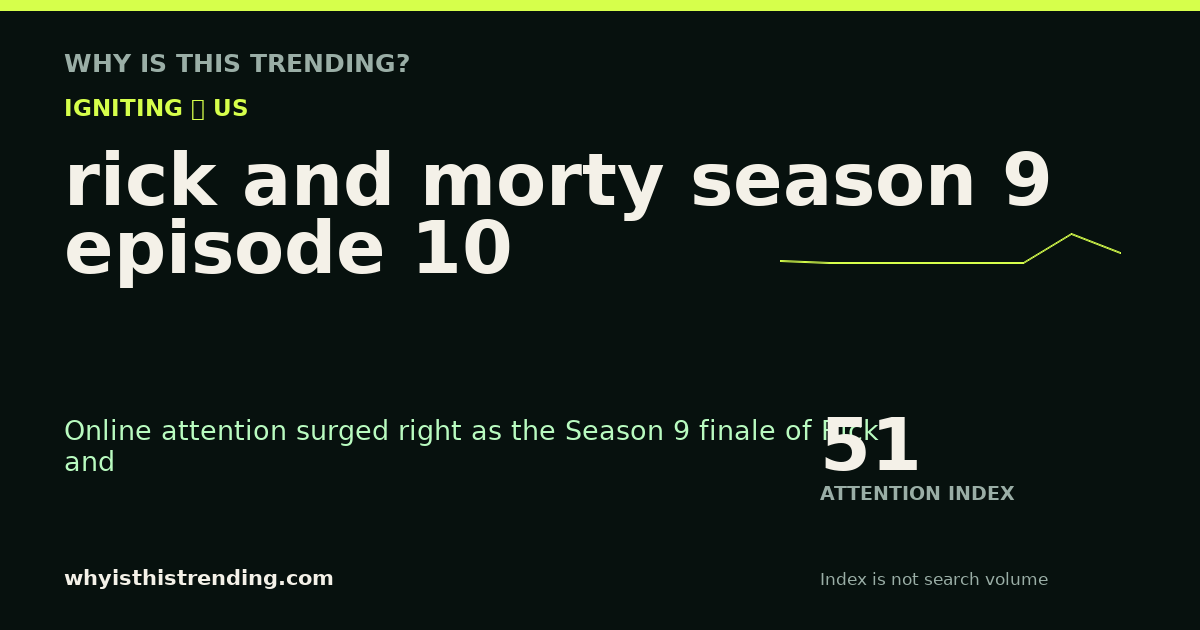
The Anatomy of a Multiversal Attention Spike
When attention metrics registered a sharp upward tick following the live broadcast window, it did not happen in a vacuum. That movement directly mirrored the real-world television schedule: the tenth and final episode of Rick and Morty
Season 9—titled Field of Dreams
—completed its live broadcast on Adult Swim at 11 p.m. ET / 8 p.m. PT on Sunday, July 26, 2026 [1].
Yet the mechanical trigger for the ensuing search frenzy wasn't just the plot's dark, multiverse-hopping exploration of Morty engaging in funeral-hopping
across alternate realities [3]. Instead, a massive segment of the audience was trying to figure out logistical access on the fly. Viewers without traditional cable packages flooded search engines looking for viable access points, creating a distinct intersection between appointment television and digital coupon-hunting.
To understand why this specific window generated an intense flurry of queries, we have to look closely at how modern audiences interact with cable-locked programming. A high-profile series climax creates immediate urgency. Fans do not want to be spoiled online the next morning; they want to experience the narrative twists synchronously with the rest of the fandom. When a major broadcast hits the airwaves, the gap between wanting to watch and knowing how to bypass a paywall becomes a race against time, driving viewers straight into search bars.
Signal Versus Noise: The Free Trial Scramble
In trend analysis, it is vital to separate creative chatter—such as San Diego Comic-Con panel reveals about an upcoming Season 10 [1] or early story leaks—from the immediate transactional intent of the audience. The sudden surge in queries mapped directly to consumer guides highlighting workarounds for cord-cutters.
Publishers heavily promoted live-television streaming services offering zero-commitment entry points for the night of the broadcast. Platforms like DIRECTV advertised a 5-day free trial, while Sling offered low-cost temporary passes starting at $4.99 for single-day or weekend access [1]. For a fandom eager to catch the climax of a heavily serialized season—which also doubled as a lead-in to the series premiere of the spinoff President Curtis
[1]—these promotional pathways became the ultimate digital shortcut.
It is important to recognize that broad search interest measures relative query activity over a given timeframe; it does not automatically guarantee a direct causal link to every single subscription signup. However, the exact alignment between the 11 p.m. ET broadcast window and the vertical takeoff in search traffic points to a clear audience behavior: viewers were actively seeking out these specific promotional workarounds in real time to avoid missing out on the event.
Interpreting the Shift in How Audiences Tune In
The pattern behind this trend highlights a broader evolution in how digital audiences engage with modern television finales. Traditional television ratings capture only a fraction of the actual cultural footprint, while search engines act as the default customer service desk for viewers trying to solve access puzzles in real time.
When premium cable networks debut high-profile finales late on Sunday nights, the friction between traditional pay-TV models and a streaming-native audience creates predictable attention spikes. Viewers want immediate access to cultural moments—like Morty discovering the morbid joys of alternate-reality mourning [3]—without being locked into long-term monthly utility bills. The temporary availability of trials and micro-passes effectively weaponized consumer convenience, turning a technical broadcast constraint into an intentional search phenomenon.
Ultimately, this trend serves as a case study in modern media consumption economics. Networks and streaming aggregators hold the keys to appointment viewing, but the audience holds the digital leverage, utilizing trial offers and temporary passes to curate a custom, cost-effective viewing experience. As long as high-stakes finales remain tethered to traditional cable infrastructure while alternative digital avenues exist on a trial basis, these synchronized search spikes will remain a predictable fixture of Sunday night television.