Decoding the Attention Spike and Its Trigger
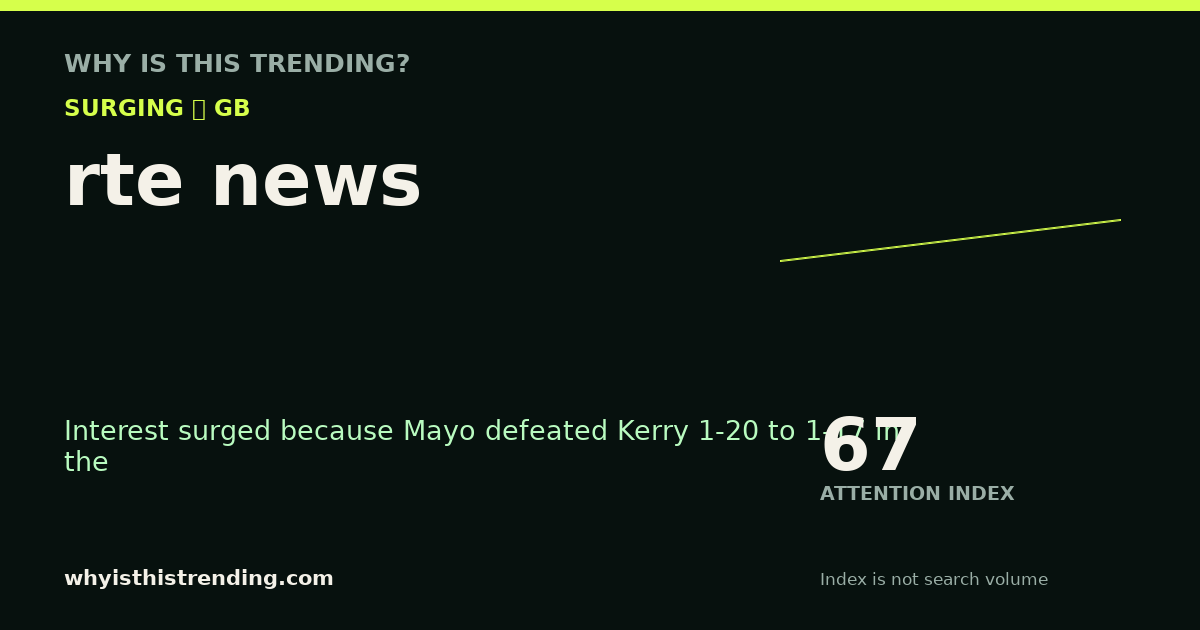
When a sporting drought spans three quarters of a century, the eventual breakthrough is bound to register far beyond the stadium gates. On July 26, 2026, public curiosity and media engagement surged simultaneously as Mayo claimed a historic triumph in the All-Ireland senior football final, defeating reigning champions Kerry with a hard-fought scoreline of 1-20 to 1-17 at Croke Park [1].
Monitoring data from platforms like Google Trends registered an immediate reaction, reflecting how rapidly news of the final spread across digital channels [1]. Rather than building slowly over the course of the week, online attention spiked instantly as the final whistle sounded. This sudden wave marked the culmination of intense pre-match broadcast coverage by networks like RTÉ—which featured live build-up programs from Croke Park [2]—and the profound emotional release felt by supporters nationwide who watched the decades-long curse finally break.
Signal Versus Noise in the Aftermath
In analyzing why this event captured such intense focus, it is crucial to separate the core cultural signal from surrounding digital chatter. The genuine signal is rooted in sporting history: Mayo bridged a 75-year gap to claim the Sam Maguire Cup [3], an outcome that resonated deeply with generations of fans who had experienced decades of near-misses, final heartbreaks, and generations of supporters who passed away before seeing it happen [3].
Immediate reactions from high-profile figures helped amplify this signal. Former Kerry manager Éamonn Fitzmaurice delivered widely shared commentary seconds after the final hooter, offering gracious praise to Andy Moran's squad [1]:
Éamonn Fitzmaurice via Irish Mirror [1]
Congratulations to Mayo. What a team, what a turnaround since the game in Roscommon, they were fantastic today.
Fitzmaurice added that the Westerners were full value for their win, noting that they played top-class football and likely had enough scoring chances to win two games [1]. This gracious acknowledgment from a fierce rival underscored the high quality of the final and validated the historic nature of the win, driving further traffic to news updates, match analysis, and community fan polls [3].
Contextualizing the Surge and Cultural Build-Up
The road to this historic Sunday was paved with heightened anticipation. In the days leading up to the fixture, cultural programming across RTÉ—including special broadcasts of Up For The Match live from Croke Park hosted by Jacqui Hurley, Dáithí Ó Sé, and Louise Cantillon—fanned the flames of public excitement [2]. Bringing together legends from both counties, musicians, and hundreds of passionate fans on the eve of the game, the broadcast set the stage for an unforgettable weekend [2].
When the match delivered a high-scoring, enthralling contest that lived up to the billing, the pent-up emotional investment of the entire country converted instantly into search queries, social media reactions, and celebratory discourse [1]. Fans took to community forums and local platforms to debate standout performances, with many pointing to leadership across the field and expressing sheer disbelief that the 75-year hoodoo had finally been lifted [3].
Interpreting the Digital Footprint
It is important to understand what Google Trends attention data can and cannot prove in scenarios like this. The tracking spikes do not measure search volume in absolute numerical terms, nor do they prove causation regarding why individual users opened their browsers. Instead, they serve as a digital barometer, mapping the exact moment offline cultural euphoria translates into online inquiry [1].
Ultimately, the sudden shift in digital attention serves as a mirror for a monumental cultural moment. For anyone tracking the trend, the defensible takeaway is clear: overcoming a 75-year curse in Ireland's premier sporting pastime is a rare, seismic event capable of uniting supporters across county lines in shared astonishment, relief, and celebration [3].