Decoding the Attention Surge Around Sam Patterson
When live combat sports events unfold across the globe, digital interest spikes instantly as fans, bettors, and casual observers look up live results, real-time highlights, and expert breakdowns. Google Trends data records a sharp uptick in attention for sam patterson
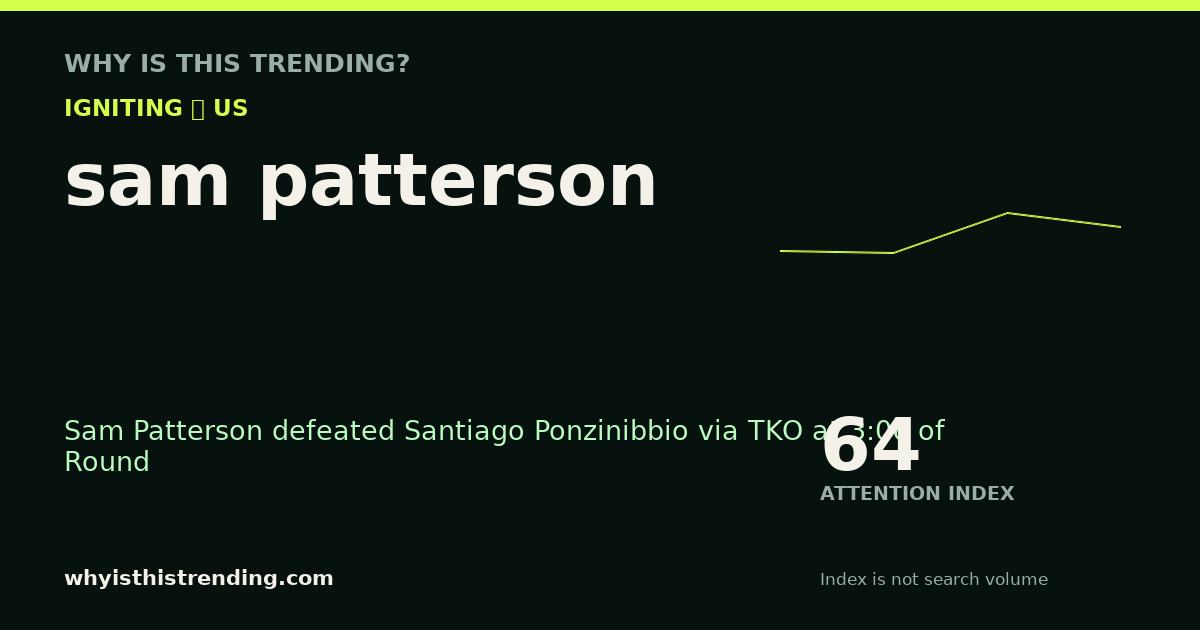
beginning on July 25, 2026, aligning precisely with the broadcast of UFC Abu Dhabi at the Etihad Arena [3]. This digital surge was not a random anomaly or an isolated blip; it was driven directly by the live in-cage outcome and subsequent media reporting detailing how the welterweight preliminary matchup played out [1].
At 3:06 of the second round, Britain's Sam Patterson landed a flush right hand that ended the contest, securing a technical knockout victory over veteran Santiago Ponzinibbio [3]. Because the preliminary-card bout carried heavy narrative weight heading into the weekend, the definitive finish immediately transformed pre-fight speculation into viral post-fight analysis across digital sports platforms.
The Milestone and the Momentum: Signal Versus Noise
To understand why this specific fight captured outsized attention compared to other preliminary bouts on the card, one must look closely at the intersecting storylines that preceded the walkouts. The encounter served as Santiago Ponzinibbio’s 40th professional mixed martial arts appearance—a significant durability milestone for any combat sports athlete operating at the elite level [5]. Leading up to the event, the 39-year-old Argentine striker openly discussed his career trajectory on a day-by-day basis, acknowledging legacy objectives while simultaneously weighing retirement [5].
Pre-fight betting markets had cast Patterson as a substantial favorite, leaning heavily on a youth-versus-experience narrative that contrasted the towering British finisher against the veteran [2]. Analysts noted that Ponzinibbio, despite possessing legendary action-hero status in the welterweight division from the late 2010s, had faced a difficult stretch of recent outcomes [2]. When a veteran standing at a career crossroads faces an enormous, surging younger competitor, the stakes naturally amplify public interest. The resulting TKO provided a definitive resolution to those lingering retirement inquiries, turning a standard preliminary fight into a major talking point across combat sports platforms.
Contextualizing the Outcome Within the Welterweight Landscape
It is vital to separate verified fight outcomes from broader assumptions about divisional rankings or long-term causation. While search traffic metrics indicate a clear correlation between the conclusion of the bout and public inquiry, they do not automatically prove long-term title trajectories for the victor. Patterson, who transitioned successfully up to the 170-pound division after initially competing as a massive lightweight, utilized his towering reach and disciplined striking mechanics to solve the veteran puzzle presented by Ponzinibbio [2].
For readers attempting to filter out the noise of live-event hype, the core takeaway is straightforward: a high-profile veteran milestone met a decisive younger finisher, and the resulting second-round stoppage delivered the exact definitive outcome that oddsmakers and preview analysts had anticipated [2], [3]. As Ponzinibbio evaluates his future in the sport following his 40th professional outing [5], Patterson secures a high-visibility win that cements his standing as a dangerous puzzle piece in the modern welterweight division.
Broader Media Dynamics and the Mechanics of Fight-Night Spikes
The sudden surge in digital interest surrounding Sam Patterson highlights how modern combat sports consumption operates. When a prominent card is broadcast, search behavior reacts dynamically to real-time events rather than pre-scheduled media rollouts. Within hours of the final bell, multiple sports outlets published detailed accounts of the finish and Ponzinibbio's post-fight remarks, compounding the initial wave of curiosity generated by live viewers [1]. This ecosystem of live broadcasting, instant social media highlights, and rapid journalistic roundups explains why a preliminary card bout can briefly dominate search trends.