The Turning Point for Cash Savers
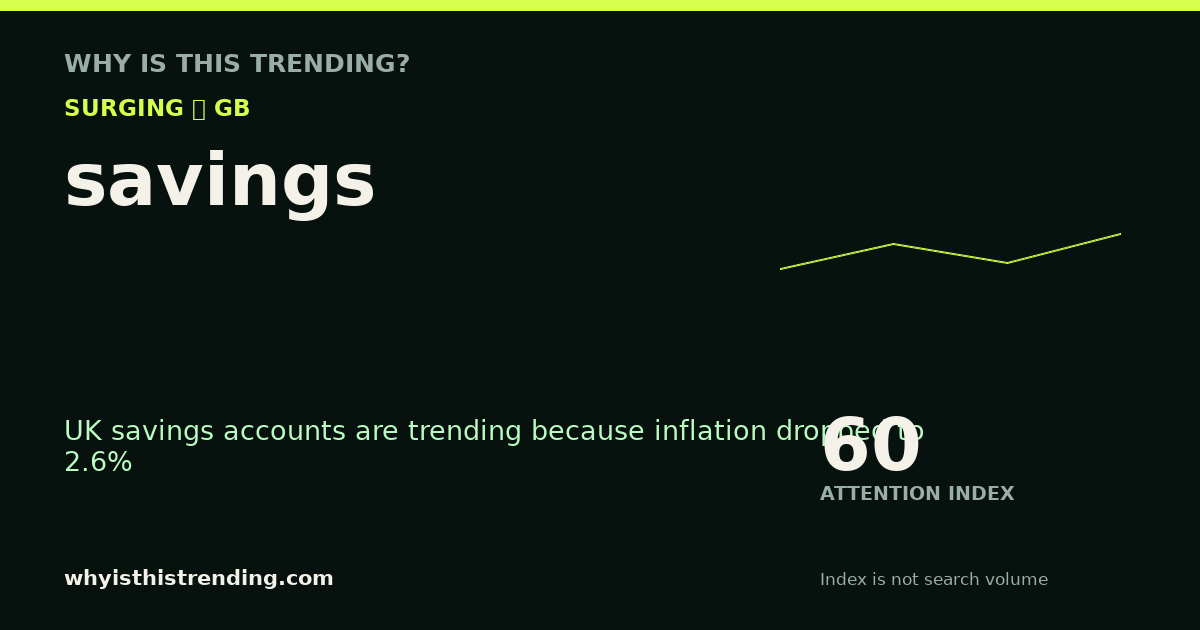
For more than a year, British savers watched helplessly as the price of everyday goods outpaced the interest earned on their cash holdings. That dynamic has decisively shifted. Following official figures showing that the Consumer Prices Index (CPI) eased to 2.6% in June 2026, down from 2.8% in May, the mathematical reality of household saving has inverted as reported by the Daily Record.
According to comprehensive market tracking from Moneyfactscompare.co.uk, the average new savings account now pays 3.59%. This leaves depositors sitting roughly 0.99 percentage points above the current rate of inflation according to Trustnet coverage. It marks the strongest real returns for cash savings since March 2025, providing a welcome cushion following a punishing stretch where average accounts persistently lagged behind the cost of living.
This macro shift alters how consumers should view cash sitting in standard current accounts. When inflation outpaces returns, holding cash is a guaranteed erosion of purchasing power. The current gap creates a genuine opportunity for proactive households to protect and grow their hard-earned money without taking on the volatility of equity markets.
Mapping the Landscape: Signal Versus Noise
A headline announcing that nearly 2,000 accounts beat inflation sounds universally positive, but sorting market signal from marketing noise requires a closer look at where those products actually sit within the financial ecosystem. The total tally of inflation-beating accounts reached 1,960 by mid-summer, climbing from 1,825 in June noted by the Daily Record. However, these products are distributed unevenly across different account categories:
- Fixed-Rate Bonds: 863 accounts
- Fixed-Rate ISAs: 412 accounts
- Easy-Access Accounts: 284 accounts
- Variable-Rate ISAs: 204 accounts
- Notice Accounts: 197 accounts
The noise in this trend often lies in headline rates that require strict adherence to temporary bonus windows or bundled current account requirements. For instance, while top-tier easy-access options like Revolut's promotional rate or Chase's 12-month boosted offer provide up to 5% or 4.5% respectively noted by the Guardian, standard reversion rates can drop significantly once promotional periods expire.
Why Banks Are Competing Aggressively
The sudden abundance of attractive rates is not an act of corporate charity; it is the direct result of fierce commercial rivalry among financial institutions. Overall product choice across the UK savings market reached a fresh record high for the sixth consecutive month, hitting 2,583 products according to Moneyfactscompare data. Furthermore, the number of live accounts paying above the Bank of England base rate—currently standing at 3.75%—climbed to 1,385, marking a six-year high reported by the Guardian.
Providers are aggressively fighting to secure retail deposits, pushing average one-year fixed bonds to 4.22% and average easy-access rates to 2.53% as detailed by the Guardian. For regular savers willing to lock away modest sums monthly, specialized products from institutions like Lloyds, Halifax, Bank of Scotland, and Santander have pushed headline yields as high as 8% per Guardian reporting.
This intense competition means that consumers are no longer forced to accept nominal returns that fail to cover basic banking fees or administrative friction. Instead, banks are actively bidding for capital, creating an environment where shopping around yields immediate financial dividends.
Strategy for Active Savers
The overarching financial takeaway is straightforward: inertia is remarkably expensive. Financial analysts emphasize that the current environment heavily rewards proactive management. Stashing £10,000 in a stagnant, low-yielding account generates a fraction of the returns possible in a competitive product. Selecting a market-leading easy access account paying 5% generates roughly £500 in interest over a year—leaving a real gain of around £240 after inflation—whereas an average account paying 3.59% yields £359, and a lagging 2% account leaves the saver losing purchasing power in real terms according to Daily Record analysis.
Yet caution remains warranted. Industry experts warn that inflation could begin to edge higher over the coming months as households face climbing energy costs and broader economic volatility noted in Daily Record coverage. Because subsequent price spikes can quickly erode real returns, flexibility is paramount. Maintaining balances in competitive, top-paying easy-access accounts allows households to capture current high yields while preserving the freedom to pivot if macroeconomic conditions shift once more.