The Perfect Storm of Broadcast and Biology
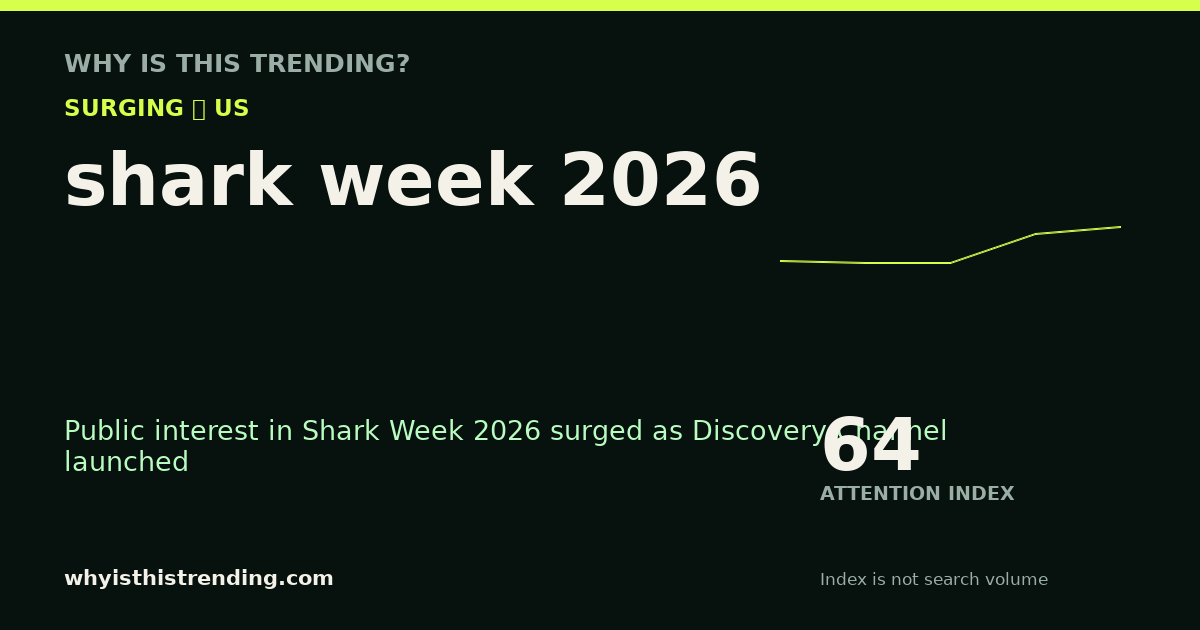
When online search interest for Shark Week spiked sharply, it mapped onto a precise calendar overlap: Discovery Channel’s scheduled broadcast window running from July 26 to August 1, 2026 [1]. But television scheduling alone rarely creates a viral attention wave of this magnitude. This year’s peak coincided with documented reports of increased shark activity and marine sightings along the U.S. East Coast [6].
Rather than a sudden, unprompted panic, the attention surge represents a classic seasonal feedback loop. As vacationers hit the beaches and marine biologists track changing migration patterns in warming coastal waters, media outlets bridge the gap between scientific observation and network entertainment [1], [6]. People are naturally drawn to look up what is swimming in the ocean when national programming and local beach advisories arrive on the exact same summer afternoon.
Understanding this behavior requires looking at how human curiosity operates during peak vacation months. When local news broadcasts warning flags or highlights rare marine encounters right as major entertainment networks flood the airwaves with apex predator documentaries, audiences experience a cognitive convergence. The boundary between real-world environmental news and scheduled pop-culture spectacle blurs, transforming passive television viewers into active online searchers looking for context.
From New York City Launch Parties to Montauk Canyons
Discovery kicked off its 38th-anniversary marketing push on July 21, 2026, with a high-profile launch event at Watermark in New York City's South Street Seaport [5]. Featuring themed activations, mechanical shark rides, and resident experts like Navy veteran and shark attack survivor Paul de Gelder alongside K-pop artist Rei Ami, the event set an energetic, cross-pop-cultural tone for the week ahead [2], [5].
Once the broadcasts began on July 26, the programming leaned directly into regional curiosities [1]. Episodes like Sharkzilla Takes New York focused squarely on local waters, following marine biologist Craig O'Connell into the Hudson Canyon roughly 100 nautical miles south of Long Island to explore historical waste disposal sites and investigate local mako populations [1]. By anchoring speculative television hooks to familiar regional geography, the network tied viewers' local news feeds directly into evening viewing habits, supercharging social media commentary.
This multi-platform rollout strategy ensures that the conversation extends far beyond the television screen. By pairing pop stars and comedians with seasoned field researchers, the network successfully widens its demographic reach, capturing audiences who might not otherwise tune in for traditional marine science programming [2], [5]. Consequently, digital discourse fragments across various platforms, ranging from short-form video reactions to deep-dive conservation debates.
Signal Versus Noise in Coastal Marine Reports
It is easy for casual observers to blur the line between seasonal animal behavior and a manufactured media frenzy. NOAA-affiliated sources and marine scientists note that rising ocean temperatures—with more than 90 percent of global excess heat absorbed by oceans over the past half-century—naturally shift where apex predators hunt and migrate [6].
When warm water marine heatwaves expand prey availability, species like great whites, bull sharks, and makos naturally extend their geographic ranges or alter their seasonal timing [2], [6]. The signal here is grounded in real ecological adaptation: sharks follow food sources into populated coastal corridors during summer months [6]. The noise, by contrast, lives in hyperbolic rumors of mutated monsters or radioactive anomalies—hypotheticals explored playfully on screen for dramatic effect rather than documented in reality [1].
Separating verified marine science from sensationalized television tropes remains essential for coastal safety. While television specials love to entertain the chilling thought of radioactive mutation near historical waste dumping sites, actual researchers emphasize that these scenarios remain purely hypothetical thought experiments [1]. Recognizing this distinction prevents unnecessary public alarm while still honoring genuine ecological shifts happening in our oceans.
Navigating the Trend Wisely
For readers tracking the conversation, understanding why the topic dominates feeds requires looking at the broader interplay of scheduled media drops and environmental realities. People head to search engines not because the ocean has suddenly transformed into a science-fiction movie, but because real-world beach advisories and blockbuster television share a calendar [1], [6].
Experts emphasize that increased apex predator presence signals a functional, recovering ecosystem rather than an intentional threat to humans [6]. Standard ocean safety practices—such as avoiding swimming at dawn or dusk and steering clear of dense schools of bait fish or seals—remain the most effective, level-headed tools for coastal visitors enjoying the summer season [6].