The Path to Launch
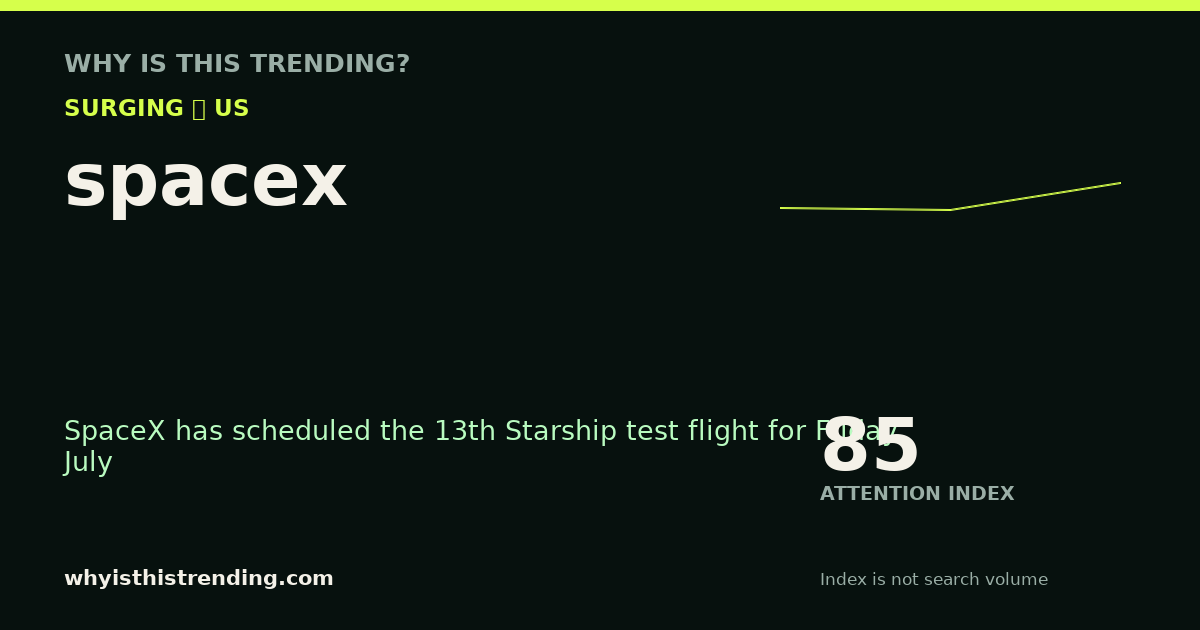
SpaceX is once again positioning its Starship vehicle for an integrated test flight, with a 90-minute launch window opening at 6:45 PM ET on Friday, July 24, 2026 [1]. This attempt follows a series of setbacks that have kept the world's most powerful rocket grounded at the company's Starbase facility in Texas. The mission, designated Flight 13, was originally slated for July 16 but was pushed back following an automatic abort triggered by engine startup issues [5]. A subsequent attempt on July 23 was scrubbed due to the arrival of Tropical Storm Bertha, which brought unfavorable wind and surf conditions to the Texas coast [5].
For this latest attempt, conditions appear to have stabilized. SpaceX has noted that visibility is forecast to be ideal
for the Friday evening window, a critical requirement for the mission's primary objective: capturing clear ground-based imagery of the vehicle's heat shield during high-dynamic-pressure ascent [1], [6]. The sheer scale of the vehicle—standing approximately 123 meters tall—means that even minor weather fluctuations can pose significant risks during the critical ascent phase, making the current window a high-stakes moment for the engineering team [4].
Technical Upgrades and Reliability
The delay from the July 16 attempt was not merely a matter of waiting for better weather; it provided SpaceX engineers with a window to implement hardware and software modifications. During the previous test, the Super Heavy booster experienced engine startup inconsistencies and a partial failure during the boostback burn, where five of its 33 engines failed to reignite properly [2]. Furthermore, the stage separation maneuver was misaligned by approximately 90 degrees due to timing variations in the engine startup sequence [2].
To address these issues, SpaceX has implemented a series of targeted refinements:
- Engine Startup Sequence: The sequence has been modified to be more resilient against timing variations, ensuring more reliable booster rotation during stage separation [2].
- Hardware Modifications: The Raptor engines on both the booster and the ship have received hardware updates to increase the reliability of in-space reignition [6].
- Safety Systems: Updates to alarm and abort systems now better reflect the complex reality of operating multiple engines simultaneously, providing engineers with more granular data should a failure occur [2].
Testing the V3 Starlink Payload
Beyond the rocket's performance, Flight 13 serves as a functional test for the next generation of SpaceX’s internet infrastructure. The vehicle is carrying 20 Starlink V3 satellites, which are designed to significantly increase network capacity and user speeds [2], [6]. This is a departure from previous tests that utilized mock payloads, signaling a shift toward operational utility.
The deployment sequence is highly specific: the satellites will be released into a suborbital trajectory, where they will attempt to deploy solar arrays and antennas and establish laser communication links with the existing Starlink constellation. Because the mission is suborbital, these satellites are expected to re-enter the atmosphere and be destroyed approximately 20 minutes after release [2]. Additionally, six of these satellites are equipped with cameras intended to inspect the Starship's heat shield during flight, providing real-time data on the vehicle's structural integrity [2]. This experimental setup allows SpaceX to gather critical data on heat shield performance without risking a full-scale orbital deployment before the system is fully proven.
Signal vs. Noise: Interpreting the Attention
The attention surrounding this launch is driven by the intersection of high-stakes aerospace engineering and the commercial pressure on SpaceX to demonstrate the viability of its fully reusable system. While the postponement of the launch has generated significant interest, it is important to distinguish between routine operational delays—common in the testing of large-scale, experimental rockets—and fundamental system failures. The modifications to the engine startup sequence and the inclusion of the V3 satellites are the true markers of progress here; they represent the transition from simply proving the rocket can fly to proving it can perform complex, multi-stage commercial tasks.
Observers should look past the weather-related noise of the last few days to monitor the success of the engine relight and the satellite deployment. These are the technical metrics that will define the success of Flight 13. If the Super Heavy booster can successfully complete its boostback and landing burn in the Gulf of Mexico, and if the upper stage can successfully deploy its V3 payload while maintaining structural integrity during reentry, the mission will be a major validation of the V3 architecture. Conversely, focus on the why
behind the delays—the engine startup reliability—as this remains the most significant hurdle to achieving the frequent, reliable flight cadence that SpaceX requires for its long-term goals, including NASA's Artemis missions and eventual human travel to Mars [4], [5].