The Anatomy of a Private Public Event
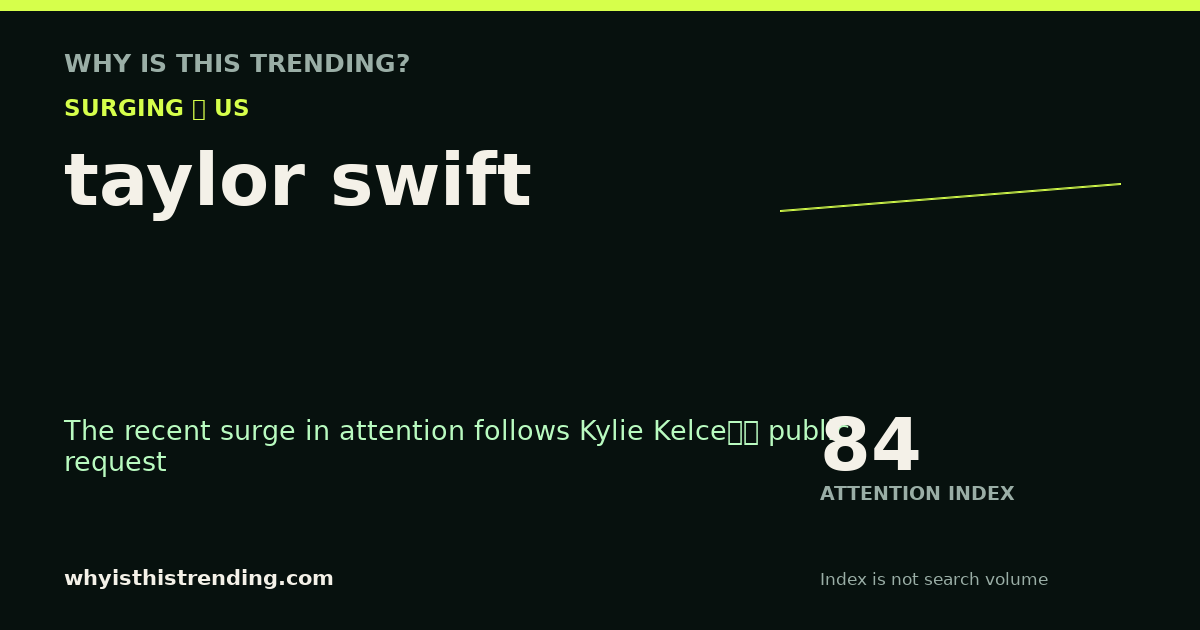
In the wake of Taylor Swift and Travis Kelce’s July 3 wedding at Madison Square Garden, the public’s appetite for details has been met with a wall of silence. The latest spike in attention, observed on July 24, 2026, stems from a candid moment on the July 23 episode of Kylie Kelce’s podcast, Not Gonna Lie. In her first public remarks since the ceremony, the sister-in-law of the groom offered a masterclass in boundary-setting, effectively cooling the speculation that has swirled since the couple tied the knot.
Kylie Kelce’s message was twofold: the event was absolutely magical
and deeply intimate, and the public’s constant questioning is unwelcome. By framing the wedding as only making it official
—noting that Swift had been a part of the family for some time—Kelce shifted the narrative from a global spectacle to a familial milestone. She explicitly directed fans to check in with Taylor and Travis
for any future disclosures, signaling that the family is not a conduit for leaks.
The Signal: A Shift in Narrative Control
The tension between the couple's massive public profiles and their desire for a private life has been a defining feature of their relationship. The wedding, which hosted approximately 1,000 guests, was shielded by extraordinary measures. Reports indicate that attendees were required to sign nondisclosure agreements, and the venue itself—Madison Square Garden—reportedly disabled its controversial facial-recognition surveillance systems for the duration of the event to ensure guest privacy, as noted by WIRED. This level of operational security suggests that the couple is not merely private by preference, but by design.
When we look at the information emerging from guests like George Kittle, we see a pattern of controlled, positive, and non-intrusive storytelling. Kittle, who attended with his wife and parents, described the event as fantastic
and highlighted the familial nature of the guest list, explaining that the invitation extended to parents due to long-standing bonds formed through the "Tight End U" events, as reported by The Times of India. This is the signal: the inner circle is aligned in maintaining the sanctity of the event, leaving the rumor mill to churn on noise alone.
Separating Noise from Reality
The noise surrounding the event often focuses on who was absent or who is no longer in the fold. Speculation regarding the guest list—specifically the absence of former friends—has dominated secondary conversations. However, these narratives often conflate independent life changes with wedding logistics. The fact remains that the event was a massive, 1,000-person gathering; the absence of any specific individual is less a commentary on the wedding itself and more a reflection of the evolving social orbits of high-profile figures.
Kylie Kelce’s frustration, which she voiced during the American Century Championship in Lake Tahoe, highlights how easily offhand comments are distorted into “insider scoops.” Her reaction to a fan recording a conversation about the wedding is a reminder that in the era of constant digital capture, even the most mundane interactions are weaponized for content. Her refusal to engage further is a defensive strategy designed to protect the couple's honeymoon phase from the pressure of public consumption.
What We Know vs. What We Want
To provide a clear view of the event's scale, we can look at the confirmed details provided by those who were present:
| Detail | Information |
|---|---|
| Date | July 3, 2026 |
| Location | Madison Square Garden |
| Guest Count | Approximately 1,000 |
| Theme | Garden-themed |
| Vow Duration | Reportedly over 12 minutes |
Ultimately, the trend is not about the wedding itself, but about the public's struggle to accept that some of the world's most famous people have successfully carved out a private space. The "trending" status is a byproduct of the friction between the public's desire for access and the couple's insistence on autonomy. As the dust settles, the most useful takeaway is that the information gap is not a failure of reporting, but a deliberate choice by the couple. For those waiting for more, the advice remains the same: wait for the primary source, or accept that some stories are not meant for the public record.