Decoding the Surge Around a Forced Confinement Thriller
When a piece of entertainment captures collective curiosity overnight, it rarely happens in a vacuum. A sharp upward trajectory in searches for “the last house” began immediately following the streaming debut of the Netflix original thriller The Last House. Directed by Louis Leterrier and starring Oscar nominee Wagner Moura alongside Golden Globe nominee Greta Lee, the film’s arrival on August 7, 2026, coincided directly with coordinated publishing waves across major culture and news desks.
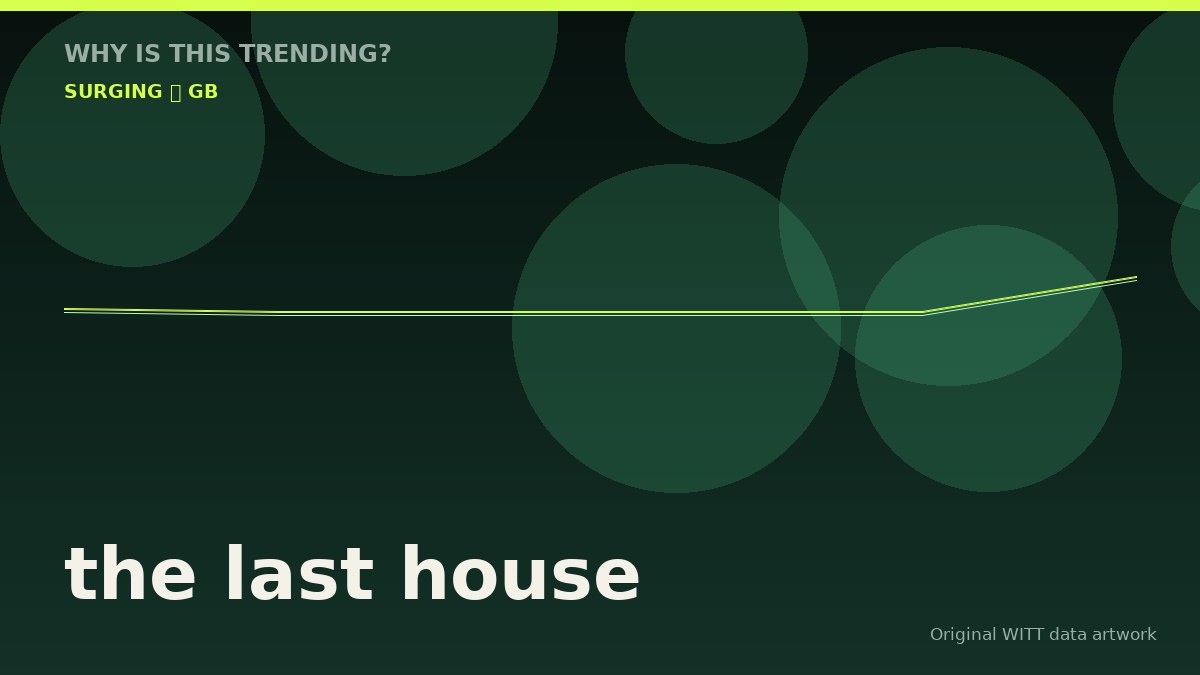
Google Trends charts illustrate a swift escalation in attention starting right as critics at outlets like The Hollywood Reporter, The Daily Beast, The Guardian, and Variety rolled out their morning-of assessments. This alignment of platform distribution and rapid journalistic critique acts as the primary engine for the visibility spike, thrusting a high-concept genre piece into immediate public discourse.
It is crucial to note that rising search interest tracks query volume rather than underlying causes. While the exact numerical search volume remains non-public, the temporal correlation between the platform's release schedule, the publication of major reviews starting before dawn on August 7, and the sudden spike in online curiosity demonstrates how modern content drops instantly manufacture conversational momentum.
What Is the Film Actually About?
The premise taps directly into lingering cultural nerves regarding isolation and home confinement. Set in a Seattle suburb, the story follows a family who wakes up to find an uncanny, inexplicable force has sealed the doors and windows of their home shut. As Variety notes, Your pandemic lockdown memories have nothing on the end-of-days scenario outlined in this Netflix offering.
As the narrative progresses past days into weeks, months, and even years, the characters are forced to adapt. The film balances grounded domestic survival tactics—such as managing food supplies, rationing resources, and utilizing home engineering through the chimney—with sweeping, ambiguous sci-fi horror elements that keep the true nature of their captors vague for much of the runtime. This blend of recognizable domestic claustrophobia and expansive cosmic mystery forms the core hook that drew audiences to search engines to figure out what was happening on screen.
Signal Versus Noise: Why the Critical Reception Is Split
Understanding the attention mechanism requires separating the initial marketing wave from the actual audience reception. Critics have offered sharply divergent verdicts on whether the execution matches the ambition of the high-concept pitch.
- The Anchor Performances: Reviewers widely commended the anchored, empathetic performances of Greta Lee and Wagner Moura as parents trying to shield their children. Publications highlighted how the actors provide genuine emotional heft and believable friction to a scenario that could easily slip into pure gimmickry.
- The Script and World-Building: Conversely, some critics expressed frustration with the trajectory of the script penned by Matthew Robinson. While the early survivalist chamber drama earned praise for its moody atmosphere, several reviews lamented that the eventual sci-fi explanations stumble in their delivery, drawing mixed comparisons to twist-heavy mystery traps that favor ambiguity over satisfying answers.
Ultimately, whether viewers find the project a compelling exercise in tension or an unsatisfying genre experiment, the sheer volume of simultaneous commentary ensures that The Last House
remains a dominant conversational anchor across social and news feeds.
Contextualizing the Genre Landscape
The timing of the film's release intersects with a broader cinematic hesitation to tackle recent collective traumas directly. As observed in reviews from outlets like The Guardian, narrative filmmakers have often found it challenging to engage audiences with direct dramatizations of pandemic-era isolation. By wrapping these familiar themes of confinement and cabin fever inside an apocalyptic genre package, the production provides a surrogate vehicle for processing environmental and psychological anxieties.
For readers looking at the sudden surge, the phenomenon is a textbook example of streaming distribution meeting cultural fatigue. The combination of star power, a high-stakes premise, and an immediate critic consensus creates a self-sustaining cycle of attention. Viewers encountering the title on their recommendation feeds naturally turn to search engines to parse reviews, compare notes on the ambiguous ending, and decide whether the runtime warrants a weekend watch.