The Anatomy of an Unexpected Cultural Spike
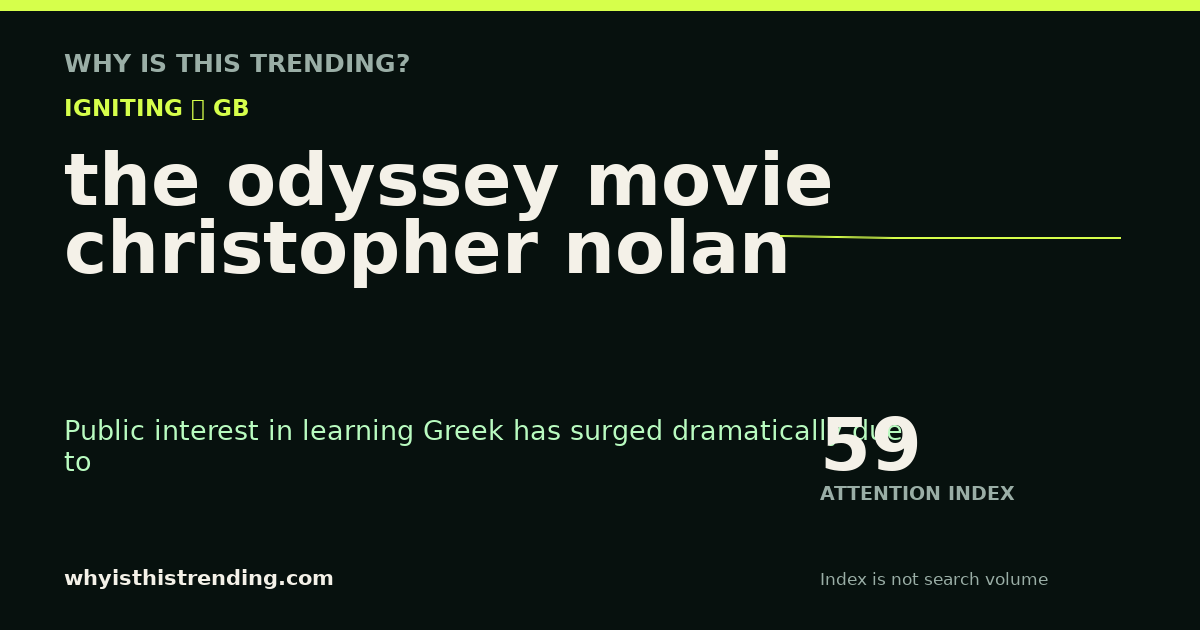
When a Hollywood tentpole drives viewers not just to the concession stand but to their local bookstores and language-learning apps, culture watchers take notice. Christopher Nolan’s adaptation of Homer’s ancient epic has proven to be a juggernaut, pulling in $87 million in its second domestic weekend alone—marking the filmmaker's best second-weekend hold ever—and pushing global receipts past $639 million [5]. But the true signal of the film’s cultural footprint lies away from the box office ledger: Google Trends data indicates a staggering 5,000 percent increase in UK searches for "learn Greek" over a single fortnight [3].
This attention mechanism is distinct from routine promotional hype. While studios spend millions engineering opening-weekend awareness, the long-tail curiosity driving language apps and a 70 percent year-on-year surge in book sales [3] points to a deeper public engagement with the source material. Crucially, Google Trends measures shifts in relative search interest over time; it is a barometer of attention rather than a direct count of individuals or proof of direct causation. Even so, the timing aligns too cleanly with the film’s rollout to dismiss as coincidence.
To understand the depth of this cultural wave, one must examine how modern cinematic spectacles interact with ancient literature. When a director of Nolan's stature brings an epic of this scale to theaters—especially utilizing groundbreaking technical achievements like filming entirely on IMAX cameras [6]—it creates a massive umbrella of shared cultural experience. Viewers who may never have opened a classical text are suddenly exposed to the foundational narratives of Western literature, prompting a ripple effect across search engines, bookstores, and educational platforms.
Blockbuster Triumphs Meet Literary Backlash
The cultural conversation around the movie accelerated rapidly thanks to an unusual collision between the filmmaker and the classical establishment. During the press tour, Nolan frequently cited Emily Wilson’s acclaimed 2017 translation of The Odyssey
as a primary inspiration for his vision of Odysseus, played by Matt Damon [1].
Wilson, however, declined to return the praise. In a scathing review for the London Review of Books, she lambasted the screenplay as lacking psychological, emotional, political, and ethical depth, famously writing:
I would be ashamed to have written any part of this script.
Emily Wilson [1]
This public divide between the cinematic interpretation and the academic translation created a two-sided media narrative. On one hand, general audiences embraced the film, awarding it an A
CinemaScore [1] and flocking to premium large-format IMAX screens [5]. On the other hand, cultural purists and literary critics debated historical accuracy, costume choices, and narrative liberties—such as Nolan's admission to writing an alternative ending because he found Homer’s original text so grim and so misogynistic
[3].
This friction between high art and blockbuster filmmaking amplified the story across newsrooms and social feeds alike. Critics and scholars weighed in on every creative deviation, turning a standard movie release into a wide-ranging debate about how ancient texts should be handled in the twenty-first century.
Signal Versus Noise in Classical Curiosity
It is easy to mistake internet discourse for systemic change, but the current wave of curiosity carries tangible educational side effects. Language experts point out a vital distinction for prospective learners:
-
Ancient Greek: Differs significantly from modern spoken Greek, but offers direct access to Homer's original text and the classical world [3].
Modern Greek: Connects learners directly to contemporary Greek culture and current speakers [3].
Even amid her sharp critique of the script, Wilson acknowledged the silver lining of the blockbuster's cultural oxygen, noting that the release is still an event to celebrate
[1]. She expressed hope that the renewed visibility might persuade a few college administrators not to cut their literature, language and history departments
[1].
Whether this momentary spike in language acquisition translates into long-term academic enrollment remains to be seen. For now, the trend serves as a powerful reminder that high-stakes clashes between populist entertainment and high art can successfully pull ancient texts out of dusty library corners and drop them straight back into the public square.